The Theory of “Make Friends with Monkeys”: A Lesson from UNTAC Peacekeeping in Cambodia
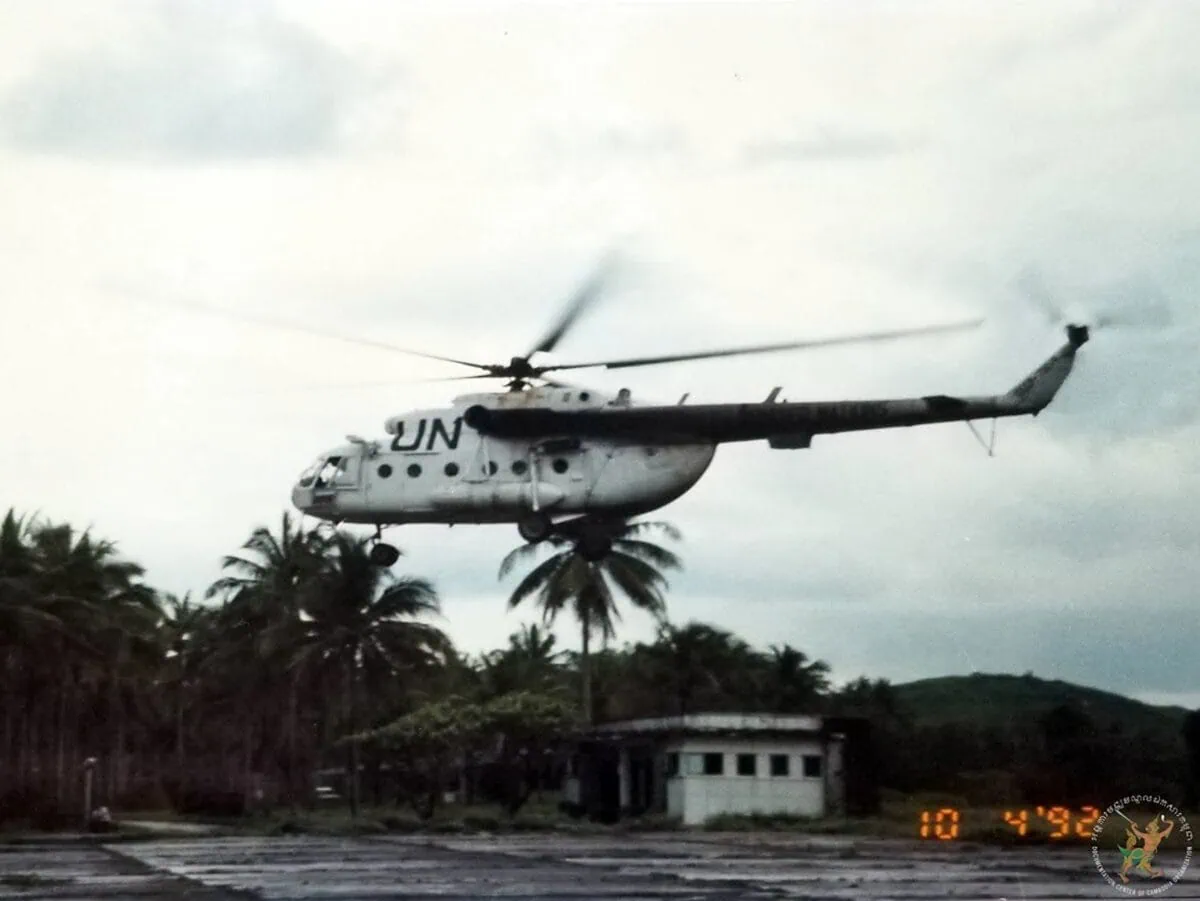 A helicopter attached to UNTAC lifts off from a provincial airstrip in 1992. DC-Cam
#Opinion
Certain experiences remain vivid long after history has moved on. One such experience occurred during my service with the UN Transitional Authority in Cambodia (UNTAC) in the early 1990s. Although more than three decades have passed, the lesson I witnessed continues to shape the way I think about conflict resolution, peacekeeping and human relationships.
The incident took place in Kampong Thom province’s Popok village, in Stoung district, in what was then designated “Sector 5”.
At the time, Cambodia was emerging from decades of conflict. Large areas remained under the control of Khmer Rouge forces, and for security reasons, UN personnel were generally prohibited from entering most of those parts of the country. The risks were considered too great, and contact between peacekeepers and Khmer Rouge units was often limited and highly sensitive.
One exception existed in Popok Village, where an Indonesian battalion had established a company position. What distinguished this company from many others was not its military strength, but its philosophy of engagement.
Rather than treating every encounter with suspicion, the Indonesian soldiers chose to build confidence through simple acts of goodwill. On occasion, they gave individual Khmer Rouge soldiers inexpensive personal items such as portable radios, sarongs, scarves or cameras. These were not military supplies or strategic assistance, but ordinary gifts intended to establish communication and reduce hostility.
An especially interesting practice involved cameras. The Indonesian soldiers told their counterparts that once they had finished taking photographs, they could bring the rolls of film to the Indonesian camp for developing. After the films were processed, both the negatives and the printed photographs were returned to their owners.
Over time, these seemingly modest gestures helped create a relationship built on trust rather than confrontation. As confidence grew, the Indonesian company was able to conduct patrols with a greater sense of security, while tensions between the peacekeepers and local Khmer Rouge soldiers noticeably declined.
Not everyone viewed this approach favourably.
Some observers accused the Indonesian company of becoming too friendly with the Khmer Rouge and questioned whether it had compromised its neutrality. The allegations eventually prompted a UN team from headquarters in Phnom Penh to visit the company and examine the situation.
According to the account I heard at the time, the company commander explained his philosophy with a memorable phrase: “Make Friends with Monkeys”.
The expression was clearly metaphorical and provocative, but the underlying principle was straightforward. It did not mean supporting one side in the conflict or abandoning impartiality. Instead, it reflected the belief that reducing hostility and building trust could create a safer environment for peacekeepers while allowing them to better understand the communities and circumstances in which they operated.
Looking back, I believe this approach produced several practical benefits.
First, improved relationships enhanced operational safety. Lower levels of tension reduced the likelihood of misunderstandings and made routine patrols considerably less dangerous.
Second, the arrangement for developing photographic film unexpectedly improved situational awareness. The photographs often revealed local terrain, villages, transportation routes, the identities of some local commanders and the types of weapons visible in the background. Without coercion or confrontation, the peacekeepers gained a deeper understanding of the operational environment.
Third, the trust that had been established provided greater freedom of movement. While many UN military observers elsewhere in Cambodia continued to face restrictions when approaching Khmer Rouge-controlled areas, this Indonesian company maintained communication and carried out its duties with comparatively fewer obstacles.
This experience left a lasting impression on me because it demonstrated that successful peacekeeping requires far more than military capability. Diplomacy, cultural sensitivity, patience and respect are often equally important tools. Winning confidence can sometimes accomplish what force alone cannot.
The lesson also extends beyond peacekeeping. Whether in international diplomacy, community relations, business negotiations, or everyday human interaction, people are generally more willing to cooperate when they are treated with dignity and respect rather than fear and hostility. Trust does not eliminate differences, but it can create the space necessary for dialogue and peaceful coexistence.
The story of “Make Friends with Monkeys” should therefore be understood within its historical context. It does not advocate support for any armed group, nor does it excuse the actions of parties involved in Cambodia’s conflict. Rather, it illustrates a practical confidence-building strategy employed by one peacekeeping unit operating under exceptionally difficult circumstances during the UNTAC mission.
More than thirty years later, I still regard it as one of the most memorable lessons I witnessed during my time with UNTAC. Sometimes the most effective path toward security is not found in confrontation, but in understanding; not in hostility, but in carefully cultivated trust.
Tesh Chanthorn is a Cambodian citizen who longs for peace. The views and opinions expressed are his own.
-Phnom Penh Post-