Regarding Cambodia’s Stance on Thailand’s Claim Concerning the Suspension of the Joint Boundary Commission (JBC) Negotiations 2 July 2026
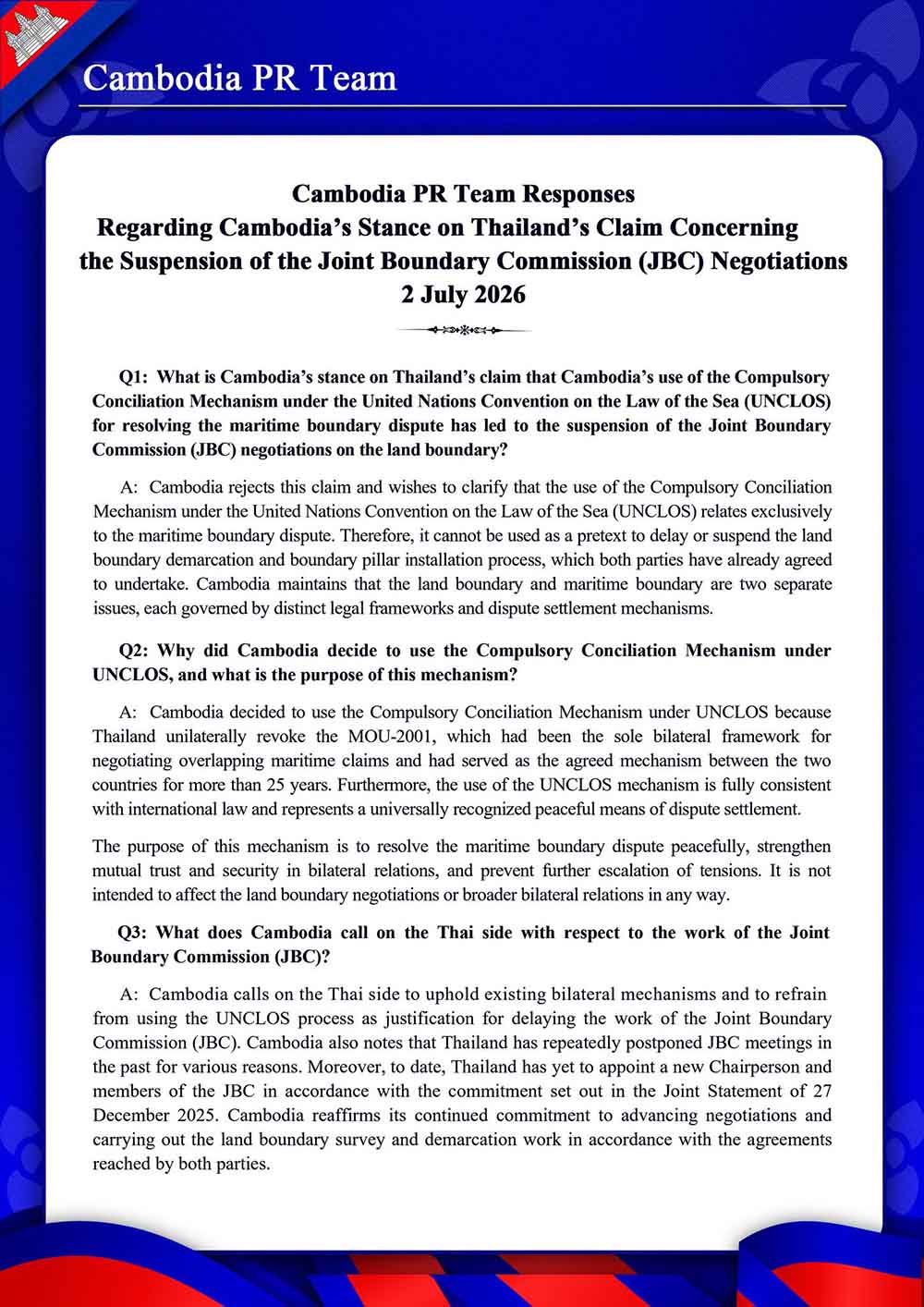 Regarding Cambodia’s Stance on Thailand’s Claim Concerning the Suspension of the Joint Boundary Commission (JBC) Negotiations 2 July 2026
Cambodia PR Team Responses
Regarding Cambodia’s Stance on Thailand’s Claim Concerning the Suspension of the Joint Boundary Commission (JBC) Negotiations
2 July 2026
Q1: What is Cambodia’s stance on Thailand’s claim that Cambodia’s use of the Compulsory Conciliation Mechanism under the United Nations Convention on the Law of the Sea (UNCLOS) for resolving the maritime boundary dispute has led to the suspension of the Joint Boundary Commission (JBC) negotiations on the land boundary?
A: Cambodia rejects this claim and wishes to clarify that the use of the Compulsory Conciliation Mechanism under the United Nations Convention on the Law of the Sea (UNCLOS) relates exclusively to the maritime boundary dispute. Therefore, it cannot be used as a pretext to delay or suspend the land boundary demarcation and boundary pillar installation process, which both parties have already agreed to undertake. Cambodia maintains that the land boundary and maritime boundary are two separate issues, each governed by distinct legal frameworks and dispute settlement mechanisms.
Q2: Why did Cambodia decide to use the Compulsory Conciliation Mechanism under UNCLOS, and what is the purpose of this mechanism?
A: Cambodia decided to use the Compulsory Conciliation Mechanism under UNCLOS because Thailand unilaterally revoke the MOU-2001, which had been the sole bilateral framework for negotiating overlapping maritime claims and had served as the agreed mechanism between the two countries for more than 25 years. Furthermore, the use of the UNCLOS mechanism is fully consistent with international law and represents a universally recognized peaceful means of dispute settlement.
The purpose of this mechanism is to resolve the maritime boundary dispute peacefully, strengthen mutual trust and security in bilateral relations, and prevent further escalation of tensions. It is not intended to affect the land boundary negotiations or broader bilateral relations in any way.
Q3: What does Cambodia call on the Thai side with respect to the work of the Joint Boundary Commission (JBC)?
A: Cambodia calls on the Thai side to uphold existing bilateral mechanisms and to refrain from using the UNCLOS process as justification for delaying the work of the Joint Boundary Commission (JBC). Cambodia also notes that Thailand has repeatedly postponed JBC meetings in the past for various reasons. Moreover, to date, Thailand has yet to appoint a new Chairperson and members of the JBC in accordance with the commitment set out in the Joint Statement of 27 December 2025. Cambodia reaffirms its continued commitment to advancing negotiations and carrying out the land boundary survey and demarcation work in accordance with the agreements reached by both parties.