China’s case for fairer global governance
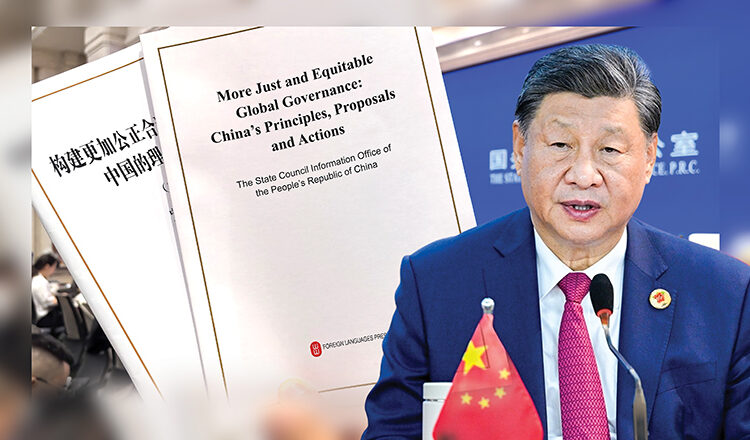 China’s case for fairer global governance
#opinion
When Cambodia and Thailand needed the heat taken out of their border this year, China was one of the parties that helped. When drug syndicates worked the Mekong, Chinese police ran joint operations with their Cambodian, Lao, Myanmar and Thai counterparts. When scam compounds spread across the region, takedowns with Thailand, Myanmar and Laos closed many of them.
None of this is presented as charity. China calls it the everyday work of global governance, and in June, it laid out the full argument in a white paper, “More Just and Equitable Global Governance: China’s Principles, Proposals and Actions”.
The document outlines the Global Governance Initiative (GGI), which President Xi Jinping proposed in 2025. The timing was chosen with care. The year marked 80 years since the United Nations was founded and since the end of World War II. China says nearly 160 countries and international organisations have backed the initiative, and that more than 60 have joined a Group of Friends of Global Governance.
A world in trouble
The starting point is a hard reading of the world. The white paper says the number of armed conflicts in 2025 reached its highest since 1945, with more than 50 countries drawn directly into conflict or war. It states that more than 830 million people still live in extreme poverty and that 2.3 billion face food insecurity. It points to trade wars, unilateral tariffs and what it calls “small yards with high walls” as forces pulling the global economy apart. The UN, it argues, is being weakened from the inside as one major power pulls out of agencies, cuts their funding and blocks decisions.
Against that backdrop, the GGI rests on five ideas: sovereign equality, international rule of law, multilateralism, a people-centred approach and real actions.
Sovereign equality comes first, and it is part of the pitch designed to land with a smaller country. The white paper’s line is that every nation, large or small, has the same right to sit at the table and to be heard. Without that principle, it warns, “anyone at the dining table today could appear on the menu tomorrow”. For a middle power like Cambodia, used to watching larger states set the terms, that is a deliberate appeal.
China’s record
Much of the paper is a list of what China says it has already done, and a good share of it directly touches this region. On trade, China says it is the main trading partner of more than 160 countries and has signed 24 free trade agreements. Closer to home, it has signed the China-ASEAN Free Trade Area 3.0 upgrade and pushed the Regional Comprehensive Economic Partnership, the deal that ties Cambodia to 14 other economies. It has placed zero tariffs on goods from the least developed countries, a group that includes Cambodia.
The Belt and Road figures are the centrepiece. The China-Europe Railway Express has run more than 130,000 freight trips, the paper says. Trade between China and Belt and Road countries reached 23.6 trillion yuan (about $3.49 trillion) in 2025, just over half of China’s total foreign trade. Two-way investment between China and its Belt and Road partners totalled $240 billion from 2021 through the first half of 2025.
On the UN, China says its share of the regular budget rose from under 1% in 2000 to more than 20% in 2025, second only to the United States. It says it is the largest troop contributor to UN peacekeeping among the five permanent Security Council members, with more than 50,000 personnel sent on 29 missions. On climate, it repeats its pledge to peak carbon dioxide emissions before 2030 and reach carbon neutrality before 2060.
The paper does not hide who it is arguing against. It describes a world where “might makes right”, where a handful of rich countries write the rules and the rest are expected to follow. It rejects what it calls the “core-periphery” model of the old order, and it calls for more seats and louder voices for the Global South, which it says now produces over 60% of world output measured by purchasing power and contributes 80% of global growth. The number of UN member states has risen from 51 in 1945 to 193 today, the paper notes, and it argues that the old habit of a few countries running world affairs can no longer hold.
The test ahead
For Cambodia and its neighbours, the test is whether the words match the next decade. China will host the APEC summit in 2026 for the third time, under the theme “Building an Asia-Pacific Community to Prosper Together”, with openness, innovation, and cooperation as priorities. The agenda the paper sets out, reform of the IMF and World Bank, rules for artificial intelligence, climate finance and trade, is where the GGI will either become a working system or stay a statement of intent.
The white paper’s own answer is honest about the distance left to travel. It calls the goal “a gradual historical process” and accepts that “great undertakings are rarely achieved overnight”. For readers in Phnom Penh, the clearest measure is the one already on the table: the border that was talked down, the trade deal that took effect, the tariffs that came off. The region will judge the initiative on what it deliverss, not on what is promised. Xinhua
Full text of the white paper at english.news.cn/20260617/1f77114fe0274c8ebeef11849113e612/c.html
-Khmer Times-