Cambodia’s unique place between the Quad
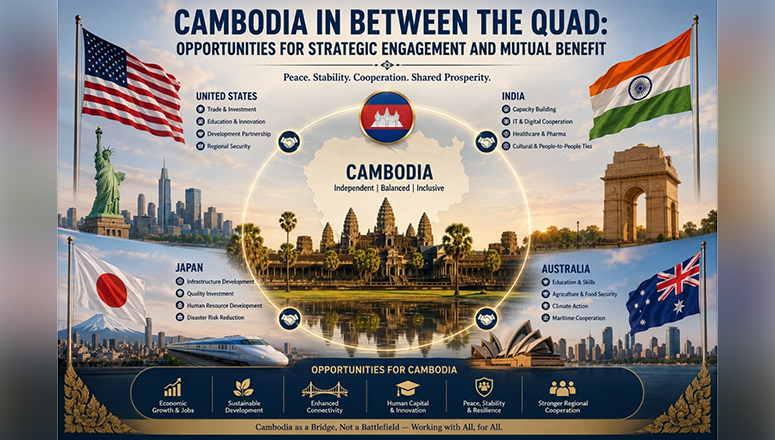 Cambodia enjoys longstanding diplomatic relations with each member of the Quad, comprising the US, Japan, India and Australia. Supplied
#opinion
In the evolving geopolitical landscape of the Indo-Pacific, the Quadrilateral Security Dialogue (Quad) — comprising the United States, Japan, India, and Australia — has emerged as a significant platform for cooperation. While not a formal military alliance, the Quad represents a flexible diplomatic partnership focused on promoting a free, open, inclusive and resilient Indo-Pacific. For Cambodia, a nation that maintains strong friendships with all Quad members while upholding an independent foreign policy and ASEAN commitments, understanding and engaging with this grouping is not about choosing sides but about pragmatically advancing national interests.
Cambodia’s position is unique. Among ASEAN members, only Cambodia, Laos, and Myanmar have not been formally invited into Quad-related frameworks in the same manner as others. Yet this exclusion does not diminish the value of bilateral ties. Cambodia enjoys longstanding diplomatic relations with each Quad country: historical and developmental partnership with Japan; growing economic and defence links with India rooted in ancient civilisational ties; robust people-to-people and development cooperation with Australia; and multifaceted engagement with the United States. These relationships position Cambodia ideally to benefit from Quad initiatives without compromising its strategic autonomy or its role as a bridge-builder in ASEAN.
The Quad’s strengths lie in its practical, outcome-oriented approach. Unlike traditional blocs, it delivers tangible public goods across key domains: maritime and transnational security, economic prosperity and supply chain resilience, critical and emerging technologies, cybersecurity, health security, climate action, infrastructure, and humanitarian assistance and disaster relief (HADR). Originating from the 2004 Indian Ocean tsunami response, the Quad has evolved into a “force for good,” as noted by Indian Prime Minister Narendra Modi, emphasising cooperation that benefits the broader region.
Key initiatives highlight its value. The Indo-Pacific Partnership for Maritime Domain Awareness enhances monitoring of illegal fishing, smuggling and environmental threats — highly relevant for Cambodia’s coastal and Mekong interests. The Quad Health Security Partnership builds on COVID-19 vaccine efforts, where Quad countries delivered hundreds of millions of doses regionally, strengthening pandemic preparedness. On infrastructure and connectivity, programmes like the Quad Infrastructure Fellowship and clean energy supply chain diversification promote sustainable, high-quality projects — aligning perfectly with Cambodia’s development priorities under the Rectangular Strategy and Vision 2050.
Climate cooperation, critical and emerging technologies (including digital public infrastructure), and cybersecurity offer Cambodia pathways to leapfrog in green growth, digital economy and resilience. The Quad’s focus on resilient supply chains for semiconductors, critical minerals, and clean energy can diversify Cambodia’s partnerships, reducing over-reliance on any single partner while attracting investment in sectors like renewable energy, where Cambodia has immense solar potential.
From Cambodia’s perspective, engaging with these initiatives offers multiple advantages.
First, economic diversification and development. As a least developed country aspiring to upper-middle-income status, Cambodia needs quality infrastructure, technology transfer and skills development. Japan has been a top investor and donor, upgrading ties to a Comprehensive Strategic Partnership in 2023, with focus on digital technology, economics and security. Australia provides substantial development assistance in health, agriculture and education. India offers opportunities in capacity building, pharmaceuticals and cultural exchanges. The US supports trade and targeted investments. Quad frameworks can amplify these bilateral flows through trilateral or multilateral projects.
Second, strengthening maritime and food security. Cambodia’s reliance on the Mekong and Gulf of Thailand makes it vulnerable to climate impacts, pollution and resource challenges. Quad maritime awareness tools and HADR capabilities can support disaster preparedness, especially amid increasing extreme weather events.
Third, technological and human capital advancement. Initiatives in AI, 5G/Open RAN, cybersecurity, and digital public infrastructure can help Cambodia build a modern economy. Fellowships, training programmes and partnerships would empower Cambodian youth and institutions.
Critically, Cambodia’s engagement would not alienate traditional partners. The Quad repeatedly affirms it is inclusive and complementary to ASEAN centrality. Cambodia, as an ASEAN member and former Chair, can advocate for greater Quad-ASEAN synergy, ensuring initiatives respect sovereignty and avoid bloc confrontation. This “friends with all” policy — rooted in peace, neutrality and development — allows Cambodia to extract maximum benefits while contributing to regional stability.
To capitalise on these opportunities, Cambodia should pursue a multi-pronged strategy:
– Deepen bilateral ties strategically: Leverage existing comprehensive partnerships (e.g., with Japan) and elevate dialogues with others to identify Quad-aligned projects in infrastructure, health and tech.
– Seek observer or partner status in select initiatives: Explore participation in non-sensitive areas like health security, climate resilience, HADR and infrastructure fellowships, similar to how other regional states engage.
– Build domestic capacity: Establish inter-ministerial coordination to map Quad offerings against national priorities, such as the Pentagonal Strategy, focusing on human resource development and green growth. Promote trilateral cooperation: Facilitate projects involving one or more Quad countries plus Cambodia, perhaps in Mekong sub-region development, aligning with Quad statements supporting sub-regional mechanisms.
– Enhance people-to-people links: Expand scholarships, cultural exchanges, and tourism to foster goodwill and long-term understanding.
Challenges exist, including perceptions of the Quad as strategically competitive. Cambodia’s response must remain pragmatic: prioritise development over geopolitics, insist on inclusivity and maintain policy independence. By doing so, Cambodia avoids being “in between” as a passive actor and instead becomes an active beneficiary shaping outcomes.
In conclusion, the Quad’s evolution into a platform delivering concrete benefits in health, climate, technology and security presents a strategic opening for Cambodia. As a nation at the heart of ASEAN with amicable relations across the board, Cambodia is well-placed to harness these initiatives for sustainable growth, resilience and prosperity. Strengthening ties with Quad countries through targeted, mutually beneficial cooperation will not only advance Cambodia’s development goals but also contribute to a stable, inclusive Indo-Pacific where smaller nations thrive.
Cambodia’s diplomacy has always emphasised balance and friendship; engaging constructively with the Quad exemplifies this wisdom in a multipolar era.
Dr Seun Sam is a policy analyst at the Royal Academy of Cambodia. All views in this article are his own.
-Khmer Times-