Trump faces growing pushback as Republicans worry about midterms
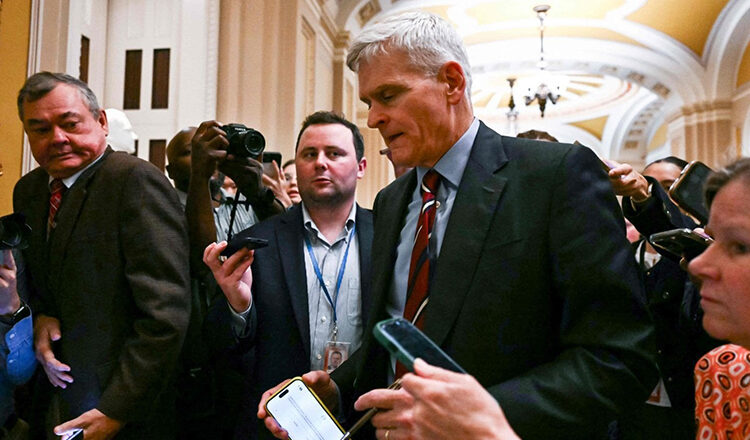 US Senator Bill Cassidy, Republican from Louisiana, speaks with reporters as he walks to a meeting with Senate Republicans at the US Capitol in Washington, DC. President Donald Trump’s agenda faces a series of tests in the US Senate on Thursday, as lawmakers begin a marathon amendment process on a 70-billion immigration enforcement bill after weeks of Republican anxiety over some of his most contentious policy moves. AFP
#opinion
United States President Donald Trump is used to getting his own way with Republican lawmakers — but there are signs of dissent as his party nervously eyes the looming midterm elections.
From a vote against the Iran war, to dissent over his US$1.8 billion “anti-weaponisation fund” and costly White House ballroom, the nearly 80-year-old president is facing growing pushback.
It comes as Trump faces record-low approval ratings 500 days into his second term, deepening Republican fears that they could lose control of Congress in November’s midterms.
Billionaire Trump, the only president in American history to be impeached twice, has himself warned that he could face a third impeachment if that happens.
“Republicans are looking at their own polls and discovering that Trump is turning into a drag on their reelection chances,” said Larry Sabato, a political scientist at the University of Virginia.
Trump himself has begun to appear increasingly bored with the political battles, preferring to talk about grand projects closer to his real estate-developer heart.
But Republicans worry that his focus on pet projects — like an Ultimate Fighting Championship bout at the White House on his June 14 birthday — makes him look out of touch.
The biggest rebuke to Trump came when the House of Representatives backed a resolution on June 3 seeking to halt the increasingly drawn-out US military action against Iran.
Trump lashed out on social media at the “unpatriotic” move and blasted four members of the Republican majority who crossed the floor to vote with rival Democrats as “GRANDSTANDERS!”
Since his extraordinary return to power in January 2025, Trump has largely exerted an iron grip over the Republican Party.
The party has, in turn, largely subsumed itself to Trump’s wishes and to the goals of his “Make America Great Movement”.
There have been blips, particularly over the Jeffrey Epstein scandal, when lawmakers voted to release files related to the late sex offender.
But the economic fallout from the Iran war has deepened recent unease among Republicans about defending Trump’s priorities when voters are worried about the cost of living.
In the USA Today newspaper, columnist Rex Huppke said Republicans were “starting to show the faintest signs of embryonic spines”.
Some of the most controversial of those priorities were front and centre as the US Senate embarked on a raft of votes on June 3.
One of those was the proposed fund for Trump’s allies who claim they were unfairly targeted by the government, dubbed a “slush fund” by critics, provoking outrage among some Republicans.
The Trump administration said the plan was being dropped earlier this week after a judge ruled against it, but Trump himself has indicated that he was still keen on it.
Another controversial issue — a demand for US$1 billion for security for the new White House ballroom — was dropped before it could be voted on.
Two of Trump’s recent personnel changes have also sparked dissent among Republican ranks.
His choice of relatively junior housing official Bill Pulte as the new US national intelligence chief has prompted threats from some lawmakers to scuttle efforts to renew a powerful surveillance programme.
Trump insisted on June 3 that Pulte’s appointment was a stopgap, although it is one of his favourite tactics: using a temporary nomination to avoid a messy Senate confirmation.
A bid to nominate his former personal lawyer, Todd Blanche, as the US attorney-general could run into similar trouble.
While the cracks may be showing, Trump’s hold over most Republicans remains clear.
Trump has thrown his weight around by successfully backing MAGA candidates over Republican incumbents who defied him in several — very expensive — primaries.
But that could also eventually work against him, said Sabato.
“He defeated or forced into retirement several senators and representatives. In essence, he publicly humiliated them, and so now they aren’t inclined to do Trump any favours,” he said.
“The Congress is closely divided in both chambers, and a few defections can matter.”
-Khmer Times-