An Open Letter to Prime Minister Anutin: Rhetoric vs. Reality on the Cambodia Border
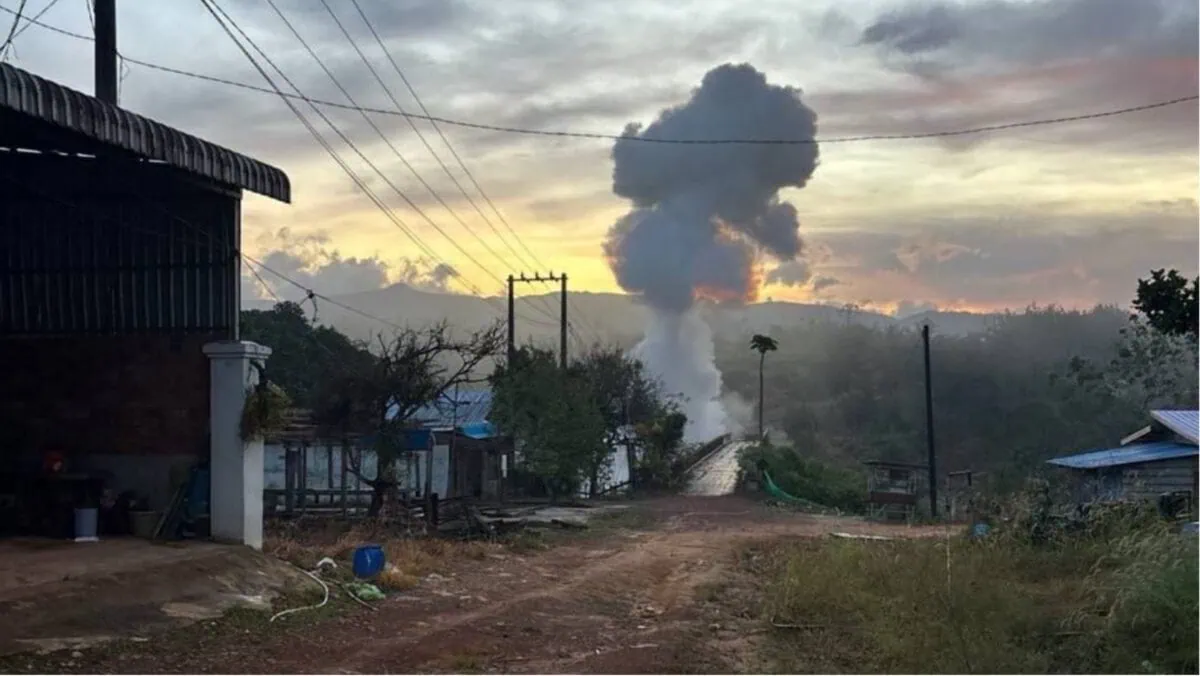 Smoke billows from a Thai F-16 bomb strike on Cambodian territory in December 2025. Supplied
At the ASEAN Future Forum 2026 in Hanoi, Thai Prime Minister Anutin Charnvirakul spoke eloquently of peace, trust, dialogue, stability and a rules-based regional order. Speaking to reporters on June 9, he stated that Thailand and Cambodia are at an important crossroads, emphasising that lasting solutions require trust, confidence and dialogue in good faith. He went on to issue a sweeping proclamation regarding regional security: “I would like to reaffirm that Thailand has never invaded or violated the sovereignty of other countries”. He followed this with a stern warning, adding that anyone thinking of using force against Thailand should “think very carefully”.
These are important principles that every ASEAN member should support. However, as a Cambodian citizen who has watched our shared frontier transform under the weight of military tension, I am compelled to ask: How does Your Excellency reconcile this spotless narrative with the historical record and the undeniable realities currently visible on the ground?
To an international community unfamiliar with our geography, Prime Minister Anutin’s words sound like a standard defence of peace. But to those who live along the 817-kilometre frontier, the statement is a stark contradiction of recent history. Border disputes cannot be erased by political rhetoric, nor can unilateral actions be hidden behind declarations of absolute innocence.
A truly civilised nation does not rely on military force when peaceful legal mechanisms are available. The hallmark of a mature and responsible state is its willingness to resolve disputes through dialogue, diplomacy, mutual respect and international law rather than through the threat or use of force.
The Modern Reality: The 2025 Frontier Crisis
If Thailand has “never violated the sovereignty” of its neighbours, how do we categorise the events of late 2025?
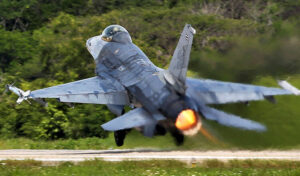
The border crisis that shattered into heavy fighting in July and December 2025 was not a minor diplomatic misunderstanding. It was an intense, localised conflict. When the Royal Thai Air Force deployed F-16 fighter aircraft to conduct combat strikes near the frontier, it marked a severe military escalation. Following these air missions and ground manoeuvres, Thai armed forces pushed into contested sectors, establishing tactical control over several hills and areas that Cambodia recognises as its sovereign territory under the 1904 and 1907 Franco-Siamese treaties.
The human and economic cost of these manoeuvres remains an open wound:
Mass Displacement: According to data from international humanitarian and disaster management reports, the 2025 conflict forced more than 490,000 civilians (over 151,000 families) to flee their homes in Cambodian border provinces like Banteay Meanchey, Oddar Meanchey, Battambang and Preah Vihear.
Economic Chokehold: Key commercial lifelines — including the Friendship Bridge and critical checkpoints like Ban Khlong Luek and Chong Chom — were unilaterally shuttered by Thai authorities. Prime Minister Anutin himself proudly doubled down on this policy recently, assuring a Thai diaspora group in Paris that these checkpoints would remain strictly closed, driving down border trade and halting the livelihoods of thousands of Cambodian cross-border workers.
On-the-Ground Encroachment: Even during the fragile truce of 2026, Thai forces have actively altered the status quo. Just recently, tense military standoffs occurred when Thai troops installed barbed-wire fencing and erected a massive Buddha statue and Thai flags on contested land, triggering official diplomatic protests from the Cambodian foreign ministry.
A Dangerous Precedent for Regional Order
Likewise, leaders of high moral character have no need to misrepresent facts to either their own people or the international community. Credibility is built through honesty, transparency and consistency between words and actions. In an age of instant communication, satellite imagery, independent reporting and international observation, public statements are inevitably measured against realities on the ground.
Cambodia’s approach to these disputes has consistently relied on international law and judicial frameworks rather than raw military power. When disagreements over boundaries arise, our legal basis rests upon historically recognised treaties and international rulings — such as the landmark 1962 International Court of Justice (ICJ) decision regarding the Preah Vihear temple complex.
This commitment to international law extends to our maritime borders. Following the Thai Cabinet’s unilateral decision in May 2026 to terminate the 2001 Memorandum of Understanding (MOU44) — threatening a peaceful resolution over the 26,000-square-kilometre Overlapping Claims Area in the Gulf of Thailand — Cambodia did not retaliate with force. Instead, Prime Minister Hun Manet launched a UN-backed compulsory conciliation process under the Law of the Sea (UNCLOS) to resolve the dispute via independent experts.
Yet, while Cambodia pursues legal arbitration, Thailand responds with defensive muscle-flexing. When a powerful neighbour uses heavy artillery and air power to annex tactical border positions, alters the status quo with physical installations on disputed land and subsequently declares to the world that it has “never encroached”, it undermines the very foundation of the rules-based order that holds the ASEAN community together.
The Path Forward
In the twenty-first century, strength is demonstrated not only by economic or military capabilities, but also by respect for truth, accountability and the rule of law. When disagreements arise between neighbouring countries, the civilised path is to present evidence, engage in negotiations and seek resolution through established international institutions and legal processes.
History has repeatedly shown that force may impose temporary outcomes, but lasting peace can only be achieved through justice, legality, and respect for sovereignty. As Prime Minister Hun Manet rightly noted in Hanoi alongside Prime Minister Anutin, the current ceasefire “remains fragile” and sovereignty must not be altered by force or coercion.
If peace, trust and good-faith dialogue are to mean anything, they must be reflected not only in speeches delivered before international audiences in Hanoi, but also in actions on the ground. True and lasting peace between Cambodia and Thailand cannot be constructed on a foundation of historical revisionism or political denial. It requires transparency, a mutual acknowledgment of legitimate territorial concerns and adherence to established international law.
Civilised nations understand that the rule of law is stronger and more enduring than the rule of force, and principled leaders understand that truth is a stronger foundation than rhetoric. If Your Excellency truly wishes for a stable, prosperous and cooperative neighbourhood, we welcome a frank explanation of how Thailand’s official stance aligns with the reality of displaced families, the shuttered border crossings and the continued presence of Thai troops on contested soil. Political declarations will not settle the frontier; only good faith and adherence to lawful mechanisms will.
As the old adage goes: “Civilised nations choose law over force, and honourable leaders choose truth over deception”.
Tesh Chanthorn is a Cambodian citizen who longs for peace. The views and opinions expressed are his own.
-Phnom Penh Post-