Cambodia’s graduation to middle-income status: Preparation and ownership
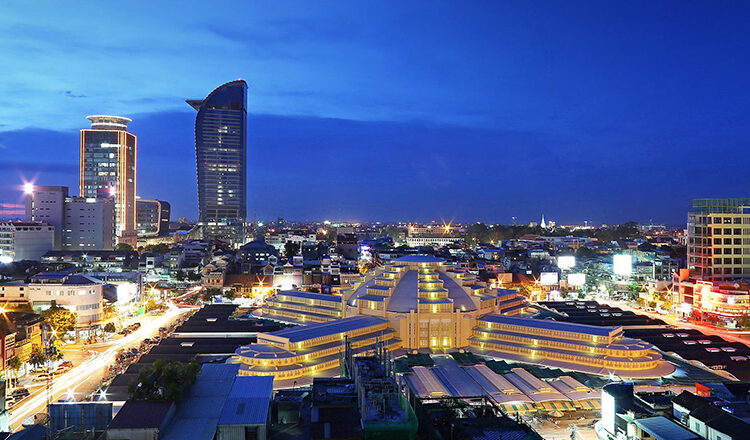 The Phnom Penh skyline. Film Noir Studio
#Opinion
Cambodia is approaching a defining moment in its development journey: the transition from Least Developed Country (LDC) to a Middle-Income Country (MIC). This milestone—often described as “graduation”—is not merely a technical reclassification. It represents a shift in how the country engages with the global economy, finances its development and assumes responsibility for its future. As with any graduation, success will depend less on the formal moment itself and more on the years of preparation leading up to it. For Cambodia, the need to accelerate that preparation is clear.
The metaphor of a student finishing school offers a useful lens. For decades, Cambodia has benefited from support measures available to LDCs—preferential trade access, concessional financing, development assistance, and technical support. These have functioned much like supportive teachers or parents: guiding, protecting and helping compensate for structural weaknesses. But just as a student cannot rely indefinitely on such support, a graduating economy cannot depend forever on external assistance.
Graduation changes the rules. Once Cambodia transitions, it will operate in a more competitive global environment. Trade preferences may diminish, financing could become more expensive and expectations for governance, productivity and innovation will rise. Like life after school, this “real world” comes with fewer safety nets and greater pressures. Opportunities will exist, but so will risks that demand resilience, adaptability and confidence.
Encouragingly, Cambodia’s leadership recognises this shift. Reforms have been initiated, institutions strengthened and efforts made to diversify the economy. Yet the key question is whether this preparation is deep, broad and fast enough. Readiness will ultimately be tested not in theory but in practice.
At the heart of this transition lies a simple principle: sustainable and dynamic development cannot be achieved without domestic initiative. External partners can support, advice and accompany, but the responsibility for shaping Cambodia’s future rests primarily with its government, institutions and people. Just as no one can take an exam on behalf of a student, no external partner can deliver long-term prosperity on behalf of a nation.
This does not mean Cambodia will stand alone. Development partners—bilateral donors, international organisations and private investors—remain engaged. However, their role is evolving. They increasingly function as advisers and collaborators: sharing expertise, supporting reforms and helping navigate complex decisions. The partnership becomes more balanced, but also more demanding.
Cambodia now faces important choices about its economic model for the next phase. There is no single path to success. Some countries have pursued centralised, state-led approaches, while others have relied on market-driven models emphasising competition, transparency and clear regulatory frameworks. Cambodia will need to define its own trajectory, based on its institutions, history and development ambitions.
Despite these choices, several fundamentals remain essential. A predictable and transparent business environment is critical to attracting investment and fostering trust. Investment in human capital—education, skills, and health—must accelerate to enable the workforce to compete in higher-value sectors. Infrastructure development should continue, with emphasis on efficiency and sustainability. Governance reforms, including strengthening the rule of law and tackling corruption, will be central to building both domestic confidence and international credibility.
Economic diversification is equally important. Cambodia’s growth has been strong but concentrated in garments, construction, and tourism. Graduation will require a broader base, including higher-value manufacturing, agro-processing, digital services and innovation-driven activities. Diversification not only supports long-term growth, but also reduces vulnerability to external shocks and changing global demand.
At the same time, strengthening domestic private sector capacity is crucial. A dynamic economy depends not only on government policy, but on entrepreneurs, small and medium enterprises and local innovation. Expanding access to finance, ensuring fair competition, and supporting skills development will help create a more inclusive and resilient economic structure.
The coming years will test Cambodia’s readiness. Like a student entering the workforce, the country will need to apply its knowledge, adapt quickly, and take responsibility for its decisions.
Mistakes are inevitable in any transition, but the key will be the ability to respond and adjust while maintaining forward momentum.
There is reason for optimism. Cambodia has shown resilience, adaptability and ambition over recent decades. Its rapid growth and significant reduction in poverty are notable achievements.
However, past success does not guarantee future outcomes. Graduation is not the conclusion of a journey, but the beginning of a more demanding phase.
The message, therefore, is clear: the time to act is now. Preparation cannot be delayed, and responsibility cannot be outsourced. Cambodia’s partners will remain supportive, but initiative must come from within. The graduating student must step forward—confident, capable, and ready to stand on its own.
If Cambodia embraces this moment with determination, ownership and strategic foresight, graduation will become not a risk but an opportunity—a gateway to a stronger, more self-reliant, and more dynamic future.
H.E. Mrs. Markéta Kolc Hájková, the Czech Ambassador