Why do Cambodia’s state-owned enterprises always run at a loss?
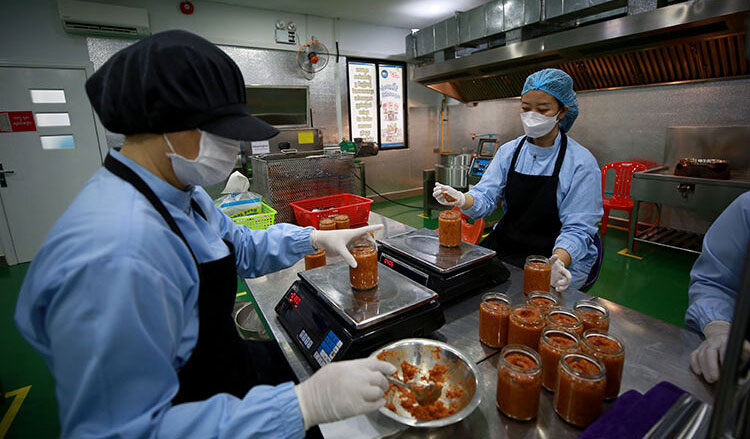 Workers at a fish sauce factory in Phnom Penh. KT/Chor Sokunthea
#editorial
The question of why Cambodian state-owned enterprises (SOEs) consistently operate at a loss remains an enduring and troubling mystery to the public. Despite their access to national resources, these entities frequently rely on government budget support and heavy subsidies rather than contributing to the treasury.
The recent irregularities at the Post Office did not surprise the public much, and many other complaints emerged along with the news. The incidents have highlighted a broader systemic failure, where poor service quality has driven citizens toward private alternatives like Virak Buntham or DRSB, which offer superior speed and convenience without the burden of irregular charges.
Telecom is in a similar situation. Despite the promise of 5G connection, internet speed is far from meeting expectations and after-sales service is difficult to access: When you call an operator, you are simply told to “please call another department”, with no sign of centralised control and monitoring of services.
Another point for the Cambodian public to contend with is the financial status of Electricité du Cambodge (EDC). While the company generates massive annual revenues, it paradoxically reports significant losses that necessitate state intervention.
This creates a logical disconnect for consumers: as Cambodia constructs more power plants and increases production capacity, the price of electricity remains stagnant instead of decreasing. The public expects economies of scale in energy production to translate into lower household costs.
Recent financial data indicates that while EDC’s revenue has grown due to increased industrial demand, its net losses have persisted. For instance, in recent fiscal cycles, EDC has cited high power purchase agreements (PPAs) with independent power producers (IPPs) and heavy debt servicing for transmission infrastructure as primary drivers of its deficit.
The Electricity Authority of Cambodia (EAC) Annual Report for 2024 confirms that while electricity consumption rose to 19,419 million kWh (a significant revenue base), the costs of supplying that power are heavily impacted by external factors. Cambodia relies on a mix of coal (33%) and oil/imports, which are subject to global price volatility. In recent fiscal years (notably during the global energy price spikes of 2022–2024), EDC faced a significant deficit. To prevent this from hitting citizens, the state provided subsidies of $150 million to $200 million annually to EDC to cover the gap between what it costs to buy power and the price at which it is sold to the public.
Many other SOEs focus their energy on protecting territorial monopolies rather than developing capacity. By controlling specific jurisdictions without the means to modernise them, these entities stifle the potential of entire economic sectors. This “cocooning” behaviour prevents the entry of innovative private players and keeps Cambodia trapped in a cycle of mediocrity.
Indeed, positive examples also exist.
The Sihanoukville Autonomous Port serves as a rare beacon of hope and a model for what a Cambodian SOEs can achieve.
Expansion of the port is a three-phase project supported by Japan, with Phase 1 (14.5 metres) completing by 2026-2027, Phase 2 (16.5 metres) by 2028, and Phase 3 (17.5 metres) by 2029-2030.
By allowing large 14,000 TEU ships to dock directly in Sihanoukville, Cambodia bypasses the transshipment costs in Singapore. Currently, shippers pay a “feeder premium” (the cost of the small boat, extra handling at a second port, and the second port’s fees). Direct shipping is expected to save at least $200 per container in pure logistics and handling expenses. The Sihanoukville Autonomous Port intends to bring its total handling and freight costs into line with those of neighbouring ports like Laem Chabang in Thailand and Cai Mep in Vietnam, which are significantly cheaper because of their deep-water capabilities.
In terms of revenue, the Sihanoukville Autonomous Port has shown transparency. As a listed company on the Cambodia Securities Exchange (CSX), the port is required to release audited financial statements. These documents confirm its consistent profitability. In 2024, it reported a total revenue of 459 billion riel ($114 million), with a net profit of 126.7 billion riel ($31 million), representing a 3.91% increase in profit compared to 2023. According to CSX filings, the port has a consistent history of paying cash dividends to its shareholders. For the 2023 fiscal year, it declared a dividend of 454 riel per share.
Angkor Enterprise serves as a modern blueprint for how a Cambodian SOE can successfully transition from private management to a model of high transparency and digital efficiency. Every month, it releases detailed statistics on visitor numbers and revenue, which are widely reported in the media. In 2025, Angkor Enterprise recorded nearly $47 million in revenue from international visitors across its managed sites of Angkor Park, Koh Ker, and Beng Mealea. Under state management, revenue is now directly funnelled into the national budget, with a fixed portion of $2 per ticket transparently allocated to the Kantha Bopha Children’s Hospital, totalling millions of dollars in donations annually.
In countries like China, SOEs act as “captains of industry,” serving as the lead actors in national development. They drive industrialisation, support massive R&D, and compete effectively on the international stage. These companies do not merely exist; they inject billions into the state budget and act as pioneers for their respective industries.
Cambodia must shift its perspective to view SOEs as drivers of wealth rather than recipients of welfare.
To modernise the state sector, the government must adopt a comprehensive framework for transformation built upon five foundational pillars of reform.
First and foremost is the mandate for Profitability, which dictates that SOEs must transition from being liabilities on the national budget to becoming engines of growth that generate consistent net income and contribute significantly to state revenues.
This financial shift must be accompanied by a Customer-First mandate, where public services are no longer granted a pass for mediocrity but are instead strictly benchmarked against the private sector to ensure they become faster, more affordable, and increasingly reliable for the average citizen.
Achieving these goals requires a foundation of Transparency, necessitating the eradication of irregular practices that enrich a few individuals at the expense of the institution through the implementation of rigorous, independent auditing processes.
Beyond simple transparency, SOEs must lead the way in Corporate Compliance, acting as the nation’s premier role models for ethical business practices and unwavering adherence to the law, thereby setting the standard for the private sector to follow.
Finally, these enterprises must embrace International Competition by emerging from the shelter of state protection to measure their performance against rigorous regional benchmarks and global standards, ensuring that Cambodia can compete effectively on the world stage.
SOEs are entrusted with national assets to serve the public interest and advance national policy. They should no longer be allowed to hide behind comfortable budget support while failing to deliver value to the people. It is time for a transformation where Cambodian SOEs lead the charge towards a modern, industrialised economy, ensuring that every dollar invested by the state returns a benefit to the citizens it serves.
-Khmer Times-