A Flight from Reality: PM Anutin’s Paris Trip Exposes a Crisis of Diplomatic Leadership
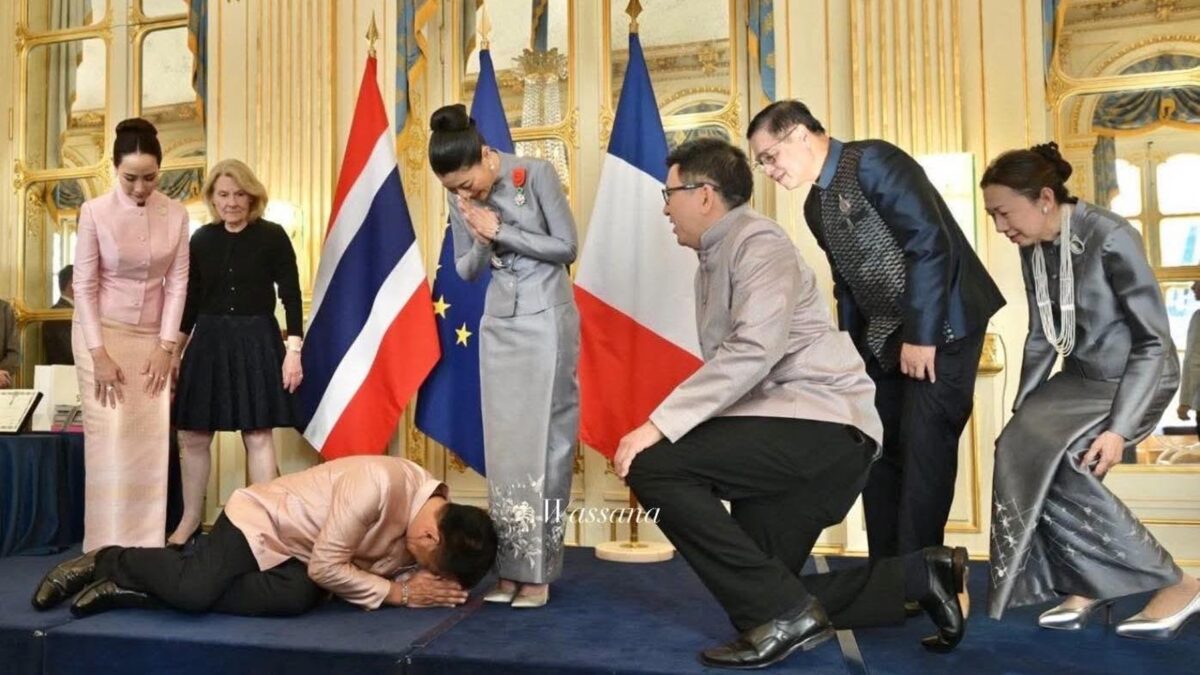 Prime Minister Anutin Charnvirakul paid royal obeisance to HRH Princess Sirivannavari Nariratana Rajakanya in Paris on May 23. The Nation Thailand
When Thai Prime Minister Anutin Charnvirakul departed for Paris, his stated mission carried a veneer of statesmanship: he was traveling to seek historical clarity from French archives regarding the Cambodia-Thailand border. It was framed as a confident, fact-finding endeavour. Yet, upon his return on May 29, the prime minister delivered not facts, but a glaring diplomatic retreat. Abruptly, he declared that the internationally recognised 1:200,000-scale colonial map long cited by Cambodia “no longer exists” for Bangkok.
This sudden, erratic pivot is not a demonstration of sovereign strength. It is an exposure of an administration struggling to reconcile its political ambitions with binding treaties, begging a question that reverberates through diplomatic corridors: What exactly did Anutin learn in France that forced such a hasty retreat from historical evidence?
The Legal Reality Check
In the realm of international law and statecraft, a leader cannot unilaterally erase a map simply because it fails to serve political convenience. The Annex I map is not merely a dusty colonial artifact; it is the foundational document validated by the International Court of Justice (ICJ) in its landmark 1962 Preah Vihear ruling.
If the prime minister genuinely sought “clarification” from President Emmanuel Macron and French authorities, the archives almost certainly offered an inconvenient truth: the historical record is immutable. France cannot — and legally would not — retroactively alter early 20th-century treaties to accommodate modern Thai political objectives. Realising that the French archives would only reinforce the legitimacy of the very maps Thailand wishes to contest, Anutin chose to abandon the legal framework rather than engage with the rules of international jurisprudence.
A state does not ask a question on the global stage if it is unprepared to handle the answer. To inquire, and then immediately declare the subject non-existent when the answer proves unfavourable, is a departure from established diplomatic norms.
The Ultimate Legal Bluff: Take it Back to The Hague
The most glaring flaw in Prime Minister Anutin’s sudden declaration is the illusion that a state can simply opt out of international jurisprudence by executive fiat. By declaring that the 1:200,000-scale map “no longer exists” for Thailand, Anutin is attempting to unilaterally nullify the very evidentiary foundation upon which the ICJ built its judgment.
If the prime minister is so confident that Thailand’s unilaterally drawn, modern 1:50,000-scale maps represent the true reality of the border, there is a clear, established mechanism for states with legitimate legal grievances: return to The Hague.
In the arena of modern international law, if a state wishes to overturn a settled boundary framework backed by an international ruling, it must present its “new facts” or superior technical data back to the International Court of Justice. It cannot simply execute a unilateral withdrawal from the negotiating table and declare the court’s core evidence extinct.
By refusing to seek a formal legal revision from the ICJ, while simultaneously refusing to negotiate using the treaty-mandated maps, Anutin exposes his hardline stance as a diplomatic bluff. He knows that Thailand’s 1:50,000 maps are unilateral lines that hold no weight under the law of treaties or the principle of pacta sunt servanda (agreements must be kept).
A Self-Inflicted Jurisdictional Trigger
Anutin’s rhetoric may also be handing Cambodia a potent legal mechanism. By publicly declaring that the Annex I map “no longer exists” for his government, the prime minister is effectively repudiating the Franco-Siamese treaty framework. This raises a critical question: Does this unilateral nullification provide Cambodia with sufficient legal grounds to haul Thailand back to the ICJ? Under international law, the answer is a resounding yes.
Under Article 60 of the ICJ Statute, the Court has the authority to intervene whenever there is a dispute regarding the meaning or scope of its judgments.
A formal, executive dismissal of the foundational treaty map by a head of government constitutes a direct dispute over the scope of the Court’s previous rulings. Instead of forcing Cambodia to accept Bangkok’s unilateral map, Anutin’s remarks may have inadvertently given Phnom Penh the exact jurisdictional trigger it needs to seek fresh legal enforcement from The Hague. If Cambodia chooses to litigate this treaty repudiation, Thailand will find itself defending an indefensible position — arguing against a map the highest court in the world has already ruled binding.
The True Test of Domestic Promises
If Prime Minister Anutin genuinely wishes to satisfy his domestic constituency by severing Thailand’s legal ties to the Franco-Siamese treaties, his current rhetoric is entirely insufficient. A unilateral declaration of nullity at a press conference may generate fleeting applause in Bangkok, but it holds zero weight in international law.
Furthermore, Anutin’s posture is exposed as calculated political theatre because he knows the legal avenue for revision is permanently sealed. Under Article 61 of the ICJ Statute, any petition to revise a judgment based on “new facts” or unilateral maps carries a strict ten-year statute of limitations. The window to legally challenge the 1962 Preah Vihear ruling closed in 1972. Consequently, his public disavowal of the map functions not as a mechanism to secure sovereignty, but as a low-risk performance — he is demanding a new baseline while hiding behind the fact that he is procedurally barred from ever having to defend it in The Hague.
Sabotaging Bilateral Mechanisms and ASEAN Stability
Beyond the halls of international courts, Anutin’s posture actively undermines the practical frameworks designed to maintain peace. Thailand and Cambodia have long established bilateral channels, such as the Joint Boundary Commission (JBC), specifically tasked with addressing technical demarcation issues through agreed-upon treaty frameworks. By setting the total rejection of the 1:200,000 map as a non-negotiable precondition, the prime minister is effectively sabotaging these very commissions. He shifts his profile from a firm negotiator to an international obstructionist.
Regionally, this unilateralism sends a chilling wave through Southeast Asia. As a core member of ASEAN, Thailand’s actions disregard the spirit of the ASEAN Charter, which binds member states to the peaceful settlement of disputes, institutional consensus and adherence to the rule of law. If any member state can unilaterally declare historical treaty maps “non-existent” whenever the legal geography proves politically inconvenient, the entire architecture of regional border stability will fracture.
Domestic Calculations Over Statesmanship
True leadership requires the courage to navigate complex geopolitical realities. It does not mean prioritising domestic nationalist sentiment at the expense of international credibility.
This domestic calculation extends directly to Bangkok’s engagements with UNESCO. By officially denying the legal maps that govern heritage sites along the border, Anutin is attempting to artificially inject Thailand as an equal stakeholder in sovereign Cambodian territory. It is a transparent, legally hollow strategy to demand “both sides” inspections in areas where international jurisprudence has already settled the matter of jurisdiction.
Prime Minister Anutin’s abrupt dismissal of the French archives illustrates reactive, inconsistent leadership. A statesman confronts historical evidence and navigates disputes through established legal mechanisms and mutual respect. A politician simply closes his eyes and declares the evidence “no longer exists”
Bilateral trust and regional stability are built on adherence to established frameworks, not erratic shifts in policy following disappointing overseas trips. Thailand’s leadership must realise that ignoring the map does not change the territory — it only isolates the leader who refuses to look at it.
Conclusion: The Geography of Denial
Ultimately, Prime Minister Anutin’s pronouncements in Paris and Bangkok reveal a fundamental misunderstanding of how sovereign borders function in the 21st century. International boundaries are forged by historical treaties, ratified by international jurisprudence and maintained through institutional trust. They are not erased by political decree, nor are they rewritten to soothe domestic anxieties.
By unilaterally declaring the Franco-Siamese treaty maps null and void while refusing the only legal avenue available to challenge them at the International Court of Justice, the Thai administration has painted itself into a diplomatic corner. It is a strategy of obstruction disguised as strength, one that hands Cambodia a potent legal trigger while simultaneously fracturing the stability of the ASEAN framework.
Thailand’s leadership must recognise that diplomacy by denial is an unsustainable doctrine. You can close your eyes to the archives, you can walk away from bilateral commissions and you can declare a map non-existent to the applause of a domestic audience. But ignoring the map does not change the territory, and running from the law does not exempt you from its reach. It only isolates the leader who refuses to look at reality.
Panhavuth Long is founder and attorney at law at Pan & Associates Lawfirm. The views and opinions expressed are his own.
-Phnom Penh Post-