The $2,870 problem
#opinion
Cambodia has the ambition. It has stability. What it does not yet have is a strategy to close the gap (Part 1 of 10)
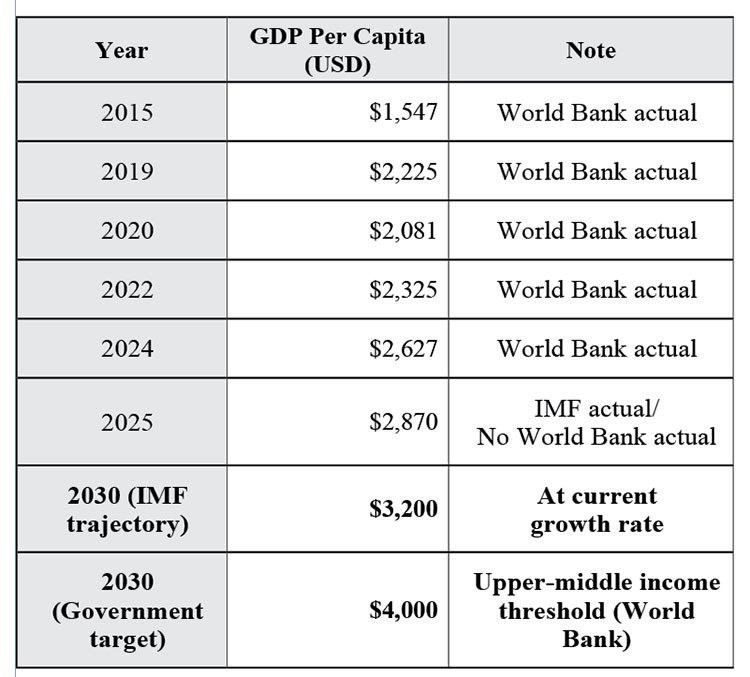
In 2025, Cambodia’s GDP per capita stood at $2,870. The government’s stated goal is to reach upper-middle-income status by 2030, a threshold the World Bank defines as a GNI per capita of at least $4,000. This means Cambodia needs to add roughly $1,700 per person in six years, nearly doubling the income gains it achieved over the previous decade.
The World Bank has called this target “very ambitious.” The IMF projects that Cambodia will reach approximately $3,200 by 2030, based on current growth trends. These are real gains. They also fall short of the government’s own definition of success by roughly 20%.
The gap between where Cambodia is heading and where Cambodia says it wants to go is not a rounding error. It is a structural problem. And it cannot be solved by doing more of the same.
Table 1. Cambodia GDP per capita: Actuals v 2030 target
A growth model built for yesterday
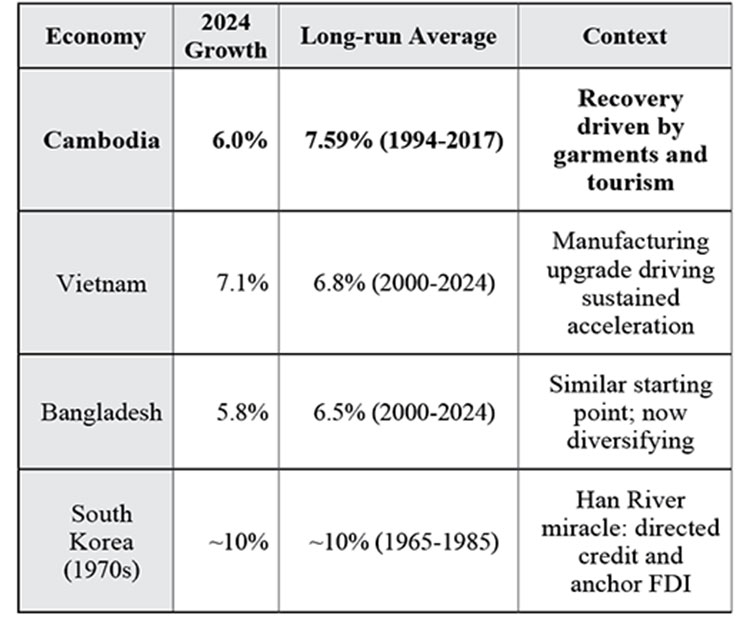
Cambodia’s economy has been built on three pillars for 30 years: garments and footwear, tourism centred on Angkor Wat, and construction and real estate. These sectors drove the 7.59% average annual growth Cambodia sustained from 1994 to 2017, one of the fastest rates in the world. That achievement is real and should not be minimised.
But the same model now faces hard limits. Garments, footwear, and travel goods (GFT) account for over 62% of Cambodia’s total exports and employ nearly one million workers. That concentration is a vulnerability, not a strength. When the US or EU adjusts trade preferences, as has already happened with the partial suspension of the Everything But Arms arrangement, Cambodia’s entire export economy is exposed to a single policy decision made in Brussels or Washington.
Tourism tells a similar story. Cambodia attracted 6.7 million international visitors in 2024, finally surpassing the 2019 pre-pandemic peak. In 2025, arrivals dropped to 5.57 million, a 16.9% decline driven largely by border tensions with Thailand. The volatility is instructive.
A tourism economy anchored to a single site and dependent on land arrivals from one neighbouring country is one geopolitical incident away from a bad year. Angkor Wat is a wonder of the world. It is not, by itself, a tourism strategy. Visitors come once. They rarely return.
Meanwhile, the sectors the government has identified as the future — high-value agriculture, advanced manufacturing, digital economy — remain nascent. The strategic direction is right. The resource allocation, governance structures, and implementation machinery are not yet equal to the ambition.
Table 2. GDP growth rate comparison: Cambodia v peer economies
The arithmetic of getting $4,000
Reaching upper-middle-income status by 2030 requires Cambodia to grow GDP per capita by approximately 6.8% annually for five consecutive years. With a population growing at roughly 1.5% per year, that translates to a total GDP growth rate of around 8.3%, which is well above the 4-5% the IMF projects for the near term. It will not be closed by the current strategy alone. The only economies that have managed comparable sustained growth over that timeframe are China, during its peak industrialisation decades, and South Korea in the 1970s. The World Bank has noted explicitly that Cambodia would need to grow at China’s pace to hit its 2030 target.
That is not impossible. But it requires a fundamentally different set of bets than the ones currently being placed. It requires identifying Cambodia’s genuine structural advantages and building an economic strategy around them rather than on historical habit.
Cambodia has those advantages. A fully dollarised economy eliminates currency risk for foreign investors. A young population with a median age under 27. Geographic centrality in mainland Southeast Asia. Improving political stability under a new generation of leadership. A regulatory environment that, with targeted reform, could become one of the most competitive in the region for specific high-value industries.
None of these advantages is being fully exploited. That is the subject of this series.
What this series will argue
Over the next nine columns, this series makes a specific, evidence-based case for a different economic identity for Cambodia. Not a rejection of what has worked, but a clear-eyed assessment of what the current strategy cannot deliver and what a genuinely ambitious alternative would look like.
The argument covers Cambodia’s dollarised economy as the foundation for an offshore financial and fintech hub; the data centre and digital infrastructure opportunity the country is positioned to capture; a redesigned tourism strategy built around medical wellness and long-stay residency; the lessons of Singapore’s Jurong Island and Vietnam’s VSIP for SEZ reform; the specific policy mechanisms behind Korea’s Han River miracle; and the governance reforms without which none of the above is possible.
The $2,870 problem is solvable. Solving it requires choosing the right strategy, not just executing the current one more energetically.
Next in this series (Part 2): ‘What got you here won’t get you there’ — An honest assessment of garments, mass tourism, and agricultural subsidies as Cambodia’s engines for the next decade.
The author is a founding partner of Plateaux Capital, a private equity house based in New York. He has served as CFO of a Cambodian microfinance institution, managing director at Siguler Guff Company & LP, and founder of a fintech company he exited.
‘Cambodia’s Next Economy’ is a 10-part column series offering a roadmap for how Cambodia can move beyond garments and Angkor Wat to build a genuinely competitive economy anchored in offshore finance, digital infrastructure, and wellness tourism before 2035.
-Khmer Times-