Educating for future jobs
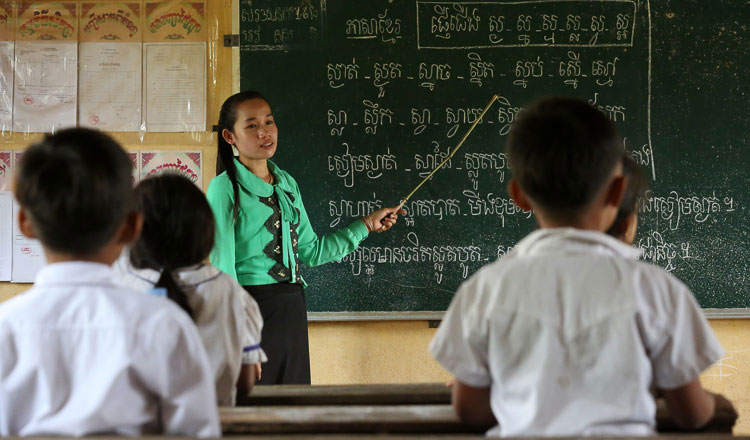 Teachers must move from being transmitters of knowledge to facilitators of learning to equip students with future-ready skills. KT/Chor Sokunthea
#editorial
The World Economic Forum 2025 report shows that the global labour market will be transformed by five major forces by 2030: technological change, geoeconomic fragmentation, economic uncertainty, demographic change, and the green transition. The report is based on a survey of more than 1,000 employers, representing over 14 million workers across 22 industries and 55 economies.
The most important finding is that the world is entering a period of large-scale job transformation, not simply job loss.
By 2030, the report estimates that about 170 million new jobs will be created while 92 million jobs will be displaced, resulting in a net gain of around 78 million jobs. However, this positive outlook depends heavily on whether workers can acquire new skills fast enough.
The fastest-growing jobs are mainly in technology, data, AI, cybersecurity, software development, green energy, environmental engineering, logistics, care services, and education.
Jobs such as AI and machine learning specialists, big data specialists, fintech engineers, software developers, renewable energy engineers, environmental engineers, nurses, social workers, and teachers are expected to grow.
By contrast, routine and repetitive jobs such as data entry clerks, bank tellers, cashiers, administrative assistants, postal clerks, and some accounting or clerical roles are expected to decline because of digitaliSation, automation, and AI.
The report stresses that skills are changing rapidly. Around 39% of workers’ current skills are expected to be transformed or become outdated by 2030.
The most important future skills include analytical thinking, resilience, flexibility, agility, leadership, social influence, creative thinking, AI and big data, cybersecurity, technological literacy, curiosity, and lifelong learning.
This means education systems can no longer focus only on memorisation and examination performance. They must prepare students to think, adapt, create, communicate, and work with technology.
The report sends a clear message: education must shift from knowledge transmission to capability formation. The future economy will reward people who can solve problems, use digital tools, work with AI, adapt to change, and continue learning throughout life.
For countries such as Cambodia and other developing economies, this is especially important. A young population can become a demographic dividend only if education produces a skilled, productive, and adaptable workforce. Otherwise, youth unemployment, underemployment, and skills mismatch will become major social and economic risks.
What education reform must do
First, curriculum reform must focus on future-ready skills. Schools should integrate digital literacy, AI literacy, coding, data analysis, financial literacy, environmental literacy, entrepreneurship, communication, teamwork, and problem-solving across subjects.
Second, STEM education must be strengthened, but not in isolation. Science, technology, engineering, and mathematics should be connected with creativity, ethics, social responsibility, and practical problem-solving. The future requires not only engineers and programmers, but also responsible innovators who understand society, environment, and human needs.
Third, technical and vocational education must be upgraded. Future jobs will grow in logistics, renewable energy, advanced agriculture, construction, digital services, healthcare, and manufacturing. TVET should be modernised through industry partnerships, updated equipment, workplace learning, apprenticeships, and certification systems that are recognised by employers.
Fourth, AI and digital tools must be integrated into teaching and learning. Students should learn how to use AI responsibly for research, writing, coding, design, translation, simulation, and problem-solving. Teachers also need training to use AI to improve lesson planning, assessment, feedback, and personalied learning.
Fifth, teacher training must become the heart of education reform. Teachers must move from being transmitters of knowledge to facilitators of learning. They need continuous professional development in digital pedagogy, inquiry-based learning, project-based learning, critical thinking, and student mentoring.
Sixth, assessment systems must change. Exams should not only test memory. They should assess analytical thinking, creativity, communication, collaboration, digital competence, ethical reasoning, and real-world problem-solving. Project-based assessment, portfolios, presentations, research tasks, and practical assignments should be expanded.
Seventh, lifelong learning must become a national system. Since many workers will need reskilling and upskilling by 2030, education cannot stop at graduation. Governments, schools, universities, and companies should work together to provide short courses, micro-credentials, online learning, professional certificates, and adult learning programmes.
Eighth, education must be linked more closely with industry. Schools and universities should regularly consult employers to understand labour-market needs. Internship programmes, career guidance, industry advisory boards, innovation labs, and school-enterprise partnerships should become part of the education ecosystem.
-Khmer Times-