Cambodia must learn to think like a maritime state
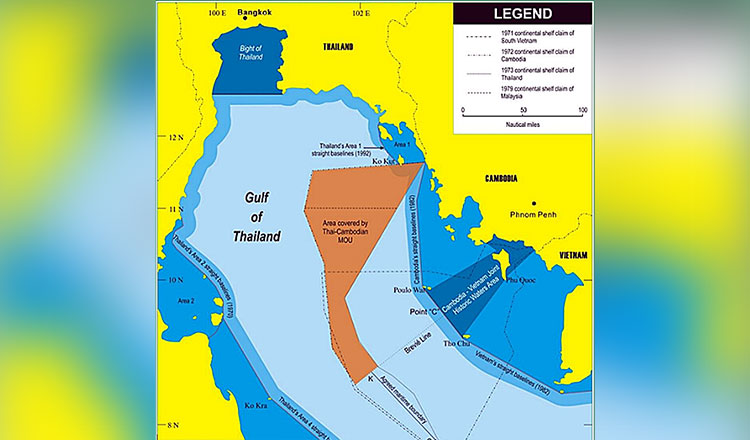 Map shows the Cambodia-Thailand overlapping claims area in the Gulf of Thailand. Arsana and Schofield
#opinion
Cambodia has long understood national security through the memory of land. This instinct is natural. Much of Cambodia’s historical trauma was suffered on land—through invasion, occupation, and civil war. But the next test of Cambodian sovereignty, prosperity, and resilience will increasingly come from the sea.
At the April 27 United Nations Security Council’s high-level open debate on “Safety and Protection of Waterways in the Maritime Domain”, Senior Minister and Special Envoy Sok Siphana captured the issue clearly. “Safe and secure waterways,” he said, are essential to “peace and security, sustainable development, and global economic stability.”
Cambodia reaffirmed its commitment to the UN Convention on the Law of the Sea, peaceful dispute settlement, freedom of navigation, lawful transit passage, and protection of seafarers. It called for stronger technical assistance for developing coastal states, including capacity-building in maritime law enforcement, port and vessel security, maritime domain awareness, and information-sharing.
This message matters because the sea is now the bloodstream of the global economy. More than 80% of global trade moves by sea, and Southeast Asia is one of the world’s most important maritime crossroads. A single disruption in a major waterway can shake supply chains, raise insurance costs, interrupt energy flows, and weaken economic confidence.
Maritime security today is no longer only about pirates or naval clashes. It is about ports, drones, cyber systems, insurance, fisheries, shipping, energy, criminal networks, and human trafficking.
Cambodia is not a great maritime power. But it is a maritime state. Its coastline stretches roughly 435 kilometres, and its exclusive economic zone covers about 55,600 square kilometres.
Sihanoukville is the country’s main gateway to global trade. Koh Kong, Kampot, and Kep form a strategic coastal belt linking tourism, fisheries, logistics, energy, environmental protection, and national defence.
The Funan Techo Canal, connecting the Mekong River system to the sea through Kampot, will further strengthen Cambodia’s land-sea connectivity and reshape its strategic geography.
Yet Cambodia still suffers from what maritime scholars call “sea blindness”—the habit of prioritising land security while underestimating maritime vulnerabilities. This blind spot must be overcome.
The first challenge is sovereignty.
Cambodia faces sensitive maritime boundary issues and overlapping claims. These involve resources, history, nationalism, legal interpretation, and political will.
Cambodia’s position is clear and consistent: maritime disputes must be settled peacefully through dialogue, diplomacy, and international law. But we need to accept that principle without capacity is fragile.
The reported Thai move to terminate the 2001 Memorandum of Understanding on overlapping claims with Cambodia creates uncertainty and instability. Thailand might use force to change the status quo as it did on the land border.
Against this backdrop, Cambodia must respond with robust diplomacy and legal preparedness while swiftly building credible maritime deterrence capabilities.
The second challenge is illegal, unreported, and unregulated (IUU) fishing. IUU fishing is not only an environmental issue. It is an economic, social, and sovereignty issue. It depletes fish stocks, damages marine ecosystems, weakens coastal livelihoods, and creates tension among neighbouring states.
In Southeast Asia, IUU fishing is often driven by weak enforcement, poor fisheries management, disputed boundaries, poverty among fishers, overcapacity, and strong market demand.
For Cambodia, protecting fisheries means protecting food security, coastal communities, and national jurisdiction.
The third challenge is transnational crime.
The maritime domain is attractive to criminal networks because it is vast, difficult to monitor and institutionally fragmented. Smuggling, drug trafficking, illegal migration, forced labour, and human trafficking often exploit the gaps between land and sea agencies.
IUU fishing can also be linked to forced labour and trafficking, with victims often coming from vulnerable communities in the Mekong region. Maritime security, therefore, must also be understood as human security as well.
Cambodia’s policy agenda on maritime affairs should focus on four pillars.
First, Cambodia must modernise its maritime forces. This does not mean militarising the Gulf of Thailand or provoking neighbours. It means building credible, defensive, and professional capability.
Cambodia needs patrol vessels suited to its waters, coastal radar, maritime surveillance, secure communications, maritime intelligence, trained crews, maintenance capacity, and rapid-response units.
A small state does not need a large navy. It needs a smart navy—one that can see, communicate, patrol, deter, and respond. Cambodia is compelled t to develop a drone ecosystem and anti-ship missile system to protect its maritime sovereignty.
Second, Cambodia must strengthen maritime infrastructure.
Ships alone do not create maritime power. Ports, naval facilities, repair yards, fuel storage, coastal logistics, search-and-rescue centres, emergency medical response, data systems, and interagency command centers are equally important.
Without infrastructure, vessels cannot operate. Without maintenance, equipment becomes symbolic. Without data-sharing, agencies work blindly. In this connection, the Ream naval bases and other future bases must be developed and modernised.
Third, Cambodia needs a whole-of-government maritime security framework.
The navy, maritime police, fisheries administration, customs, immigration, port authorities, provincial administrations and ministries must work from one shared maritime posture and positioning.
Cambodia needs clear mandates, regular coordination, accountable enforcement, and a national maritime strategy. The private sector must also be included. Shipping companies, insurers, logistics operators, and port managers can strengthen reporting, early warning, cyber resilience and emergency preparedness.
Fourth, Cambodia should establish a maritime research centre, a national brain trust on maritime affairs.
Its mandate should include maritime boundary studies, UNCLOS analysis, maritime security, IUU fishing, trafficking routes, port security, naval modernisation, maritime law enforcement, blue economy strategy, marine environmental protection, and international maritime cooperation.
It should train young specialists, support crisis simulations, and connect Cambodian experts with regional and international networks.
The deeper issue is that Cambodia’s maritime challenge is not only a capability gap. It is also a governance gap, a knowledge gap, and a strategic culture gap.
Cambodia must become a maritime-aware state. The sea offers opportunity: trade, tourism, food, energy, connectivity, and regional influence. But it also brings risk: territorial pressure, illegal fishing, trafficking, smuggling, environmental damage, and strategic competition.
Sovereignty must be defended on land, in the air, in cyberspace—and at sea. Cambodia must invest in maritime domain awareness and capacity.
Chheang Vannarith is Chairman of National Assembly Advisory Council. The views expressed here are his own.
-Khmer Times-