Thailand Should Not Let Nationalism Sink Cooperation in the Gulf
 Thailand Should Not Let Nationalism Sink Cooperation in the Gulf
#opinion
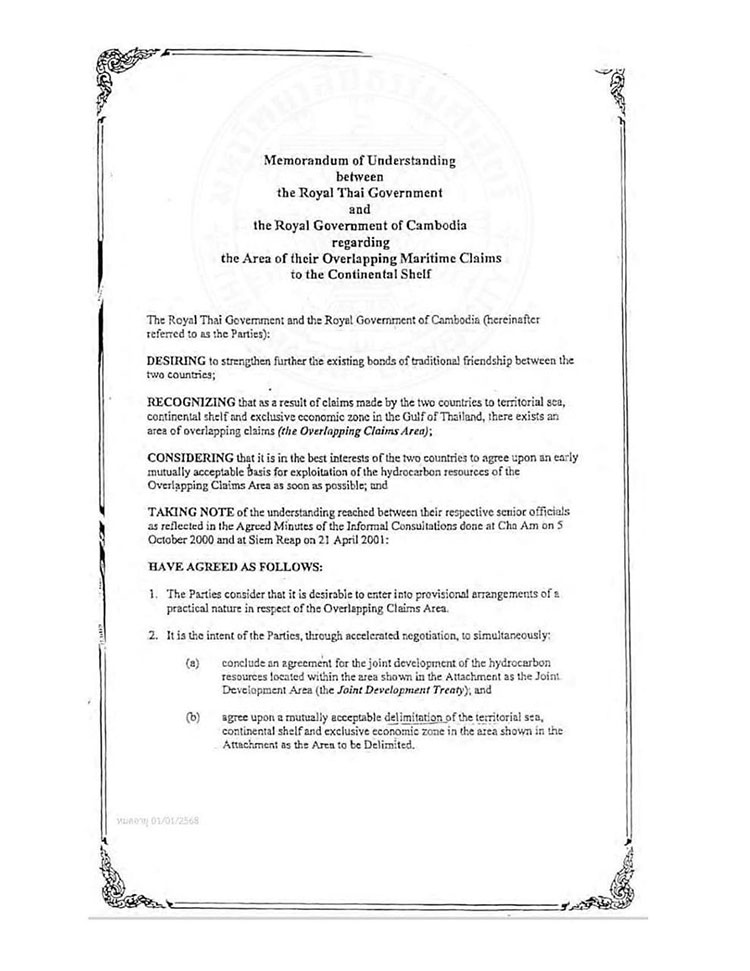
Thailand’s reported push to revoke the 2001 Memorandum of Understanding on maritime cooperation with Cambodia is more than a legal or technical matter. It is a test of whether Thailand will choose responsible statecraft or nationalist theatre.
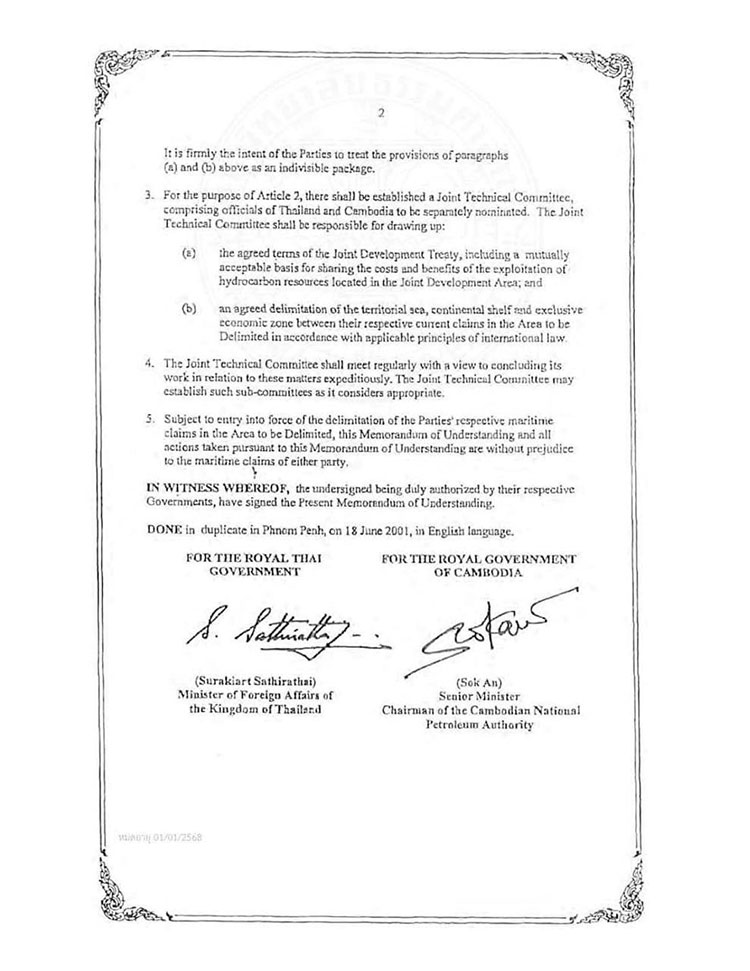
For more than two decades, the 2001 MOU has served as the only bilateral framework through which Cambodia and Thailand could manage their overlapping maritime claims in the Gulf of Thailand. The agreement was designed to pursue two important goals together: maritime boundary delimitation in accordance with international law, and cooperation for joint development of potential resources in the overlapping claims area. Cambodia has rightly reaffirmed its commitment to this framework and warned that a unilateral Thai withdrawal would be “deeply regrettable.”
Thailand should reconsider. The 2001 MOU does not surrender Thai sovereignty. Nor does it surrender Cambodian sovereignty. It is not a concession by one side to the other. It is a diplomatic instrument created precisely because both countries have competing claims and because neither side can solve such a sensitive issue through slogans, pressure, or unilateral action. The MOU recognizes a simple truth: neighbors must negotiate, not dictate.
To revoke this agreement in the name of nationalism would not strengthen Thailand’s position. It would weaken trust, damage Thailand’s international credibility, and create a diplomatic vacuum. Even Thai experts have warned that revocation may not solve the dispute and could instead create uncertainty unless a replacement framework is agreed by Cambodia as well.
Cambodia and Thailand are not distant rivals. They are neighbors bound by geography, history, trade, security, and people-to-people relations. A maritime dispute should not be turned into a domestic political weapon. Nationalist rhetoric may win applause for a moment, but it cannot draw a maritime boundary, unlock resources, attract investors, or build lasting peace.
The Gulf of Thailand should be a sea of cooperation, not confrontation. The overlapping claims area (OCA) is believed to hold significant energy potential, and responsible joint development could benefit both countries. For Cambodia, it could support national development and energy security. For Thailand, it could provide another source of economic and energy stability. For both peoples, it could transform a long-standing dispute into shared prosperity.
That is why the 2001 MOU remains important. It keeps the door open. It gives both sides a peaceful mechanism. It allows legal and technical experts to continue their work. It prevents unilateralism from replacing dialogue. Most importantly, it reflects the cooperative spirit that two civilized neighbors should uphold.
If Thailand walks away from the MOU, what message does it send? That bilateral commitments can be discarded when domestic politics become inconvenient? That negotiation is useful only when it favors one side? That international law should be invoked selectively, while existing agreements are abandoned?
Cambodia has made clear that it remains committed to resolving overlapping maritime claims peacefully and in accordance with international law. This is not weakness. It is maturity. It is the conduct of a responsible state that believes disputes should be settled through law, diplomacy, and mutual respect.
Thailand’s leaders should resist the temptation to let nationalism dictate maritime policy. True patriotism is not measured by tearing up agreements. True patriotism is measured by protecting national interests wisely, peacefully, and sustainably. A responsible government does not inflame public emotion; it guides public understanding. It does not create a vacuum; it builds a path forward.
The 2001 MOU is not perfect. No framework dealing with complex maritime claims is ever perfect. But it is better than uncertainty. It is better than escalation. It is better than starting from zero after 25 years of diplomatic effort.
Cambodia and Thailand have a choice. They can allow nationalism to turn the Gulf into another arena of suspicion, or they can preserve the MOU as a foundation for negotiation, joint development, and peaceful coexistence.
Thailand should choose cooperation. It should honor the 2001 MOU, return to sincere dialogue, and prove that its regional leadership is grounded not in unilateral gestures, but in good faith, international law, and respect for its neighbor.
The sea between Cambodia and Thailand should not divide the two nations. With wisdom and restraint, it can become a shared bridge of peace, prosperity, and mutual benefit.
Roth Santepheap is a geopolitical analyst based in Phnom Penh. The views expressed are his own.
-Khmer Times-