Cambodia–China Ironclad Friendship in the New Era: Win-Win Cooperation and Shared Prosperity
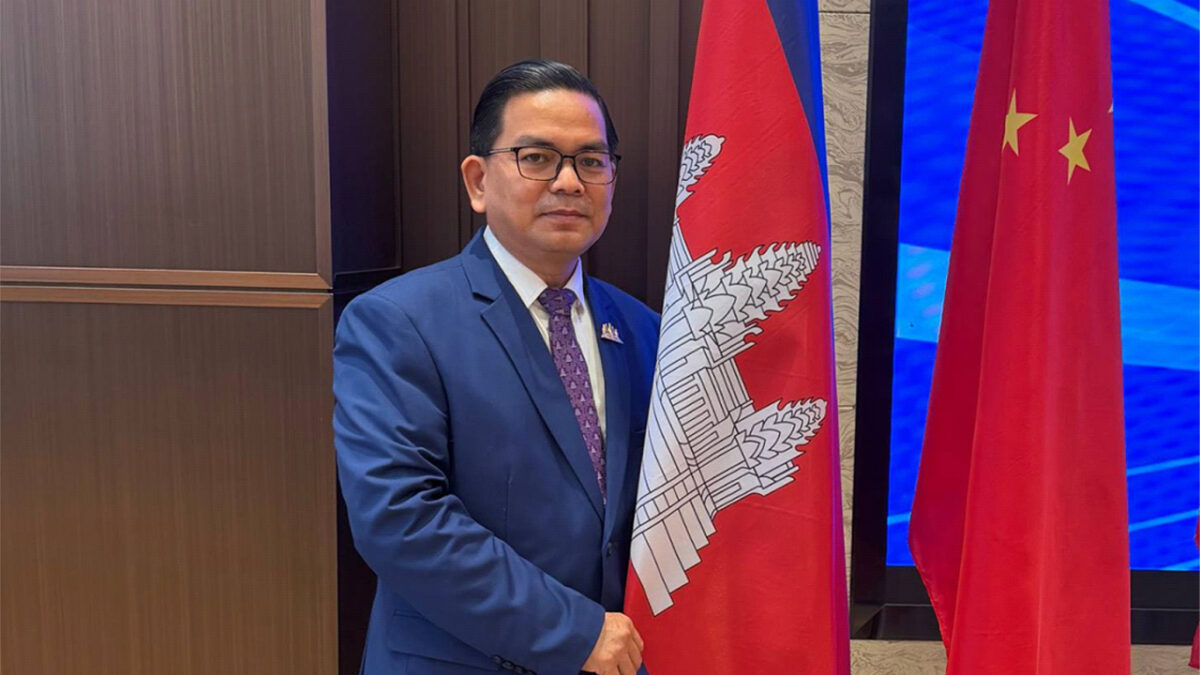 Dr. Kin Phea is director of the International Relations Institute at the Royal Academy of Cambodia. Supplied
Today, I speak not of abstract diplomacy, but of a living model — the Cambodia–China ironclad friendship in the new era. A partnership that is not only enduring, but evolving; not only strategic, but transformative. I argue that this relationship offers compelling evidence that win-win cooperation is not a slogan — it is a pathway to shared prosperity.
Ironclad Friendship in a New Strategic Phase
Just days ago in Phnom Penh, Cambodia and China held the inaugural “2+2” Strategic Dialogue between our foreign and defence ministers. This was not a routine diplomatic event — it was a structural upgrade of our relationship, integrating diplomacy, defence and increasingly public security cooperation into a coordinated strategic platform.
This mechanism reflects a deeper truth: “Ironclad” means resilience under pressure. It means trust that transcends geopolitical turbulence.
After 68 years of diplomatic relations, our partnership has entered a new phase — more institutionalised, more comprehensive and more security-responsive.
At the core of this evolution lies the Diamond Hexagon Cooperation Framework, a six-pillar architecture covering political cooperation, production capacity, agriculture, energy, security and people-to-people exchanges. This is not just a framework — it is a blueprint for long-term strategic alignment, linking China’s Belt and Road Initiative with Cambodia’s Pentagonal Strategy.
From Vision to Reality: Shared Prosperity in Action
Speeches are measured in words — but partnerships are measured in livelihoods.
First, the economic reality: Despite global headwinds, bilateral trade reached over $19 billion in 2025, with China remaining Cambodia’s largest trading partner. The Cambodia–China Free Trade Agreement has unlocked thousands of tariff lines, allowing Cambodian agricultural products — from rice and bananas to mangoes and pepper — to reach Chinese markets at unprecedented scale.
Second, the connectivity reality: Infrastructure cooperation with China has transformed Cambodia’s economic geography. The Phnom Penh–Sihanoukville Expressway has reduced travel time from five hours to under two. Corridor development is strengthening regional integration. With several seaports and China-supported inland waterways under construction linking the Mekong to the sea, Cambodia is reducing logistics costs and transit time.
Third, the people-centred reality: At the Sihanoukville Special Economic Zone, over 45,000 Cambodians are employed across more than 200 enterprises. In agriculture, technology transfer under bilateral cooperation has increased yields significantly, lifting thousands of families above the poverty line.
This is not dependency.
This is capacity-building.
This is development with dignity.
Security, Trust, and Strategic Balance
Our cooperation is also expanding into the domain of security and governance, responding to emerging challenges.
Through the new strategic dialogue mechanisms, both sides have agreed to jointly combat telecom fraud, online gambling and cyber threats, while strengthening law enforcement cooperation. This demonstrates that our partnership is not only about growth — but also about stability and resilience.
At the same time, Cambodia remains firmly committed to an independent and balanced foreign policy.
Ironclad friendship does not mean uniformity. It means mutual respect for sovereignty and core interests.
Cambodia consistently supports peaceful dialogue, ASEAN centrality and a rules-based regional order. Our cooperation with China complements — not contradicts — our principle of being a “friend to all”.
Addressing Perceptions with Clarity and Confidence
I am aware that questions are often raised: Is this relationship balanced? Is it sustainable?
My answer is clear: Win-win does not mean equal in every transaction — it means mutual benefit over time.
Cambodia benefits from investment, technology and market access. China benefits from a stable, reliable partner at the heart of Southeast Asia. But beyond material gains, what sustains this partnership is trust.
That said, sustainability requires strategic management. As highlighted by Cambodian scholars, we must remain attentive to challenges — such as economic overdependence, environmental risks and geopolitical sensitivities — and address them through diversification, transparency and balanced diplomacy.
This is precisely where think tanks play a vital role: to provide evidence-based analysis, to clarify misunderstandings, and to ensure that cooperation remains inclusive, sustainable and nationally beneficial.
Conclusion: Intertwined Futures
By 2030, Cambodia aims to graduate from Least Developed Country status and become an upper-middle-income economy. China, meanwhile, advances toward the realisation of socialist modernisation. These journeys are not parallel. They are intertwined.
As scholars and practitioners, our responsibility is to ensure that this partnership continues to evolve — toward new frontiers such as digital economy cooperation, green development and regional connectivity.
Confucius reminds us: “The noble person seeks harmony, not uniformity”.
In Cambodia, we say: “A good harvest depends on shared water”.
China and Cambodia have shared that water. We have built the channels of cooperation. And in this new era, we will harvest together.
Dr. Kin Phea is director of the International Relations Institute at the Royal Academy of Cambodia. The views and opinions expressed are his own.