Calls to safeguard peace on Khmer Rouge anniversary
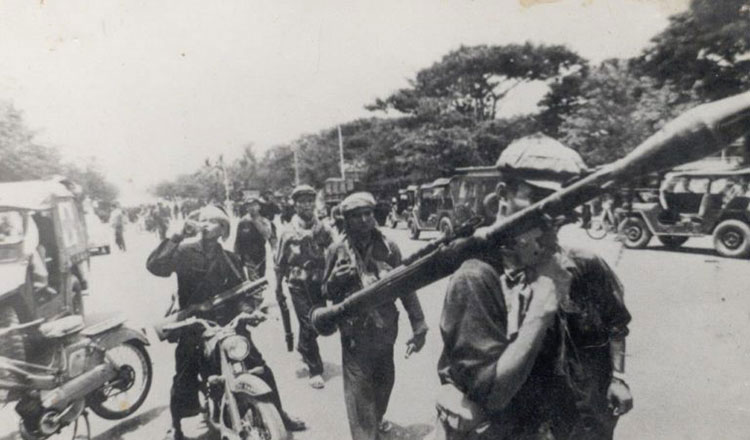 Khmer Rouge soldiers take over Phnom Penh on April 17, 1975. Tuol Sleng Genocide Museum Archives
#National
Synopsis: Kingdom commemorates the 51st anniversary of the feared Communist regime’s rise to power on April 17, with officials, analysts and opposition parties underscoring the importance of peace, justice, and national reconciliation.
Cambodians remembered the atrocities of the Democratic Kampuchea, better known as the Khmer Rouge, while underscoring the need for peace, justice and national reconciliation, as the country marked the 51st anniversary of the notorious regime’s rise to power on April 17.
The date marked over five decades of the Khmer Rouge’s capture of Phnom Penh, initiating a four-year reign of terror (1975–1979) that killed about 1.5 to 2 million people, or about a fourth of Cambodia’s population.
The Documentation Centre of Cambodia (DC-Cam) has extensive records of the Khmer Rouge period (1975–1979). Established in 1995, it has since grown into the world’s largest archive of original materials from the era.
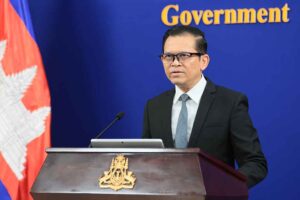
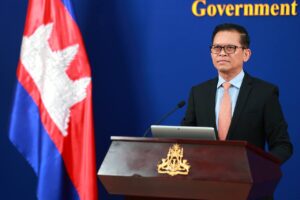
In an anniversary message, Information Minister Neth Pheaktra, a former spokesman for the Extraordinary Chambers in the Courts of Cambodia (ECCC), a “hybrid” court set up in 2006 to try senior leaders of the Khmer Rouge, said the date “brought about one of the darkest tragedies in Cambodia’s history and is a deeply painful day for the entire Khmer nation,” adding that millions lost their lives while many others endured severe suffering.
He said survivors of the regime faced trauma from torture and starvation.
Pheaktra pointed to the liberation of Cambodia on January 7, 1979, led by the Kampuchean United Front for National Salvation with the support of Vietnamese volunteer forces, as “a historic turning point” that saved the nation from genocide.
He credited the “Win-Win policy” of former Prime Minister Hun Sen with dismantling the vestiges of Khmer Rouge political and military structures, bringing what he described as “full peace” to Cambodia.
“We remember the past to protect peace, uphold justice, and build a future free from genocide,” he said.
Pheaktra, former spokesman for the Khmer Rouge Tribunal, which concluded judicial proceedings on September 22, 2022, after 16 years of operation, also recalled the November 2018 verdict in Case 002/02, in which senior Khmer Rouge leaders Nuon Chea and Khieu Samphan were given life in jail.
Samphan is the only surviving Khmer Rouge leader serving life in prison. He was arrested by co-investigating judges of the Khmer Rouge Tribunal on November 19, 2007.
The Tribunal delivered a landmark—though limited—measure of justice by convicting senior Khmer Rouge figures, including Kaing Guek Eav, former head of the S-21 Security Centre, Nuon Chea, and Samphan, for crimes against humanity and genocide committed between 1975 and 1979.
The ruling Cambodian People’s Party marks January 7 as “Victory Day” (or Liberation Day), commemorating the 1979 overthrow of the Khmer Rouge regime, which it regards as the nation’s “second birthday”.
Political scientist Kin Phea said April 17, 1975 marked the end of the US-backed Khmer Republic, as Lon Nol’s soldiers laid down their weapons.
Phea, Director-General of the Royal Academy of Cambodia’s International Relations Institute of Cambodia, added that the Khmer Rouge implemented an unprecedented and unusual governing policy in human history. As a result, nearly two million Cambodians died of disease caused by a lack of medicine and healthcare, starvation, mass killings, or forced overwork.
The political scientist said Pol Pot launched a Four-Year Plan, under which Cambodia pursued its “Super Great Leap Forward” towards socialism by 1979. His goal was to increase rice production to three tonnes per hectare by opening new farming zones in forested and malaria-prone areas in the northeast.
Those forced out of cities were labelled “new people” or “April 17 people”, required to abandon their past, and sent to remote areas to dig canals, build dams, and clear land.
He added that the Khmer Rouge claimed that only “pure” people were fit to build the revolution.
Immediately after taking power, the regime executed thousands of soldiers, officers, and civil servants of the Khmer Republic. Over the next three years, the regime killed hundreds of thousands of intellectuals, urban residents, and ethnic minorities such as the Cham, Vietnamese, and Chinese. Even their own soldiers and party members were labelled spies and killed.
Phea said: “After half a century, I still do not understand why the Khmer Rouge killed their own people and destroyed their own nation to this extent. Was there a foreign force behind it? Was it ideological conflict or personal vendetta? If it was personal, why was it so extreme?”
He added that in Cambodian history, no regime had killed more intellectuals than the Khmer Rouge, which survived only three years, eight months, and 20 days.
-Khmer Times-