Sovereignty, Society and Strategic Continuity: The Imperative of Domestic Normalcy Amid Border Tensions
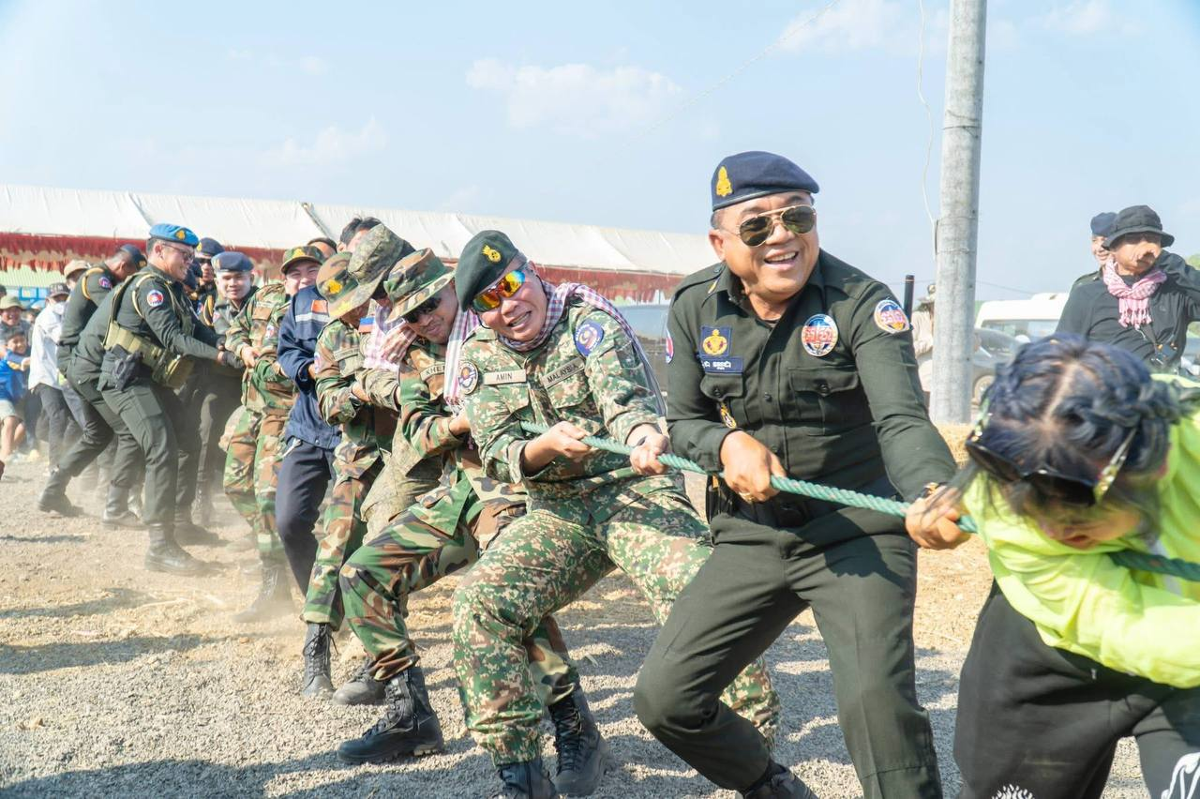 AOT team members were invited to play traditional games during Khmer New Year, at temporary shelters for displaced people in Banteay Meanchey province. Oum Reatrey
The recent observance of the traditional Khmer New Year occurred against the backdrop of ongoing border frictions with Thailand, sparking a rigorous domestic debate on how a nation should conduct itself during times of external pressure.
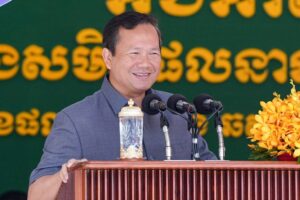
Senate president Hun Sen’s assertion that a wound on one little finger should not make the entire body disabled encapsulates a pragmatic reality of governance. Analysed independently through the lens of institutional statecraft, this discourse highlights a fundamental challenge for any developing democracy: the delicate task of balancing the rigid imperatives of national security with the absolute necessity of socio-economic stability.
The Validity of Civic Patriotism
To evaluate this situation objectively, one must first acknowledge and respect the profound validity of the public’s anxiety. Voices questioning the appropriateness of nationwide festivities while border forces and displaced citizens face hardship are not mere political noise; they are driven by a deep-seated patriotism and genuine solidarity with those on the front lines.
In any maturing political landscape, public scrutiny of border management serves a necessary civic function. The citizenry’s expectation that the state remains hyper-vigilant, transparent and fiercely protective of its territorial integrity is legally and morally justified. However, this civic passion must recognize that Cambodia’s commitment to its sovereignty remains absolute. The state is actively and vigorously protecting its territories — not through reactive posturing, but by utilising every legal, peaceful and diplomatic mechanism available under international law. Policymakers must view this public pressure not as a nuisance, but as a testament to the nation’s collective resolve, a resolve the state continuously translates into steadfast diplomatic defence.
Crucially, both the state and the citizenry must recognise that this collective vigilance is not a political vulnerability, but a profound strategic asset. Patriotism is the highest civic morality a sovereign nation can cultivate. For Cambodia to navigate an increasingly complex geopolitical landscape, it absolutely requires a populace that fiercely values its territorial and cultural integrity. An indifferent citizenry is the first symptom of a decaying state; conversely, a public that passionately scrutinises its borders is demonstrating the exact civic virtue required for national survival. The government, therefore, must not interpret this patriotic fervour as mere opposition, but as the foundational moral imperative that binds the nation together. It is this shared, unyielding dedication to the state that ultimately fortifies Cambodia against any external pressure, proving that a demanding public is exactly what a strong Cambodia desires and must have.
The Architecture of Border Diplomacy
However, channelling this patriotism constructively requires managing public expectations regarding how international friction is legitimately resolved. There is a common public tendency to conflate diplomatic patience with inaction. When border tensions arise, the immediate societal impulse is often to demand swift, visible retaliation or to halt daily life in a display of national mourning.
From a legal and geopolitical standpoint, this impulse, while understandable, is strategically flawed. Modern geopolitical disputes are notoriously protracted. Border demarcations and localised frictions are governed by complex historical treaties, bilateral mechanisms and international legal frameworks. They demand meticulous diplomatic strategy, evidentiary precision and institutional fortitude.
Patriotism demands vigilance; statecraft demands patience. Geopolitics is won through institutional endurance, not emotional reaction.
Demanding that the public halt its normal life misunderstands how mature states manage conflict. A government’s legal and constitutional mandate is to absorb these localized shocks at the institutional level, insulating the broader population so that the country can continue to function, negotiate and enforce its rights from a position of strength.
The Macroeconomic Engine of National Defence
Furthermore, the proposition that domestic celebrations and economic activities should be suspended in solidarity with frontline troops fails the test of macroeconomic viability. Cambodia is a dynamic nation of over 17 million people. Deliberately stalling domestic commerce, pausing the education system and halting social activity out of a sense of crisis would induce artificial economic paralysis.
In geopolitical terms, allowing localised border friction to trigger a national economic shutdown hands a strategic victory to external adversaries. A paralysed nation cannot defend its borders; our greatest defence is unstoppable domestic momentum. National defence is not funded by public anxiety; it is sustained by economic output. A weakened domestic economy directly undermines the state’s fiscal capacity to sustain border defence, equip its military, and support displaced populations. Maintaining socio-economic vitality during the Sankranta period is not a distraction from national security — it is the economic engine that makes the defence of sovereignty possible.
Cultural Continuity as Strategic Defiance
Engaging in the centuries-old tradition of the Khmer New Year also serves a highly strategic societal purpose: it acts as a form of cultural protectionism and strategic defiance. Critics who equate celebratory citizens to carefree grasshoppers fundamentally misunderstand the psychology of national resilience.
When a nation faces external pressure, proceeding with its cultural traditions signals unshakeable institutional strength to both domestic citizens and international observers. It demonstrates that the Cambodian state and its people possess the administrative and social capacity to manage localised conflicts without allowing them to dictate or destabilise the national way of life. A populace that remains united in its cultural identity is far more formidable than one divided by fear, outrage and economic stagnation.
A Unified Posture
Ultimately, national security and domestic prosperity are deeply interdependent. An objective legal and political assessment dictates that a nation does not have to choose between being vigilant at its borders and remaining active within them. The most effective defence strategy for Cambodia does not operate in extremes. It is a strategy that combines unyielding diplomatic and military vigilance with uninterrupted economic and cultural vitality. By keeping markets open, advancing education and celebrating its heritage, Cambodia defends its sovereignty not just with troops on the border, but with the unstoppable momentum of a functioning, prosperous society.
Panhavuth Long is founder and attorney-at-law of Pan & Associates Law Firm. The views and opinions expressed are his own.