Terror as a Russian strategy: Ukraine between missiles and disinformation
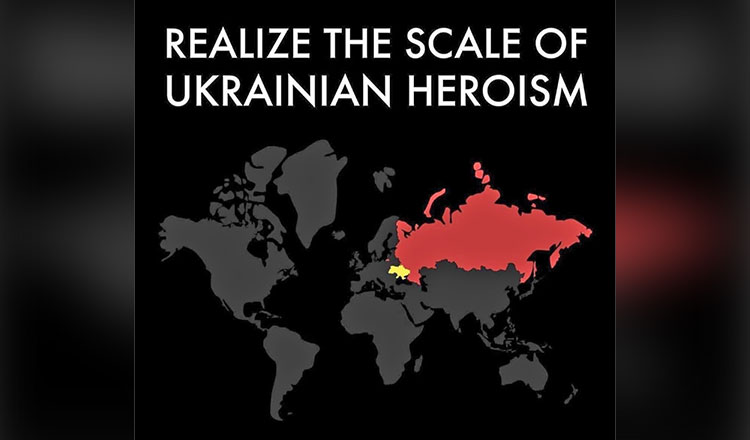 For four years now, Ukraine has been battling a far larger, richer, and more populous neighbour. Khmer Times illustration
#opinion
Ukraine is entering the fifth year of Russia’s full-scale invasion at a time when the global security system is in deep crisis. This war has long gone beyond a purely military confrontation. It has become a test for international law, for the principle of state sovereignty, and for the world’s ability to distinguish aggression from propaganda disguise.
Despite its clear advantage in territory, resources, and military power, Russia has failed to achieve its strategic goals. Unable to break Ukraine’s defence, it turned to systematic terror against civilians. Massive attacks on energy infrastructure during winter, when temperatures fall to -20C, strikes on residential areas, hospitals, and schools all serve one purpose: to spread fear, exhaust society, and undermine the country’s internal resilience. This is neither accidental damage and nor “side effects of war”. It is a deliberate strategy of terror aimed at forcing Ukraine to surrender.
Millions of Ukrainian families are left without electricity, without heating or water, for 20 to 22 hours a day. Hospitals, maternity wards, kindergartens, and schools are freezing and operating on emergency generators or forced to shut down. In many homes, cold has become a permanent reality.
And yet, Ukraine has not broken—and will not break.
What is happening in Ukraine is neither a “special military operation” nor a “local conflict”, as Russia tries to present it. It is a full-scale war accompanied by systematic war crimes, massive violations of international humanitarian law, and a deliberate attempt to change internationally recognised borders in Europe by force.
Russia’s aggression against Ukraine has deep historical roots. It is a continuation of a long-standing policy of denying Ukrainian statehood and the right to choose their own future. Ukraine is not a geopolitical project or an artificial construct. It is a state with its own historical tradition and a clear national identity. Ukrainians’ desire for freedom and self-determination is the real cause of this conflict. That desire directly challenges an imperial mindset that refuses to accept Ukraine’s independence and identity as a nation. History provides many examples of Russia’s imperial ambitions.
The most brutal expression of this policy was the Holodomor of the 1930s—an artificial famine created by the Soviet regime in Ukraine. It was caused by confiscation of food, isolation of entire regions, and a ban on people fleeing to survive. According to various expert estimates, between four and 10 million Ukrainians were deliberately killed as a result of this campaign. The goal was clear: to break Ukraine’s will for independence and to destroy any resistance to imperial control. This is why the Holodomor is recognised as an act of genocide.
Cambodian society knows all too well where the language of “historical necessity”,» “higher goals”, and “purification” leads, having seen how such words were once used to justify immense human suffering.
Today’s war is a direct continuation of the same logic—an attempt to destroy the Ukrainian nation, its identity, and to deny an independent state the right to exist.
For four years now, Ukraine has been resisting a state that is far larger, richer, and more populous. Russia is the largest country in the world by territory, a nuclear power with a population several times larger than Ukraine’s, and with much greater mobilisation and military resources. Geographically, Russia’s territory is about 28 times larger than Ukraine’s; demographically, its population is almost four times bigger. Militarily, Russia has a significant advantage in manpower, heavy weapons, and strategic systems, Moscow inherited after the collapse of the Soviet Union.
And yet, this huge advantage has not brought Russia the easy victory it expected over a much smaller but brave neighbour.
Four years of full-scale war clearly show that size, numbers, and resources do not guarantee success. Ukraine has managed to survive, preserve its statehood, and prove that outcomes are determined by societal motivation, quality of leadership, technological adaptability, and international solidarity. This is a clash between an imperial logic of force and a nation’s desire for freedom and self-determination.
At the same time as the military war, Russia is fighting another war—a disinformation war. Using vast financial resources, state and semi-state media networks, pseudo-expert platforms, and political proxies around the world, the Kremlin systematically spreads disinformation to justify its aggression and distort the causes of the war. Russia tries to impose a false narrative on international audiences, claiming it was “forced” to invade to protect Russian-speaking people—people whom it has in fact been killing for the past four years. It also claims that Ukraine faces a threat of “fascist ideology” and that the Ukrainian state is “artificial” or “fake”. These claims have nothing to do with reality. They are spread for one purpose only: to remove responsibility from the aggressor and weaken international solidarity with the victim.
Especially cynical is the Kremlin’s use of the term “denazification” to justify the full-scale war. Ukraine is a democratic state whose president was elected in free and competitive elections. Political pluralism and freedom of speech are core elements of its society. In reality, this war is about an empire’s deep fear of a nation that refuses to surrender.
Fear is the key to understanding Russia’s actions. Despite its vast territory, nuclear arsenal, and significant resources, Russia views a smaller Ukraine as an existential threat—a threat capable of spreading democratic values into imperial Russia and undermining the authoritarian system built over recent decades.
Russia often capitalises on the goodwill of countries that cherish the Soviet legacy, by exploiting the positive memories of past Soviet support to advance its own agenda. This selective nostalgia allows Russia to invoke familiar narratives, portraying itself as a partner standing against perceived Western dominance. However, behind these friendly gestures, Russia uses these ties to legitimise its aggressive actions, expecting silent acceptance or support from nations with historical bonds to the Soviet Union.
To those who fall for Russian propaganda portraying Ukrainians and Russians as “brotherly nations”, it must be stated clearly: we have never been brothers, nor even close relatives. Our histories, cultures, and identities are distinct. Shared governance in the past does not make us one people. Ukraine has always aspired to chart its own path, free from Russian imperial control. Today, we are defending our right to live as a sovereign nation, independent of Russian dominance.
Ukraine has proven that it is possible to resist even a much stronger enemy. Moral resilience, human solidarity, and principled commitment can restrain imperial coercion. This lesson matters far beyond Ukraine. It shapes the future of the world and the global security order.
Russian diplomats are forced, day after day, to repeat worn-out Kremlin narratives, trying to pass open propaganda as diplomacy. They speak of peace on behalf of a state that launched a full-scale war against Ukraine. They speak of sovereignty on behalf of a regime that has repeatedly crushed it with tanks and missiles. They speak of non-interference on behalf of a country that brutally and unjustifiably interfered in the internal affairs of another independent state.
Appeals to international law and the role of the United Nations sound especially offensive when the international community has repeatedly affirmed Ukraine’s sovereignty and territorial integrity and has clearly named this war for what it is—a full-scale armed aggression. Russia’s silence about this fact is not accidental. It is a deliberate attempt to mislead the international audience.
Against this background, the position of the Kingdom of Cambodia deserves special and principled respect. From the first days of the Russian invasion, Cambodia openly and clearly stated its position, without hiding behind vague expressions of “concern” or false claims of so-called “neutrality”. The country’s leadership did not pretend that “everything is complicated” or that it is impossible to distinguish the aggressor from the victim. It did not choose cynical silence, which many in the region have presented as a policy of false equidistance.
Unlike many others who hid behind general phrases, empty calls for “restraint” and rhetoric of so-called balance, Cambodia called things by their proper names and clearly and consistently condemned Russia’s armed aggression against Ukraine.
With consistency and moral resolve, Cambodia demonstrated real state leadership to much larger countries in the region. It reminded the world that the international order must be built on the power of law, not the law of power, and that the principles of international law are not optional. They cannot be bent, bargained, or selectively applied—they must be upheld without exception
In Cambodia, a country with its own tragic history, lies that portray aggression as “self-defence” and the destruction of cities as “care for civilians” do not work.
Ukraine has already proven that it can stand against a much stronger enemy. With the support of international partners, it will preserve its statehood, defend freedom, and restore justice. This struggle is not only about territory. It is about a principle: no state has the right to redraw borders by force or impose its will on others. International law cannot remain just words on paper. It must work—and it will.
Law will prevail over force, and accountability over impunity.
The author is the non-resident Ambassador of Ukraine to the Kingdom of Cambodia, based in Hanoi.
-Khmer Times-
—————–