Turning the Online Scam Crisis into an Opportunity for Korea-Cambodia Cooperation
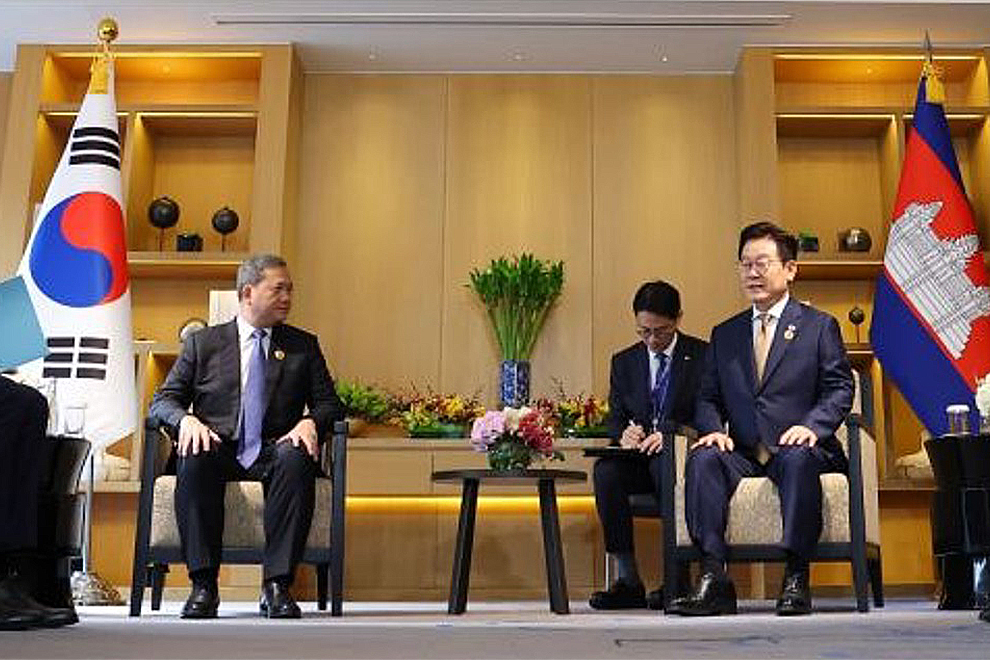 South Korean President Lee Jae-myung and Cambodian Prime Minister Hun Manet hold a summit meeting in Kuala Lumpur, Malaysia, in 2025. Yonhap News
#opinion
A recent exchange of friendly social media messages between South Korean President Lee Jae-myung and Cambodian Prime Minister Hun Manet marks a pivotal moment in bilateral relations, far surpassing routine diplomatic gestures. This interaction, centred on addressing the pervasive issue of “online scams” — a global threat that has plagued societies worldwide — exemplifies how public diplomacy can convert potential conflict into meaningful collaboration. In an era where digital crimes transcend borders, this leadership-level dialogue underscores a commitment to mutual trust and shared goals, setting a model for international partnerships.
For years, online scams have inflicted deep wounds on both South Korea and Cambodia. In South Korea, these fraudulent schemes have victimised countless ordinary citizens, from young professionals to retirees, leading to substantial financial losses and widespread public frustration.
Scammers, often operating remotely, have exploited vulnerabilities in digital platforms, eroding confidence in online transactions and fuelling demands for stronger governmental action.
Meanwhile, Cambodia has borne a disproportionate brunt of reputational harm. Despite being a victim itself — with criminal syndicates infiltrating its territory through coercion, corruption or exploitation of economic zones — the country has been unfairly stereotyped as a primary hub for such activities. This negative perception has deterred potential investors and tourists, hindering Cambodia’s economic progress and overshadowing its rich cultural heritage and developmental strides.
The roots of this crisis are not isolated to Cambodia. A UN report highlights that online scam centres are prevalent in at least four Southeast Asian nations: Thailand, Myanmar, Laos and Cambodia.
These operations, often run by transnational criminal networks, involve forced labour, human trafficking and sophisticated cyber tactics. Yet a glaring hypocrisy emerges when examining regional responses. Some neighbouring countries host the largest and most notorious scam hubs, with reports from international organisations like the UN Office on Drugs and Crime (UNODC) detailing extensive networks in border areas and urban centres.
Despite this, that country’s authorities and media have often deflected scrutiny by amplifying criticisms of neighbouring countries like Cambodia, rather than introspecting on their own systemic failures. This selective outrage not only perpetuates injustice but also undermines regional solidarity against a common foe.
Cambodia, in contrast, has emerged as a proactive victim, acknowledging the infiltration of these crimes and taking bold steps to combat them, even as it grapples with the socioeconomic fallout. Justice demands that we recognise Cambodia’s efforts and call out such double standards, ensuring that blame is apportioned fairly and solutions are pursued collectively.
However, amid these challenges, the online scam crisis has evolved into a remarkable opportunity for Korea-Cambodia cooperation. Rather than succumbing to finger-pointing or isolationism, both governments have embraced a pragmatic path of “collaboration”.
The administrations of President Lee Jae-myung and Prime Minister Hun Manet have fostered close channels of communication, viewing online scams not as a unilateral domestic problem but as a borderless transnational crime requiring joint resolve.
This shift culminated in the establishment of the “Korea-Cambodia Joint Task Force (TF)”, a robust framework that integrates police forces, intelligence agencies, and cybersecurity experts from both nations. Through the TF, real-time intelligence sharing, coordinated raids and cross-border investigations have become standard practice, disrupting scam operations at their source.
The catalyst for this momentum was the unwavering determination of the two leaders. President Lee publicly commended the Cambodian government’s steadfast dedication to crime eradication and its cooperative stance in facilitating Korean-led probes. In a reciprocal gesture, Manet expressed gratitude for South Korea’s provision of advanced technical expertise, including digital forensics tools and training programmes, as well as its unwavering trust in Cambodia’s intentions.
This high-level exchange resonated deeply with the publics of both countries, transforming narratives of suspicion into ones of alliance. It conveyed a powerful message: citizens of Korea and Cambodia are not adversaries in this fight but “reliable partners” united against a shared criminal adversary that exploits global connectivity for illicit gains.
The tangible outcomes of this partnership are already manifesting in compelling ways, both quantitatively and qualitatively.
In South Korea, data from the National Police Agency indicates a marked decline in scam incidents traced back to Cambodian origins, with victim reports dropping by over 30% in the past year alone. This reduction has alleviated public anxiety and restored faith in cross-border law enforcement. On the Cambodian side, aggressive crackdowns — supported by Korean technical aid — have led to the shutdown of numerous scam compounds, the rescue of trafficking victims and the prosecution of key perpetrators.
These actions are swiftly rehabilitating Cambodia’s global image as a “safe and investment-friendly destination”, spurring renewed interest in sectors like tourism, manufacturing and renewable energy. For a nation emerging from decades of turmoil, this cooperation has injected vital momentum into its national development agenda, fostering job creation and economic diversification.
Yet, complacency is not an option. As criminal methodologies grow more intricate — leveraging artificial intelligence, deepfakes and encrypted networks — new variants of online crime could surface unpredictably. To counter this, South Korea and Cambodia must elevate their collaboration beyond ad-hoc measures. Institutionalising judicial mutual assistance treaties, for instance, would streamline extraditions and evidence sharing.
Expanding human resource exchanges — such as joint training workshops for cyber investigators — and transferring cutting-edge digital tools could build long-term capacity. Moreover, integrating private sector involvement, like partnerships with Korean tech giants (e.g., Samsung or Kakao) and Cambodian startups, could innovate preventive solutions, such as AI-driven scam detection systems tailored to regional contexts.
This reaffirmed trust, forged in the crucible of the scam crisis, lays a sturdy foundation for broader strategic partnerships across multiple domains. Economically, enhanced cooperation could accelerate initiatives under the Korea-ASEAN Free Trade Agreement, boosting trade in electronics, agriculture and infrastructure.
Culturally, joint programs — ranging from K-pop exchanges to Khmer art exhibitions — could deepen people-to-people ties, promoting mutual understanding among youth and diaspora communities. In the energy sector, South Korea’s expertise in green technologies could support Cambodia’s transition to sustainable power sources, aligning with global climate goals.
Such multifaceted engagement not only fortifies bilateral resilience but also contributes to regional stability in Southeast Asia, where shared prosperity counters the divisiveness sown by crimes like online scams.
In essence, by confronting the online scam menace head-on, South Korea and Cambodia are scripting a narrative of triumph over adversity. This partnership exemplifies how nations can rise above victimisation — Cambodia as an unfairly maligned host and Korea as a defender of its citizens — to achieve justice and mutual benefit.
As they continue to collaborate, the shadows of distrust will dissipate, paving the way for a luminous era of Asian solidarity and progress. When two nations like these clasp hands to navigate the digital age’s perils, the promise of a harmonious, prosperous future becomes not just aspirational, but attainable.
Dr. Seun Sam is a policy Analyst with the Royal Academy of Cambodia. The views and opinions expressed are his own.
-Phnom Penh Post-
———————