Cambodia rejects Thai claims over Ta Krabey and Ta Mone temples
 Cambodia rejects Thai claims over Ta Krabey and Ta Mone temples
#National
The Ministry of Culture and Fine Arts has strongly rejected recent statements by Thailand’s Minister of Culture, reaffirming that the Ta Krabey Temple and the Ta Mone Temple Complex are located entirely within Cambodia’s sovereign territory.
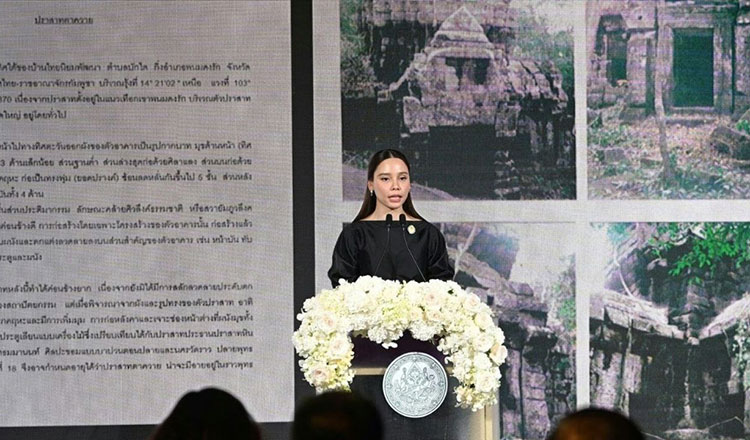
In a press statement issued today the ministry dismissed remarks made on February 6 by Sabida Thaiseth, Thailand’s Minister of Culture, who claimed that the sites—referred to by Thailand as Ta Kwai and Ta Mone—fall under Thai sovereignty.
“The Ministry of Culture and Fine Arts of the Kingdom of Cambodia firmly rejects the recent statements made on February 6, 2026,” the statement said, adding that it “categorically denies the claim that Ta Krabey Temple and the Ta Mone Temple Complex fall under Thai sovereignty.”
The ministry stressed that the temples are “located entirely within the sovereign territory of the Kingdom of Cambodia”, noting that this is clearly established by the Franco-Siamese Treaties of 1904 and 1907 and their annexed maps. It added that these legal foundations are the same ones upheld by the International Court of Justice (ICJ) in its 1962 judgement concerning the Temple of Preah Vihear.
Rejecting arguments based on Thailand’s domestic administrative actions, the ministry said, “Claims based on unilateral registrations, domestic administrative acts from 1935, or non-recognised maps hold no legal validity under international law and cannot override binding bilateral treaties.”
The statement also warned against any restoration or construction activities carried out without Cambodia’s consent, saying that “any ‘restoration’ work conducted without the consent of the territorial state constitutes a violation of the 2000 Memorandum of Understanding on Land Border Demarcation and undermines the spirit of ASEAN cooperation.”
The ministry further emphasised that cultural heritage must not be used or controlled through force, stating that “the occupation or control of cultural heritage through military presence or force is strictly prohibited under the UN Charter and the 1954 Hague Convention for the Protection of Cultural Property in the Event of Armed Conflict.”
Despite the strong language, Cambodia reiterated its commitment to peaceful and lawful solutions. “Cambodia remains committed to a peaceful, rules-based resolution,” the ministry said, calling on Thailand “to cease all unilateral activities at these sites.”
It added that if disagreements persist, Cambodia “invites a transparent and legally binding settlement through the International Court of Justice, rather than through the use of force or inflammatory rhetoric.”
The ministry stated that “the Kingdom of Cambodia remains steadfast in its duty to protect its cultural heritage and uphold the integrity of its national borders.”
-Khmer Times-