When “control” becomes seizure the legal test Thailand cannot avoid
 When “control” becomes seizure the legal test Thailand cannot avoid
#Midnight – The Quiet Catalyst
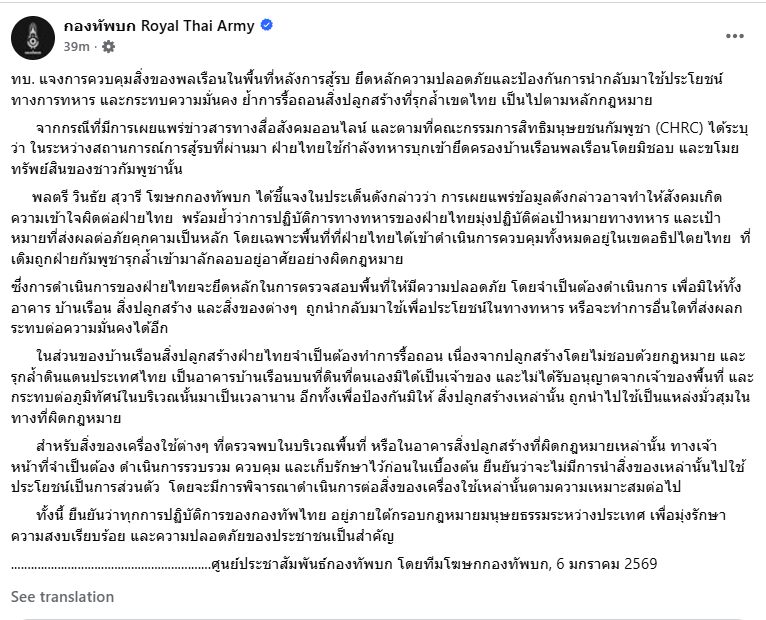
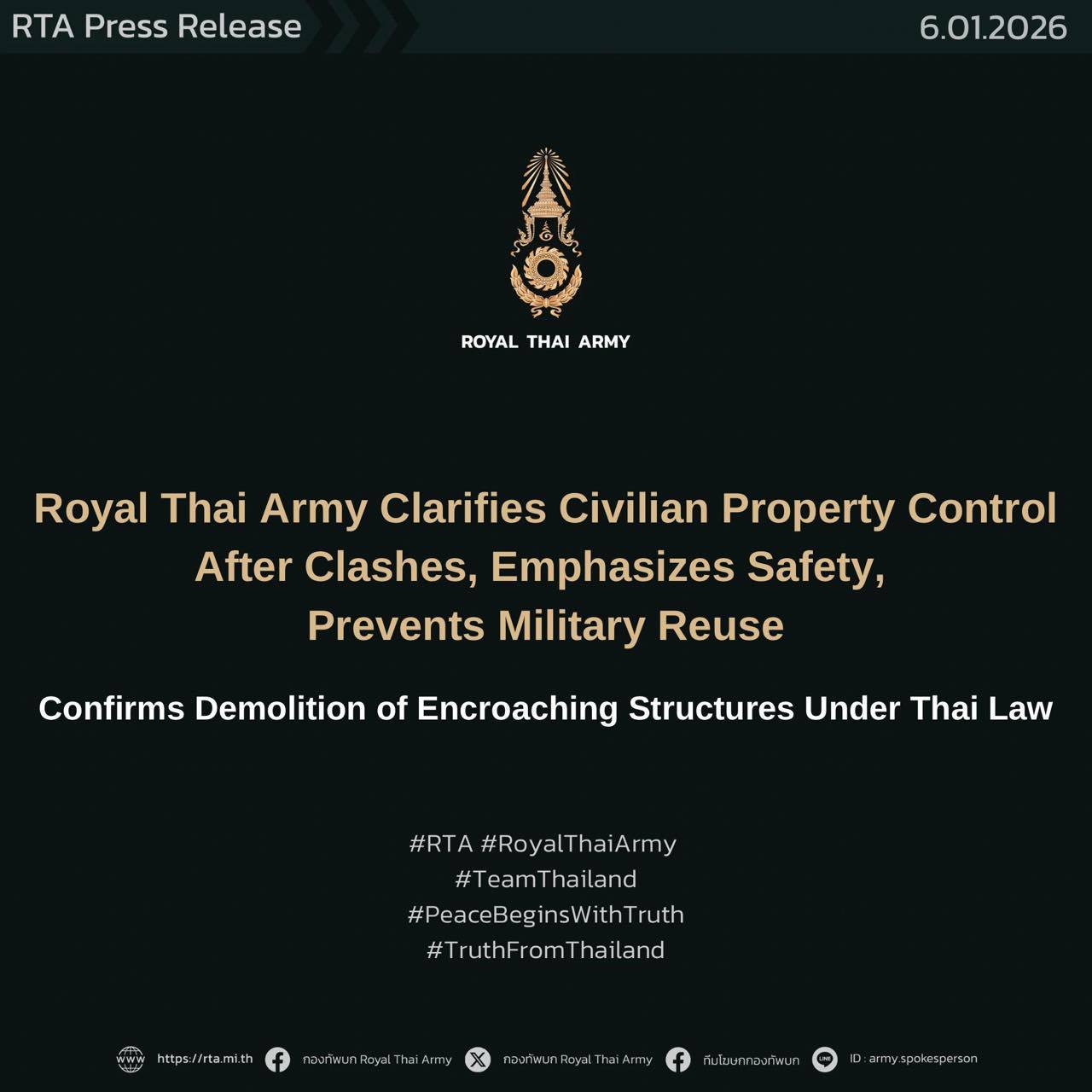
On 6 January 2026, the Royal Thai Army stated that Thai forces had collected, controlled, and stored civilian belongings found in houses and structures following fighting, arguing that this was necessary for safety and to prevent reuse for military purposes. The same statement justified the demolition of structures by asserting that they were illegal encroachments on Thai territory and that all actions were conducted in compliance with international humanitarian law. According to the Royal Thai Army public statement of 6 January 2026.
One day earlier, the Royal Thai Navy rejected reports of seizure as fake news while simultaneously confirming that valuables found would be secured and returned to lawful owners. According to the Royal Thai Navy public statement of 5 January 2026.
These statements mark a clear shift. Thailand is no longer arguing that nothing occurred. It is arguing that what occurred should be understood as lawful control. This analysis proceeds from Thailand’s own public statements and assesses them against applicable international humanitarian law. Under international law, legality does not depend on vocabulary. It depends on function, safeguards, and verifiable procedure.
Once a state invokes international humanitarian law, its conduct is judged by international humanitarian law. This applies in situations of occupation or effective control, even where sovereignty is disputed, because humanitarian protections attach to factual control rather than formal labels, as reflected in the Fourth Geneva Convention relative to the Protection of Civilian Persons in Time of War.
The Fourth Geneva Convention is explicit. “Pillage is prohibited,” as stated in the Fourth Geneva Convention relative to the Protection of Civilian Persons in Time of War, article 33. Customary international humanitarian law restates the same rule without qualification. “Pillage is prohibited,” under the ICRC Customary International Humanitarian Law Study, Rule 52.
International law does not ask whether property was taken with good intentions. It asks whether civilians were deprived of possession without transparent safeguards preventing misappropriation. When armed forces take custody of civilian property, even temporarily, the legal burden shifts to documentation. This includes inventories, chain of custody records, prohibition of private use, and a real and accessible mechanism for restitution. Without these safeguards, control becomes functionally indistinguishable from seizure.
Under international humanitarian law, exceptions based on military necessity are construed narrowly, and the burden of demonstrating necessity rests with the party invoking it. This principle governs both the taking and the destruction of civilian property under established humanitarian law doctrine.
The same evidentiary burden applies to destruction.
The Fourth Geneva Convention provides that “any destruction by the Occupying Power of real or personal property is prohibited, except where such destruction is rendered absolutely necessary by military operations,” as stated in the Fourth Geneva Convention, article 53. Customary international law mirrors this standard, allowing destruction only when it is “imperatively demanded by the necessities of war,” under the ICRC Customary International Humanitarian Law Study, Rule 50.
Civilian homes and personal belongings are civilian objects by default, and “civilian objects shall not be the object of attack or of reprisals,” as provided in Additional Protocol I to the Geneva Conventions, article 52 paragraph 1. Where destruction is claimed to be lawful, the necessity must therefore be specific, immediate, and demonstrable.
Administrative explanations such as illegality of construction, impact on landscape, or prevention of future gatherings do not, on their own, meet the international legal threshold of absolute or imperative military necessity. Where such reasons are cited alongside security claims, the distinction between administrative enforcement and wartime necessity must be clearly shown through records, not asserted through language.
International criminal law reinforces this boundary. The Rome Statute of the International Criminal Court lists as a war crime “pillaging a town or place, even when taken by assault,” as set out in the Rome Statute of the International Criminal Court, article 8 paragraph 2 subparagraph b item xvi. This is why the pairing of denial with promises of return is legally unstable. States do not design restitution systems for acts that never occurred.
International humanitarian law further requires that private property be respected and that unlawfully seized property be restored where possible, as established in the Hague Regulations respecting the Laws and Customs of War on Land, article 46. Where restoration is delayed or obstructed, delay itself becomes a substantive compliance issue rather than a procedural inconvenience.
Thailand has stated that it is acting within international humanitarian law. That claim creates obligations, not insulation.
If civilian property was taken into custody, where are the inventories, custody logs, and publicly defined return procedures.
If structures were demolished, what specific military necessity required immediate destruction rather than securing the site pending verification.
If all controlled areas are unquestionably Thai territory, where is the documented verification, including coordinates, legal basis, and mapping, supporting that assertion.
At stake is not a debate over maps or messaging, but whether civilians displaced by fighting can return with their homes and belongings accounted for. This assessment does not presume unlawful intent, nor does it prejudge responsibility. It asks only whether the procedural safeguards required by international humanitarian law have been met.
International law does not operate on trust. It operates on records.
The question before the international community is therefore not one of rhetoric or intent. It is procedural. Compliance with international humanitarian law is proven by visible safeguards, documented necessity, and verifiable remedies. Where those elements are absent, the law does not ask observers to believe. It requires the state to show.
Midnight