Border villages suffer as Thai occupation continues amid ceasefire
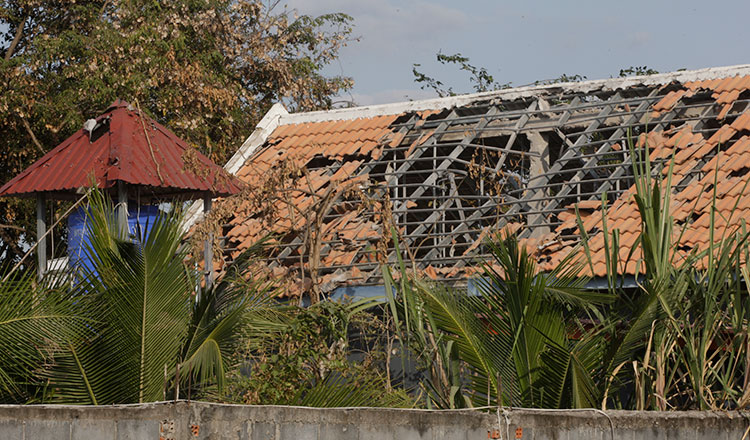 A villager’s home in Boeng Trakuon village, Banteay Meanchey province, damaged by Thai artillery shelling. KT/Chor Sokunthea
#National
Synopsis: Thousands of displaced residents live in temporary shelters, unable to return due to barricades, continued military presence, and fears of permanent seizure of their land.
Banteay Meanchey province – Days after a ceasefire took effect, swathes of border villages in Banteay Meanchey remain deserted and in ruins, as Thai troops continue to occupy civilian areas, blocking access with barbed wire and shipping containers and forcing tens of thousands of villagers to remain displaced.
These villagers cannot return to the land their families have inhabited for generations, and which have now turned into a militarised frontier.
Over the past week, Khmer Times journalists have spent days in border villages documenting the humanitarian impact of the conflict, more than a week after a fragile ceasefire agreement was reached to halt three weeks of Thai military aggression against Cambodia, brokered with mediation from the United States, China and ASEAN.
Journalists witnessed extensive destruction in the Boeng Trakuon area of Thmar Puok district, where four Cambodian villages were illegally occupied by Thai forces, before travelling to Chork Chey and Prey Chan villages in O’Chrov district, which remain fully or partially under Thai military occupation.
While tens of thousands of displaced Cambodians elsewhere have begun returning home, residents of at least seven villages in Banteay Meanchey whose land remains occupied face a very different reality. Many fear they may be permanently prevented from returning, amid concerns that their villages could be annexed if no peaceful resolution is reached.
For now, families from the occupied villages continue to live in makeshift shelters, as authorities prepare longer-term contingency plans pending negotiations over territory seized during the nearly 20 days of fighting.
‘Our village is under occupation’
Pen Rithy, chief of Chork Chey village, who is living in a nearby area after his home was destroyed, said the entire village remains under Thai military occupation.
Before the fighting, Chork Chey was home to 807 families, or 3,022 people, he said.
“As you can see, about 98 percent of the houses in this village were destroyed or heavily damaged by artillery shelling and airstrikes, especially on December 26, one day before the ceasefire agreement,” he said.
After the ceasefire, Thai troops installed barbed wire and shipping containers to block all road access to the village, preventing more than 3,000 residents from returning to their homes, he added.
Local authorities said fewer than 100 houses lie outside the barricaded areas, leaving most of the village completely inaccessible.
“They shelled our village day and night—not less than 1,000 rounds per day. It was brutal aggression,” Rithy said.
Houses inside and outside the barricades have been destroyed or heavily damaged, while unexploded ordnance (UXO) is visible in many locations. Thai national flags were seen flying atop the shipping containers.
Walls are scarred by shells, and bomb craters from F-16 fighter jets dropping bombs, and 155mm artillery shelling can be seen through the village. Vehicles and wooden houses have been burnt to the ground.
Nearby Prey Chan is one of the seven border villages currently under partial occupation.
Along the roads leading into the village, houses and shops have been reduced to rubble by artillery shelling, while several vehicles have been charred.
In areas secured by Cambodian soldiers, villagers were briefly allowed to collect remaining belongings from the ruins of their homes, but were warned to leave quickly due to serious safety risks from UXO.
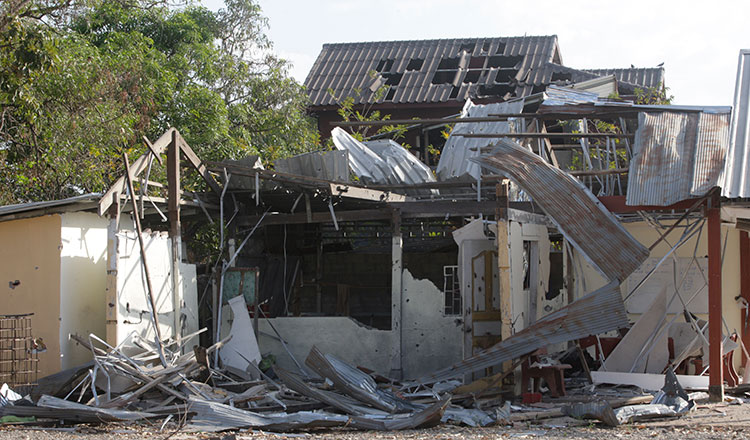
Chhem Duy, 44, a motorbike mechanic, was seen salvaging belongings with his wife and three children from what remained of their home.
“I fled on December 8 with nothing but one motorbike,” he said. “I spent half my life savings to buy land and build this house with a loan. I still owe $3,000.”
He said he had been afraid to return even after hearing about the ceasefire.
“I came back today and saw my house in rubble. We were not allowed to rebuild it now,” he said. “It is not easy living in a displacement camp. I can’t sleep at night. I don’t know how long will this suffering is over.”
Nearby, Neak Pong, 69, a retired soldier who moved to the area two years ago after returning from Preah Vihear province, said his home was hit multiple times by artillery.
He said he spent most of his retirement money to build a shophouse with his wife, but the Thai military has destroyed his family’s hope.
“My house was struck by 155mm shells,” he said. “Now I will move to stay at Chansy Pagoda, where makeshift shelters were prepared by authorities. I don’t know how long it will be before we can return.”
He condemned Thai military for targeting civilians areas, saying he hopes one day the two countries can live as good neighbour.
Villagers said many valuable belongings were lost during and after the fighting, alleging that Thai troops looted property during military operations and following the ceasefire.
Videos posted on social media by Thai soldiers themselves appear to show the seizure of civilian property, including vehicles, motorbikes, bicycles, household items and even pets, drawing strong condemnation from the Cambodian public and calls for accountability.
For families from the occupied villages, the ceasefire has brought little immediate relief. With their homes destroyed, land sealed off and access denied, many say peace will remain out of reach until they are allowed to return home safely and with dignity.
Along the routes in Prey Chan village, Thai military trucks were seen stuck and abandoned after failing to advance further into Cambodian territory. Barbed wire had been installed, and shipping containers were placed to block road access to other parts of the village, which are now under illegal Thai military occupation.
A primary school and a local pagoda were left deserted, with bullet marks visible on the walls. Unexploded ordnance (UXOs) and cluster munitions were also found within the compounds.
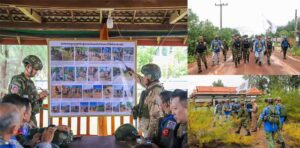
Khmer Times journalists also gained access to frontline positions, where Cambodian soldiers remained on high alert to protect the nation following the fragile ceasefire agreement reached on December 27, 2025.
The Banteay Meanchey provincial administration on Friday said that Thai military forces have illegally encircled and occupied four Cambodian villages near the border in the Boeng Trakuon area of Thmar Puok district, despite a recently agreed ceasefire between the two countries.
According to provincial authorities, the villages—located in the Boeng Trakuon area of Thmar Puok district—were surrounded using shipping containers deployed by Thai troops following the implementation of a bilateral ceasefire at noon on December 27, 2025.
Banteay Meanchey Provincial Governor Oum Reatrey said the affected villages include Banteay Mean Rith, Phlov Bambek, Trapeang Samraong and Samakki. Together, the four villages cover approximately 292 hectares, including 205 hectares of residential land, and are home to more than 6,000 residents living in 1,365 houses.
A report issued by the provincial administration and obtained by Khmer Times details that Samakki village spans 72 hectares, Trapeang Samraong spans 60 hectares, Phlov Bambek spans 108 hectares and Banteay Mean Rith spans 52 hectares.
In a statement, Cambodian government condemned the Thai military aggression, describing it as a serious breach of commitments made under multiple bilateral agreements aimed at resolving border disputes peacefully. These include ceasefire arrangements, General Border Committee meeting records and joint declarations signed throughout 2025.
Journalists gained access to the affected border villages in the Boeng Trakuon area, where Thai troops had installed barbed wire and shipping containers to block road access, preventing Cambodian villagers from returning to their homes. Houses and public buildings are severely damaged, and unexploded ordnance (UXOs) was found in several locations.
Despite permanent border markers installed during the French colonial era and the presence of a permanent border checkpoint in the area, Thai military forces installed barbed wire and containers about one kilometre inside Cambodian territory, deploying tanks and armoured personnel carriers (APCs) across the international border to encircle the villages.
Thai APCs were also seen patrolling the villages, as witnessed by reporters, which were illegally occupied during military aggression between December 7 and December 27, 2025.
At the refugee camps, villagers unable to return home cried for justice and appealed to the international community to end the Thai occupation and allow them to rebuild their lives. “We took loans to build a house, and now the Thai army bombed it into pieces and took my land,” said Koeung Rey, a 40-year-old widowed and disabled resident of Chork Chey village who is currently living in makeshift shelter with her two children.
“I spent half of my life saving money to build a house, but the Thai military destroyed it. How can I live?” she said.
The Thai military has said through its local media that Thailand will not return the land it occupied during the military aggression against Cambodia, claiming it as Thai territory based on a unilateral map that is not recognised by Cambodia or the international community.
The Cambodian government on Saturday said that during three weeks of armed aggression against Cambodia, Thai military forces illegally occupied Cambodian territory in four provinces bordering Thailand.
According to the Ministry of Foreign Affairs and International Cooperation, during full-scale military operations from December 7 to December 27, 2025, Thai armed forces carried out coordinated and systematic attacks across multiple sectors of the internationally recognised boundary.
The ministry said Thai forces forcibly entered, seized and placed under their effective control areas unequivocally located within Cambodian territory in the following provinces:
In addition to Banteay Meanchey province, Thai military forces occupied the Phluk Damrei area and the Thmar Da International Point of Entry area (Chrok Chey Chomneas) in Pursat province.
In Preah Vihear province, affected areas included An Ses, Ta Thav and Phnom Troap.
In Oddar Meanchey province, affected areas included O’Smach, Khnar Temple, Ta Krabei Temple, Tamoan Thom Temple, Chob Angkunh and Chok Krous.
The Ministry of Foreign Affairs and International Cooperation has lodged a strong protest against Thailand over what it described as continued violations of Cambodia’s sovereignty and territorial integrity by Thai armed forces, despite the ceasefire agreement that came into force following the third Special Meeting of the General Border Committee (GBC) on December 27, 2025.
In a statement issued on Saturday, the ministry said Thai armed forces continued aggressive actions after the ceasefire, including military operations and occupation of areas that Cambodia said are unequivocally within its territory, in some cases extending beyond what Thailand claims as its boundary line.
According to the Ministry, during full-scale military operations from December 7 to December 27, Thai forces carried out coordinated attacks across several sectors of the internationally recognised boundary and entered, seized and placed under their effective control areas in four Cambodian provinces: Banteay Meanchey, Pursat, Preah Vihear and Oddar Meanchey.
The statement said affected locations included Prey Chan, Chork Chey village s and Boeng Trakuon area in Banteay Meanchey; the Phluk Damrei area and Thmar Da International Point of Entry area in Pursat province; An Ses, Ta Thav and Phnom Troap areas in Preah Vihear province; and the O’Smach area, Khnar Temple, Ta Krabei Temple, Tamoan Thom Temple, Chob Angkunh area and Chok Krous area in Oddar Meanchey province.
The government said it had lodged its strongest protest against what it described as Thailand’s continued illegal presence, occupation and military activities in these areas. The ministry added that, in disregard of the Joint Statement of the Special GBC meeting, Thai forces had intensified the demolition of Cambodian civilian and cultural structures, particularly in parts of Banteay Meanchey province and near the Thmar Da border crossing in Pursat.
The ministry said the occupation of Cambodian territory and the destruction of civilian homes and infrastructure after the ceasefire have prevented displaced civilians from returning to their homes and constitute serious violations of international law, including the UN Charter and the Geneva Conventions.
It added that Cambodia and Thailand share an international land border delimited under the 1904 Convention and the 1907 Treaty, and that the Joint Boundary Commissions (JBC) of both countries are mandated to demarcate the boundary based on these agreements.
“This occupation, having been brought about and sustained through the threat and use of force, is contrary to the fundamental principle of international law prohibiting the acquisition of territory by force,” the ministry said.
The statement added that the actions of Thai forces contradict Thailand’s commitments under multiple bilateral agreements, including the July 28, 2025 ceasefire agreement, the Joint Declaration on Peace and the Peaceful Settlement of Disputes signed in Kuala Lumpur on October 26, 2025, and the Joint Statement of the Special GBC meeting on December 27.
Cambodia called on Thailand to immediately cease all hostile military activities, withdraw its forces from Cambodian territory in line with the legally established boundary, respect the mandate of the Joint Boundary Commissions and comply in good faith with existing ceasefire and peace agreements.
The Ministry reaffirmed Cambodia’s commitment to resolving all boundary disputes peacefully and in accordance with international law, while urging the international community to encourage Thailand to settle border issues in line with its legal obligations and existing treaties.
During the reporting period, authorities observed a gradual return of displaced civilians to their homes. An additional 12,417 people returned, bringing the total number of returnees to more than 372,000. However, more than 267,000 people —including over 141,000 women and 90,000 children—remain in displacement camps out of a total of more than 640,000 people displaced by the conflict.
-Khmer Times-