The Pitfalls of Trust
 The Pitfalls of Trust
-Opinion-
In human relationships, a fundamental and indispensable element is trust. Whether in private or public life, national or international affairs, nothing is possible without a minimum of trust. Since the dawn of time, humans have attempted to strengthen the conditions of trust between individuals, institutions, businesses, workers and employers, and states by signing documents that outline the terms of an agreement. A vocabulary has emerged to designate the different types of documents: contract, convention, memorandum of understanding, treaty.
But what is the value of this document, even if national or international law grants it legal standing? This question has been asked since the earliest historical times. So much so that the Romans already affirmed a principle that remains in force in contemporary law: pacta sunt servanda, agreements must be kept.
Why this injunction? Because very quickly, the parties to an agreement have reneged on their signatures. For good or bad reasons. Rather than proposing renegotiation of the contract or requesting its termination by mutual agreement, one party has chosen the brutal path of unilateral denunciation or, even more violently, breach of contract. We are faced with a breakdown of trust.
However, once broken, trust is the most difficult, complex and slowest state of mind to rebuild. Often, the breakup is accompanied by bad-faith arguments from the party initiating it, denying obvious realities. But how can one believe in the good faith of a partner who has justified their decision using bad-faith arguments?
History is replete with such ruptures, especially in the context of international relations where supranational arbitration lacks the power to impose its own decisions. In the last century, treaty violations by the Axis powers (Germany, Italy, Japan) and their allies are famous examples. Cambodia was a victim of this, as Thailand’s alliance with Japan allowed it, in 1941, to annex three Cambodian provinces in violation of the 1907 Franco-Siamese treaty. It took the French threat to use its veto power over Thailand’s accession to the UN to overcome Bangkok’s refusal, in 1946, to return the illegally annexed territories.
Since then, Thailand has consistently contested the border demarcation established by the 1904 Franco-Siamese Convention and the 1907 treaty between the same parties. It has also consistently contested the maps drawn up by a joint Franco-Siamese commission and approved by both governments, despite having approved them on numerous occasions since 1908. From a legal standpoint, there is no border other than the one accepted for half a century by the Thai government. This point was emphasised twice by the International Court of Justice in its judgments of 1962 and 2013. It cannot be stressed enough.
In 2000, under a civilian government in Bangkok, a Memorandum of Understanding was signed outlining the delimitation and demarcation of the border based on documents from the colonial period, perfectly applying the international legal principle of uti possidetis iuris, the right to possess what one has long occupied. Unfortunately, a military coup — yet another one — brought this unique moment in the relationship between the two countries to an end. And once again, the ultranationalism of the Thai army dictates Thai policy. How, then, can one trust such a partner who reneges on his own signature? And who, moreover, supports his justification with a staggering number of falsehoods in utter bad faith.
Last July, when all the countries claiming to be friends of Cambodia invited it to negotiate a ceasefire with Thailand, while refusing to acknowledge that there was an aggressor and a victim, who was actually harmed by this ceasefire? Signed on July 28, it was followed by numerous violations by Thailand: the abduction the next day of 20 soldiers, two of whom died with the others still being held hostage; encroachments on the territory of several Cambodian localities, whose inhabitants are either violently expelled by Thai soldiers or threatened, if they refuse to leave, with the application of Thai law, which provides for the death penalty. Not to mention the unbelievable number of false claims intended to portray Cambodia as the aggressor.
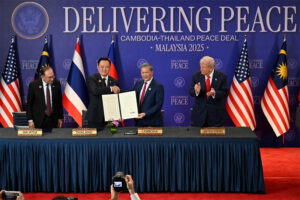
On October 26 in Kuala Lumpur, Cambodia, for the second time in less than four months, heeded the advice of major powers urging it to sign a “Joint Declaration” full of promises, the observance of which was supposed to lead to lasting peace and the establishment of normal bilateral relations. Cambodia, once again, placed its trust in them. And what do we see once again? The ink on the Declaration was barely dry when the Thai army imposed new conditions for the release of the 18 hostages, in flagrant violation of the “Joint Declaration.”
And when Thai soldiers, sent recklessly, if not intentionally, into areas mined since the 1960s — the first anti-personnel mines were laid in this very area in 1964 — became victims, Thailand used this as a pretext to undermine all efforts at reconciliation. The sheer volume of false claims made by the Bangkok authorities, readily relayed by the international press, is countless, all aimed at portraying Cambodia in the most negative light.
Since dawn on December 8th, the Thai army has launched large-scale attacks along the entire border, using armoured vehicles and aircraft, employing poison gas and cluster munitions, penetrating villages, killing civilians and burning their homes, destroying road infrastructure, as well as schools, pagodas and temples supposedly protected by UNESCO.
The Thai navy is indiscriminately bombarding a coastal province of Cambodia. This is a full-blown war waged by the Thai army against the Cambodian people. With complete impunity. For 24 hours, Cambodia did not retaliate, clearly demonstrating who the aggressor is. But to what end?
Once again, what we hear from the world’s major capitals and the UN are calls to refrain military activity and to negotiate. Without the slightest condemnation of the aggressor. So what are the five permanent members of the UN Security Council (China, France, Great Britain, Russia, and the USA) – whose mission is, in principle, to safeguard world peace… – waiting for to tell Thailand that you don’t solve your internal problems by attacking a neighbouring country, that the accusations of Cambodian threats are unfounded, and that Thailand must end its war of aggression?
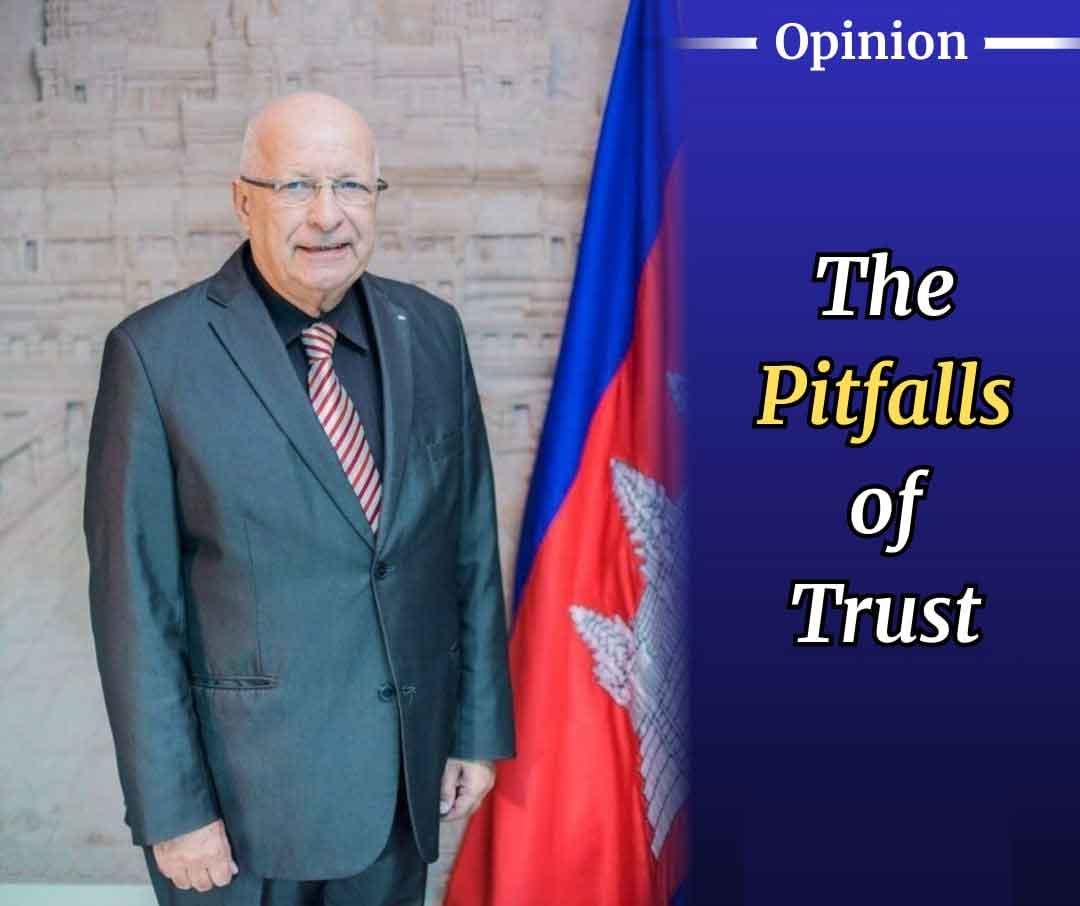
Dr Raoul M. Jennar, PhD in political science. An author, he has lived in Cambodia for more than three decades. The views and opinions expressed are his own.
-The Phnom Penh Post-
[Dr Raoul M. Jennar has lived in Cambodia for more than 30 years. Information ministry]