When a Government Closes Every Door to Dialogue, the World Sees Clearly Who Is Driving the Conflict
 When a Government Closes Every Door to Dialogue, the World Sees Clearly Who Is Driving the Conflict
-Opinion-
The recent clashes along the Cambodia–Thailand border have understandably drawn concern. But the turning point in this crisis did not occur on the battlefield. It occurred when Thai Prime Minister Anutin announced that all negotiation channels with Cambodia would be suspended. In any border dispute, the removal of diplomacy is not an administrative decision. It is the moment the international system begins to distinguish between a state managing instability and a state deepening it.
Before this announcement, Thailand’s conduct was already raising questions among regional observers. Escalating operations near civilian areas, inconsistent messaging between political leaders and military commanders, and repeated incidents along the frontier had created the impression of a conflict drifting in the wrong direction. But diplomatic uncertainty still existed. Dialogue, however strained, remained open. That ambiguity ended the moment Thailand shut every pathway to negotiation.
International conflict law does not identify an aggressor by who fires first, or by whose rhetoric appears louder. It identifies an aggressor by observable behaviour: which party rejects peaceful mechanisms, which party abandons a framework it has signed, and which party escalates when de-escalation is available. By suspending all negotiations while clashes continue, Thailand placed itself squarely within the category of a state choosing coercion over resolution. That single act carries more weight in global interpretation than any isolated exchange of fire.
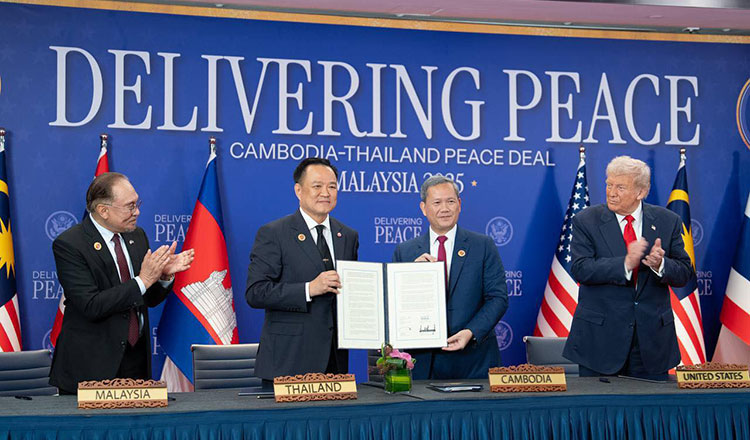
This is especially true because both governments only recently reaffirmed the Kuala Lumpur Peace Accords. The Accords function on one premise: communication must continue even under pressure. When a signatory government withdraws from that premise, the stability architecture collapses. It becomes difficult for international observers to reconcile a self-defence claim with a deliberate refusal to use the mechanisms designed to prevent further violence. Under these conditions, the proportionality argument central to Article 51 weakens sharply.
This interpretation is not emerging from Cambodia alone. It is being voiced inside Thailand. Senior opposition leaders in Bangkok have warned that the government’s approach risks casting Thailand as the aggressor in the eyes of the world. Their message is clear: once negotiations are closed, Thailand no longer appears as a state protecting its frontier but as a state asserting force without a diplomatic anchor. Even Thai military officers have stressed publicly that no border conflict in the region has ever been resolved without negotiation, underscoring how unusual and dangerous the current stance is.
The asymmetry between the two countries also shapes the global reading. In conflicts where one state possesses greater military capacity, the burden to demonstrate restraint lies with the larger power. That burden becomes heavier when civilians are displaced, when humanitarian pressure grows, and when military operations occur close to populated zones. Closing negotiation avenues removes precisely the restraint mechanism the international system expects a larger power to uphold.
Meanwhile, regional and global actors have converged on a single message. ASEAN, Washington and Beijing have all urged a return to dialogue and adherence to the Kuala Lumpur framework. Such alignment is rare, and when it occurs, it signals rising diplomatic concern. A government that continues to escalate under these conditions does not appear defensive. It appears isolated.
The humanitarian situation deepens the urgency. Families on both sides of the border have left their homes. Schools and markets have been disrupted. In periods of rising tension, communication between governments is not optional; it is the only tool that prevents local incidents from igniting broader confrontation. Without it, miscalculation becomes the dominant risk.
Border communities have lived through cycles of conflict and cooperation for generations. Their safety depends less on battlefield outcomes than on the willingness of leaders to maintain dialogue even when disagreements are sharp. Reopening the negotiation channel is not a concession. It is the threshold for restoring the peace architecture that Southeast Asia relies upon to prevent tactical clashes from becoming strategic crises.
Thailand was already facing questions about the trajectory of its actions. The decision to close every diplomatic door removes whatever ambiguity remained. In the international system, the side that eliminates the peaceful path is the side that signals intent most clearly. For the sake of regional stability and the lives along the frontier, that path must be reopened.
Ponley Reth is a Cambodian writer and commentator based in Phnom Penh. The views and opinions expressed are his own.