Diversionary Warfare: Thai Politicians Using Ruthless Strategy to Seize Neighbour’s Land and Win Popularity
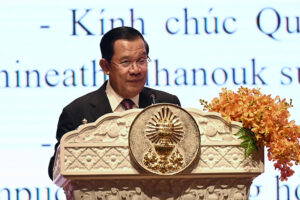
 [The author of this piece believes Thai Prime Minister Anutin Charnvirakul is using ‘diversionary warfare’ for his own political ends. ANN/The Nation]
-Opinion-
The story began in September, when Anutin Charnvirakul signed an MoU with the People’s Party to gain their full support and votes, paving the way to form an interim government. The MoU included five conditions.
1. The new PM must dissolve the House of Representatives within four months after delivering the government’s policy statement, thereby triggering a new general election.
2. If the Constitutional Court of Thailand decides that a referendum is required before amending the 2017 Constitution under Article 256, the government must hold the referendum and then establish an elected Constitutional Drafting Assembly to draft a new constitution.
3. If the court rules that a referendum is not required, the government must still expedite constitutional amendments during its term so that a new charter can be drawn up.
4. The Bhumjaithai Party must not form a majority government that could block the early dissolution of the House, meaning it must govern as a minority or in a weak coalition.
5. The People’s Party will remain in the opposition and will not accept any ministerial or cabinet positions in the new government.
Not unlike other Thai politicians, Anutin, a former health minister who legalised cannabis under Pheu Thai before later joining and then leading his party out of the coalition during the tense border incidents in June, claimed that he could not work with a party that betrayed the national interest.
His actions follow a familiar pattern much like his father’s old ally Abhisit Vejjajiva, who once used the military standoff with Cambodia around the Preah Vihear temple between 2008 and 2011 to stir up nationalism amid anti-government protests and a legitimacy crisis.
Anutin, who has a long record of betraying nearly every party and politician he has worked with, will almost certainly betray the People’s Party as well. On the day he was inaugurated, I believed he would once again use either the King, the military or Pheu Thai to justify his betrayal.
It shall be noted that via the complexity of political issues in Thailand, Pheu Thai and Bhumjaithai are not truly rivals, they share power merely to save each other’s political survival. As prime minister, Anutin could request His Majesty the King to release Thaksin from prison at any time and protect his daughter, Paetongtarn Shinawatra, from political mistakes. Their common threat is the People’s Party, which could re-enter parliament and which also poses a challenge to Thailand’s iron-handed monarchy.
The People’s Party, fully aware that betrayal is inevitable, nonetheless chose to befriend the enemy to better understand them and gain public sympathy by portraying themselves as victims of Thailand’s deeply unfair political system, one long dominated by royal, military and puppet governments that always win, not through popular support, but through institutional and elite power after every election procedure is completed.
The People’s Party also know that many of their key politicians remain banned for ten years, so forming a government anytime soon is impossible. For now, their focus is survival within such a system.
However, there is one problem more serious than this internal struggle.
Some Thai politicians use the threat of war as a diversion to strengthen their domestic political positions. Anutin is now employing this tactic for three main purposes.
The first is to create a convenient excuse for betraying the People’s Party. The second is to gain the trust and support of the monarchy and the military, the true agents of power. Finally, he aims to gain popularity by igniting nationalism, regardless of whether elections are held through people’s demand or through false claims that parts of Cambodia’s territory belong to Thailand.
This escalating situation requires our close attention.
His final purpose, false claims on Cambodian territory, is already in motion, putting Cambodian lives and territory at risk.
On November 12, a Cambodian citizen was shot dead and three others wounded in Banteay Meanchey province’s Prey Chan village.
This tragedy appears to have occurred intentionally on the day Thailand had previously announce it would release Cambodian soldiers, who have been held for over 100 days despite repeated assurances, including a commitment following the Kuala Lumpur meeting on 26 October 2025 with U.S. President Donald Trump and Malaysian Prime Minister Anwar Ibrahim as signatories.
Such actions are not what responsible permanent neighbours or ASEAN member states should engage in.
To the international community and ASEAN partners: You have heard about the five-day war and the recent shootings of civilians whose homes were encircled by barbered wires by Thai soldiers. Cambodia calls on you to acknowledge that from the very beginning, it has chosen peace and sought justice through legal and peaceful mechanisms, through its case at the International Court of Justice, through continuous bilateral border meetings and through its commitment to the ceasefire and ceasefire expansion declaration recently hosted by Malaysia and the United States.
Cambodia urges all nations to do what you can to tell Thailand to stop provoking conflicts for internal political gain.
If Thailand truly believes the disputed land belongs to them, let the matter be decided by the border committees and the ICJ based on evidence, not through the use of machinery and heavy weapons that threaten thousands of Cambodian lives along the border.
To the people of Thailand, if you happen to read this, please look back to the days when peace existed between our two nations, when lives were not at risk and when no one was manipulated for political gain.
Ask yourselves if you truly want to let your politicians play you in this endless cycle. Ask yourselves if you want to see innocent human lives across the border treated in such an inhumane way. In the name of a democratic nation and the reality of a multiparty parliament, YOU HAVE THE POWER TO STOP THIS!
Chhoumpovnika Rin is program director at 7s-INFO, a female-led international news-focused media outlet. The views and opinions expressed are her own.
-The Phnom Penh-