Lasting peace: The road ahead for Cambodia and Thailand
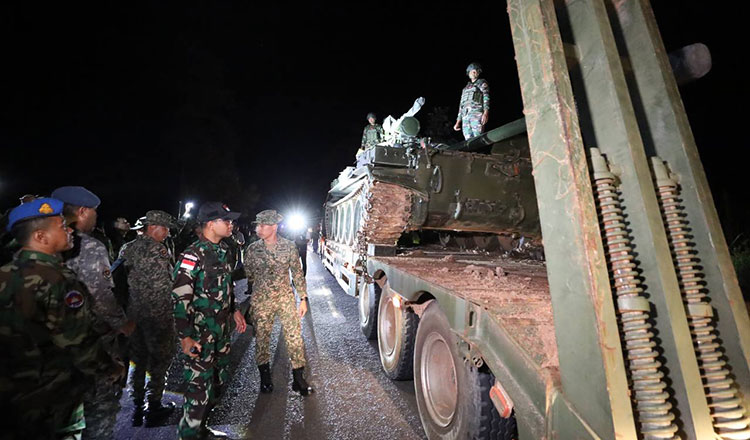 [De-escalation of the Cambodia-Thailand conflict has commenced with the withdrawal of heavy armaments from the border. Supplied]
While making war is easy, building lasting peace is a far more complex and demanding long-term commitment and endeavour.
Southeast Asia has enjoyed peace and stability for decades. There has been no major interstate war or conflict since the end of the Cold War.
Vibrant economies, diverse societies, and a dynamic spirit of innovation characterise the region.
Yet, the recent border conflict between Cambodia and Thailand starkly reminds us that peace is fragile and must be carefully guarded. It must be actively earned, nurtured, and preserved through sustained effort.
ASEAN is compelled to strengthen its capacity in crisis management and conflict resolution.
Cambodia and Thailand are not destined for conflict; they are neighbouring states whose shared history and geography bind them together.
As permanent neighbours, they have both the opportunity and the responsibility to pursue a future rooted in peace, friendship, cooperation and shared prosperity.
Achieving this requires commitment, dialogue, and a recognition that peace is a continuous journey—not a one-time achievement. We need to keep building the foundations of peace, especially people-to-people ties.
The October 26 signing of the peace agreement between Cambodia and Thailand in Kuala Lumpur, witnessed by US President Donald Trump and Malaysian Prime Minister Anwar Ibrahim, marks a milestone in the common effort to restore peace and normalcy between the two Kingdoms.
It is also a historic moment in ASEAN. This accord not only aims to restore peace between these neighbouring countries but also underscores ASEAN’s crucial role in mediating regional crises. The formation of the ASEAN Observer Team (AOT) specifically to oversee the agreement’s implementation signifies an essential step toward ensuring verification, compliance and transparency.
Notably, the integrity of the peace process hinges on the genuine commitment of both nations to uphold the terms of the agreement. This requires the implementation in good faith, transcending political and nationalistic distractions that have previously hindered resolution efforts.
The border dispute, deeply entangled in Thailand’s domestic politics, especially garners influence during periods of political turbulence. Thus, political stability in Thailand is the determinant of the peaceful resolution of the dispute. Therefore, uncertainty remains.
The international community has a critical role in monitoring the agreement’s execution to ensure it serves as a true peace guarantor. Global attention and diplomatic pressure can deter violations and encourage adherence to agreed terms.
This external oversight serves not only as a preventive measure against potential infractions but also to bolster trust between the two governments and, more importantly, among their citizens.
Despite the peace deal, a palpable emotional rift persists between the peoples of Cambodia and Thailand, challenging any swift normalisation of bilateral relations.
Historical grievances and recent conflicts have left deep psychological scars that require time and concerted efforts to heal.
Actual reconciliation calls for initiatives that promote mutual understanding and empathy, extending well beyond mere political agreements.
Moreover, economic collaboration presents a powerful avenue for reconciliation and sustainable peace.
By promoting cross-border trade and opening checkpoints, both countries can deepen economic interdependence, creating shared interests that reduce future conflict incentives.
Economic bonds can serve as both a deterrent to hostilities and a bridge for communication and cooperation.
The weaponisation of economic tools, such as border closures, must be avoided as they exacerbate tensions and seriously affect the livelihoods of the people living along the border.
To advance reconciliation, both nations must deliberately cultivate platforms for people-to-people exchanges, grounded in mutual respect and understanding.
Such initiatives can take numerous forms: academic partnerships, cultural exchanges, and joint community projects all provide avenues to dismantle stereotypes and build new narratives based on shared human values.
One significant inhibitor of peace has been the proliferation of misinformation and fake news, which have exacerbated tensions and sown discord.
A responsible media landscape, encompassing both traditional and online platforms, must be promoted to ensure accurate reporting and bridge communication gaps.
Furthermore, reducing the influence of ultranationalist and extremist factions, known for stoking animosities, is crucial. These groups often exploit media platforms to instigate hatred, making it imperative to counteract their narratives with messages of unity and understanding.
Ultimately, achieving lasting peace between Cambodia and Thailand will require a holistic, inclusive approach.
Governments, private corporations, civil societies, local communities, and the media community must constructively engage in reconciling differences, repairing ties, and restoring normal relationships.
Such a whole-of-society approach helps ensure that peace is built on robust foundations and is resilient to future challenges and risks.
The path to peace is neither straightforward nor quick; it requires dedication, patience, and collaboration. Acknowledging that “it takes two to tango,” both nations must be willing partners in this intricate dance towards long-lasting peace.
-Khmer Times-