The Strategic Importance of Cambodia–Korea Relations
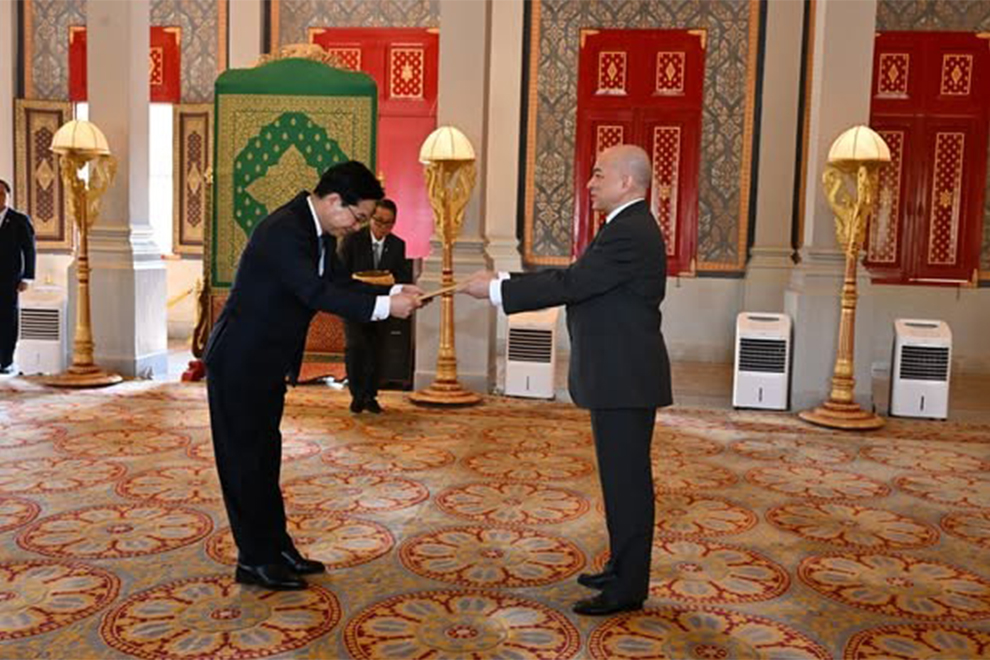 South Korean ambassador Kim Chang-wook presents his credentials to His Majesty King Norodom Sihamoni. Supplied
#opinion
In an era of global interdependence, fostering strong bilateral ties between nations is not just beneficial but essential for mutual prosperity and regional stability. The relationship between Cambodia and the Republic of Korea (South Korea) stands as a shining example of such a partnership, built on shared values, economic synergy and cultural affinity.
As Cambodia emerges as a dynamic player in Southeast Asia and South Korea continues to lead in innovation and technology, their strategic alliance holds immense potential to drive sustainable development, enhance security and promote people-to-people connections.
The foundations of Cambodia-Korea relations date back to the establishment of diplomatic ties in 1970, though they were interrupted by Cambodia’s internal conflicts in the 1970s. Relations were re-established in 1997, thanks to the efforts of former Prime Minister Hun Sen, marking the beginning of a robust partnership, focused on reconstruction and growth.
Since then, South Korea has been a steadfast ally in Cambodia’s post-conflict recovery, providing critical support in infrastructure, agriculture, healthcare and education.
This historical bond has evolved into a strategic partnership, officially elevated in 2024 during a summit between South Korean President Yoon Suk Yeol and Cambodian Prime Minister Hun Manet.
This upgrade underscores a deepening trust and commitment, positioning the relationship as a model for small and medium powers navigating complex geopolitics. Economically, the ties between Cambodia and South Korea are a cornerstone of their strategic importance. Bilateral trade has surged in recent years, reaching approximately $890 million in 2024, with projections for continued growth.
In the first half of 2025 alone, trade volume hit $438 million, a 10.7% increase from the previous year, demonstrating resilience amid global economic challenges.
South Korea ranks among Cambodia’s top trading partners, with key exports from Cambodia including garments, footwear and agricultural products, while imports from Korea encompass machinery, electronics and vehicles. The signing of the Cambodia-Korea Free Trade Agreement (FTA) in 2021 has been pivotal, reducing tariffs and facilitating smoother market access.
A joint FTA committee convened in 2024 to further boost trade, infrastructure collaboration and carbon neutrality initiatives, aligning with both nations’ sustainable development goals.
Investment flows underscore the economic vitality of this partnership. South Korea has poured over $8.5 billion into Cambodia as of 2024, primarily in the manufacturing sector, particularly clothing and textiles, where Korean firms have established factories that employ thousands of Cambodians.
The Cambodian government should provide visa free for South Korean tourists who want to visit Cambodia because South Korean peoples sense different optics when Cambodia only provides visa-free access to Chinese tourists.
Moreover, South Korean development aid, totalling $431 million from 1996 to 2022, with an additional $315 million pledged in 2025, has funded vital projects in rural development, water supply and vocational training.
These efforts have lifted communities out of poverty and fostered long-term economic resilience. Beyond economics, cultural and people-to-people exchanges form the heart of Cambodia-Korea relations, enriching both societies and building lasting goodwill.
South Korea’s vibrant pop culture, including K-pop, K-dramas and cuisine, has captivated Cambodian youth, leading to a surge in Korean language learners and cultural enthusiasts. In Phnom Penh and Siem Reap, Korean restaurants and cultural centres thrive, symbolising this affinity. Educational ties are equally strong, with thousands of Cambodian students pursuing scholarships in South Korean universities, focusing on fields like engineering, IT and business.
Programmes such as those supported by the Korea International Cooperation Agency (KOICA) emphasise human resource development, digital transformation and sustainable practices.
Tourism plays a pivotal role in these exchanges, with Korean visitors flocking to Cambodia’s ancient wonders like Angkor Wat Temple. Initiatives like visa-free entry and targeted marketing have boosted Korean tourist arrivals, prompting Cambodia to enhance tourism skills to cater to this demand.
ATheA memorandum of understanding (MoU) between Cambodia’s Ministry of Tourism and Korea’s Go & Do Social Welfare Corporation aims to strengthen tourism cooperation, encouraging two-way flows and people-to-people interactions.
Cultural events, such as joint festivals and art exhibitions, further bridge the two nations, celebrating their shared heritage of resilience and innovation. These exchanges not only promote mutual understanding but also create a foundation for enduring friendships that transcend borders.
Politically and strategically, the Cambodia-Korea partnership enhances regional stability in a volatile Indo-Pacific landscape. For Cambodia, diversifying ties with South Korea serves as a prudent hedging strategy, balancing influences from larger powers while attracting diverse investments.
This approach allows Cambodia to maintain autonomy and pursue its foreign policy goals independently. For South Korea, the alliance provides a strategic foothold in ASEAN, enabling it to expand its economic presence and contribute to peace-building efforts. Defence cooperation has also grown, with recent agreements enhancing Cambodia’s capabilities and fostering trust.
Joint initiatives in areas like cybersecurity, disaster response and climate resilience address shared challenges, reinforcing their roles in multilateral forums such as the ASEAN-Korea Dialogue.
Looking ahead, the strategic importance of Cambodia-Korea relations is poised to grow exponentially. With Cambodia’s economy projected to expand at 6-7% annually and South Korea leading in green technologies and digital innovation, opportunities abound in sectors like renewable energy, smart cities and e-commerce.
The 2026 establishment of an enhanced strategic partnership framework, including supply chain strengthening and eco-friendly projects, will further solidify these ties.
By leveraging their complementary strengths — Cambodia’s youthful demographics and natural resources alongside Korea’s technological prowess — the two nations can co-create solutions for global issues like climate change and inequality.
All in all, the Cambodia-Korea relationship is more than a bilateral affair; it is a strategic imperative that drives progress, stability and shared prosperity. As both countries navigate the complexities of the 21st century, investing in this partnership will yield dividends for generations to come. Policymakers, businesses and citizens alike should embrace this alliance, fostering deeper collaboration to build a harmonious and resilient future. The story of Cambodia and Korea is one of triumph over adversity, proving that strategic foresight and mutual respect can transform nations.
Dr. Seun Sam is policy analyst at the Royal Academy of Cambodia. The views and opinions expressed are his own.
-The Phnom Penh Post-