Private Tutoring Reconsidered: A New Pathway or the Same Old Dilemma?
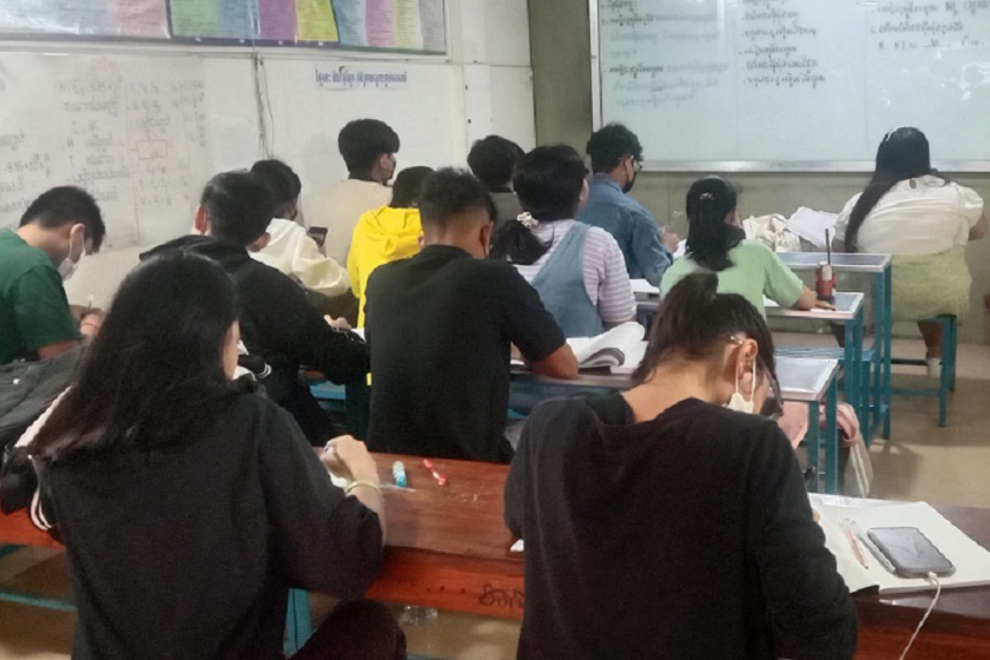 [Students attend an out-of-class tutoring session. FB]
-Opinion-
The question of “shadow education” (private tutoring, or extra classes) or “rean kour” in Khmer, has long been controversial, even though a combination of formal and non-formal education has become the standard in the Cambodian education system from the formal pre-tertiary education to the upper secondary level.
Previously, public or private education remain the main choices, however private tutoring began to emerge in the late 1980s and early 1990s. As the national education system moves toward New Generation Schools (NGS), Model Schools (Sala Komru), and Community Schools (Sala Sahakom), two questions must be asked.
“Why does private tutoring still exist within Cambodia’s education system? Why should its revival be reconsidered beyond the agency of individual teachers?”
A detailed background of an old dilemma
Tutoring classes are not a new phenomenon, nor is it a unique paradigm to Cambodia. It is common in many Asian countries, such as Singapore, South Korea, Taiwan, Hong Kong and Mauritius. Among these nations, some have sought to restrict the practice while others have encouraged it, under controversial discussions. From the perspectives of teachers, students and parents, attending tutoring class is often regarded as an essential form of supplementary education that helps strengthen students’ competencies and learning performance.
At the same time, however, it is also seen as a detrimental factor to the integrity of basic education.
In Cambodia, this practice exists due to several factors, including overloaded syllabuses, low teacher salaries, insufficient instructional time, large class sizes and high-stakes examinations. Roughly speaking, it traditionally serves to equip students with specific knowledge.
The is practice is often referred to “shadow education” since it has become deeply intertwined with the public school system, playing both supportive and exploitative roles at times. If we observe carefully, private tutoring subtly diminishes students’ critical thinking and creativity. Learners are often trained and guided merely to complete exercises or homework rather than being encouraged to think independently, or to engage with diverse learning needs.
Sadly, despite the government’s efforts to increase teachers’ salaries threefold through the Ministry of Education, Youth and Sport, the issue persists wherever schools exist. It has become a natural extension of formal education, a parallel system that many teachers rely on as an additional source of daily income. Over time, this practice has evolved into an accepted means of earning extra money by offering students supplementary lessons outside regular class hours.
Despite this perception, a recent study found that most teachers recognise the true value of education and devote their energy to improving students’ knowledge, especially their learning outcomes. The small amount of money earned is secondary and cannot be regarded as extra income, particularly for teachers working in poor or remote regions, far away from their homes and families. Lamentably, their monthly salary is insufficient to sustain a decent living away from home, especially for those who are obliged to support their elderly parents and children.
The unresolved issue: whether to ban or to embrace
The debates surrounding private tutoring remain endlessly controversial. Some scholars argue that its impacts are not entirely unusual or unexpected even though the education ministry has issued official statements discouraging teachers from using tutoring exercises as exam materials or coercing students to attend private tutoring sessions.
Some call for a total ban on such classes, arguing that teachers often pressure students to learn beyond their capacity, leading some to drop out. It encourages teachers to withhold knowledge for paid sessions, and most worryingly, it makes students lose concentration during formal classroom sessions.
Some academics suggest that the rise of private tutoring reflects both the high value placed on education and a growing distrust in mainstream schooling. It should remain a supportive supplement, not a compulsory norm. While it is beneficial for students who need extra help, its widespread necessity signals flaw in the system.
Although the arguments differ in perspectives, they ultimately circle back to the same old dilemma. Formal teaching remains limited due to inadequate practical empowerment. Moreover, some current public schools have shown that full-time classes without private tutoring are far more effective both in preserving the true value of education and in preventing corruption, as several studies have revealed. The New Generation Schools (NGS) and Sala Sahakom stand as practical models in this regard.
The NGS and Sala Sahakom school models enable students to grow more holistically, academically, ethically and socially within a well-equipped and supportive learning environment. Cambodia needs more of these schools, as private tutoring and even private schools often create a double standard for students. Strictly speaking, it reinforces a form of class divide within education.
A pathway of private tutoring, a pathway of costing
Imagine students come to class just for attendance because they believe that they just need to spend more time on extra classes since their teachers will provide enough authentic exercises to practice in order to be ready for their exams. When students do not care about their regular classes and care only for their extra sessions, the learning environment is disturbed. The reasons students do not pay strong attention to their lessons may be because they believe that regular classes not relevant to their exams, the exercises are not practical or real-world, and better lessons and homework will be offered when they attend private tutoring lessons.
A UNDP report on informal fees in Cambodian education emphasised that private tutoring has become an informal cost of schooling, affecting students who are from low-income families. It is difficult for poor students to afford such fees for their studies, leaving them discouraged from pursuing their study. Research has strongly indicated that private tutoring creates conflicts of interests among teachers within the same schools.
Generally, most students study mathematics, physics, biology, chemistry and Khmer subjects since these represent the highest proportion of available marks for the Bac II national exam. Suppose one class costs 15$ for a month, and five subjects cost around 75$. This amount of money seems to be little for students who come from well-off families, but it is a burden for those who come from financially struggling families. This issue causes classroom segregation between the haves and the have-nots.
A journey towards a true essence of education
The education ministry is working to reduce the shadow education in public schools and developing a roadmap to strengthen classroom instruction and facilities, upgrade teacher professional development, as promote ICT skills with AI integration, along with and other 21st century skills. For instance, the NGC guidelines already ban private tutoring.
The ministry has also implemented the Teacher Policy Action Plan 2024-30 (TPAP), to foster the quality of teaching within school hours. The TPAP supports professional standards for teachers and performance-based management, mainly in rural and disadvantaged areas across Cambodia. This is largely in line with national education reform programmes, which aim to secure all students have access to equitable education with inspired teachers, as stated in the ministry slogan, “Education for All and All for Education”.
The Strategic Plan for Teacher Education Reform (2024-2030), developed with UNESCO, intends to improve teaching methodology within the classroom and support well-trained teachers and educators to achieve the national goals of a quality and inclusive education, while advancing teacher education, with a focus on digital education, inclusion and foreign language teaching.
The UNDP report on “shadow education” explicitly highlighted how informal tutoring creates gaps between students in terms of their socioeconomic status and learning opportunities. By strengthening classroom instruction and teaching techniques, fair assessment, teachers’ commitment, and a friendly and supportive classroom environment within class, public schools across the country will no longer rely solely on private tutoring.
In essence, to build strong and more equitable public systems across the schools, Cambodia needs to expand the non-shadow education systems as the NGS. At the same time, the ministry must fully integrate the TPAP, to foster professional development.
Ultimately, this transformation will require an effort not just from teachers, but parents, communities and stakeholders.
It is about more than reinforcing the latest teaching methods, it is about fundamentally rebuilding deep trust, equity, fairness and integrity across public schools in Cambodia.
Meak Loemheak is a state high school teacher of morality and civics in Kampong Chhnang Province. Kon Veasna is a state teacher of English in Siem Reap province. The views and opinions expressed by the authors are their own.
-The Phnom Penh Post-