UXO threat lingers in 77 villages after Thai border clashes
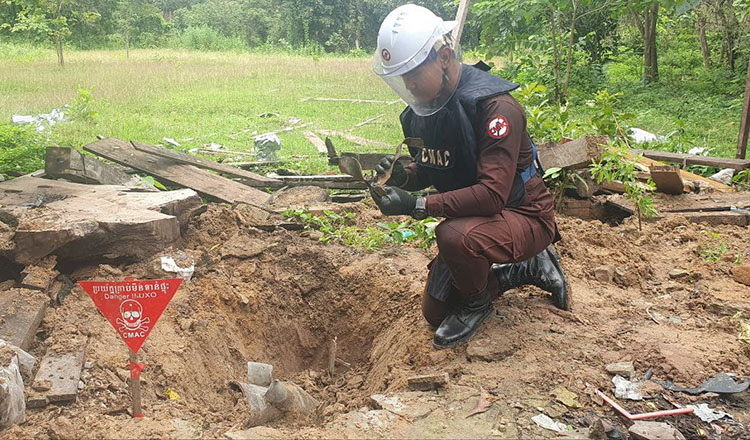 Photo: Thai assaults on Cambodian border villages during five days of armed clashes have left behind deadly unexploded cluster munitions, posing serious risks to civilians and requiring time-consuming clearance efforts. CMAC
Synopsis: Seventy-seven villages are littered with unexploded cluster bombs deployed by Thai forces during border clashes with Cambodia, contaminating farmland, displacing residents and crippling rural livelihoods.
Seventy-seven Cambodian villages are facing the threat of unexploded cluster bombs—deadly remnants of five-day armed border clashes between Cambodia and Thailand that left fields unworkable, homes destroyed, and lives forever changed.
Speaking to journalists on Sunday, Cambodian Mine Action Centre (CMAC) Director-General Heng Ratana said that the Thai military used illegal cluster munitions during the clashes that erupted along the Cambodian-Thai border in July. The attacks have affected 43 villages in Oddar Meanchey province and 34 in Preah Vihear province.
“People can no longer walk freely as before, due to fear of danger,” Ratana said. “Their livelihoods are paralysed. Farmland and rice fields are now minefields.”
CMAC demining teams are currently deployed to survey and clear affected areas, but Ratana warned that the process will take time and requires international support. “We have deployed our demining teams with an immediate focus on securing residential areas—ensuring the safety of villagers, their homes, and surrounding land. This is our first priority, and we are committed to clearing these zones completely and safely by the end of this year,” he said.
“After achieving 100% safety in residential zones, we will begin clearing agricultural and economic areas, many of which have been contaminated by cluster munitions.
Ratana said the cluster bombs are highly dangerous and time-consuming to clear, with some stuck in trees, posing a high risk of detonation.
Although Cambodia and Thailand signed a ceasefire agreement on July 28, Ratana described it as “fragile at best,” citing continued aggression and provocation by Thai forces.
He accused the Thai army of recently laying barbed wire inside Cambodian territory in Prey Chan and Chouk Chey villages in Banteay Meanchey province, in a move that has inflamed tensions.
The use of cluster bombs—banned under international law by over 100 countries—has sparked outrage among human rights groups and civil society organisations. Though neither Cambodia nor Thailand is party to the 2008 Convention on Cluster Munitions, Ly Thuch, First Vice-President of the Cambodian Mine Action and Victim Assistance Authority (CMAA), argues that the deployment of such weapons against civilian areas is a clear violation of international humanitarian norms
The five-day armed conflict resulted in the deaths of both civilians and soldiers on the Cambodian side. In addition to the loss of life, the Thai military’s bombardment destroyed homes, schools, pagodas, and infrastructure. The historic Preah Vihear Temple—a UNESCO World Heritage site—also sustained damage during the fighting.
Tens of thousands of Cambodian civilians were forced to flee their homes during the conflict, many of whom remain displaced.
-Khmer Times-
#CambodiaWantsPeace
#JusticeForCambodia
#Cambodianeedpeace
#TruthFromCambodia
#ThaiLawOnCambodianSovereignty
#ទាហានថៃបានអនុវត្តច្បាប់ថៃនៅលើទឹកដីខ្មែរ