Turning Disputes into Dominance: How Thailand Exploits Local Law and False Flags Operations to Manipulate Narratives
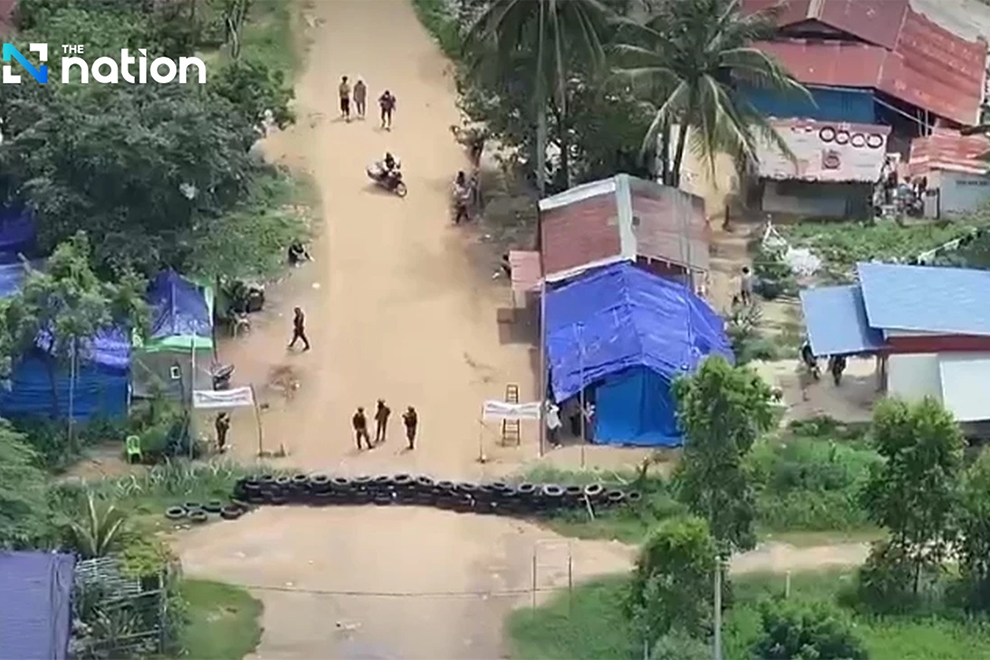 [Cambodia's Prey Chan village, in Banteay Meanchey province, has been divided in half by a Thai barricade of tyres and razor wire. Thailand has said it will use its domestic laws to evict the Cambodian residents of the village. ANN/The Nation]
-Opinion-
By advancing step by step under the cover of local public-order legal framing, selective enforcement and narrative dominance, Thailand is incrementally consolidating its foothold in disputed areas, transforming temporary gains into durable claims of control.
This creeping encroachment is often accompanied by false flag operations, creating pretexts to justify aggression while portraying Cambodia as the provocateur. By applying Thai local public-order laws to Cambodian villagers residing deep within Cambodia territory, Thailand manufactures a legalistic justification for its actions, deploying riot police, barriers and razor wire to project an image of maintaining secure and public order.
Yet in reality, it is using Thai domestic law, symbols of authority and force to claim control of Cambodian territory, all while undermining Cambodia’s rightful power. Strong media channels amplify this framing, portraying Cambodia as provocateur and Thailand as maintaining peace and order.
Incremental enforcement normalises Thailand’s control over disputed areas without provoking a large-scale backlash, and the lawful narrative enables both domestic and international audiences to perceive the actions as legitimate Thai domestic enforcement rather than aggression.
This dual strategy allows Thailand to test the limits of Cambodia’s restraint, shift the facts on the ground in its favour and maintain a strong narrative advantage internationally, all while avoiding full-scale escalation.
Cambodia, adhering strictly to the ceasefire agreement and international norms, is constrained in its ability to respond, leaving it at a growing strategic disadvantage.
Meanwhile, the Interim Observer Team (IOT), tasked with monitoring ceasefire compliance, can observe and report violations but cannot enforce corrective measures, allowing Thailand to exploit these structural limitations.
Through this combination of gradual territorial expansion, deception and leveraging the IOT’s non-enforcement mandate, Thailand steadily tilts the balance in its favour, legitimised in the eyes of both domestic and international audiences, yet fundamentally at the expense of Cambodia’s territorial integrity.
Through methodical, incremental enforcement, Thailand consolidates control while avoiding overt confrontation. By cloaking these moves in the language of legality, it manipulates international perception, presenting aggressive territorial expansion as routine domestic law enforcement.
Despite Cambodia’s repeated protests, denials and reports to international observers and the UN to expose Thailand’s manipulations, Thailand relentlessly advances its position, normalising dominance and blunting the effectiveness of both Cambodia’s resistance and international scrutiny. For Cambodia, this creates a strategic dilemma – direct confrontation risks retaliation, while inaction allows incremental territorial loss.
More importantly, by establishing facts on the ground and claiming increasing portions of Cambodia’s territory under its administration, Thailand sets the stage for later negotiations where it can bargain from a position of dominance — transforming de facto control into de jure legitimacy.
Yet, Cambodia retains an advanced counterweight by filing the disputed areas and border territories with the International Court of Justice (ICJ), anchoring the conflict in an international legal framework. This prevents Thailand’s creeping control from unilaterally resetting the baseline for future negotiations, ensuring that the legal status of the territory remains contested even as Thailand deepens its de facto grip.
The cartographic basis of the dispute further underscores this divide – Cambodia relies on French colonial maps at 1:200,000 scale tied to the 1904 and 1907 Franco–Siamese treaties as internationally recognised maps, while Thailand justifies its claims based on unilateral 1:50,000 scale maps which lack international approval.
This contrast reinforces Cambodia’s legal legitimacy and highlights the fragility of Thailand’s position, exposing its territorial advances as grounded in unilateral assertions rather than internationally sanctioned boundaries.
Chhay Bora is a Phnom Penh-based strategic advisor, and government affairs and public policy expert. The views and opinions expressed are his own.
-The Phnom Penh Post-
#CambodiaWantsPeace
#JusticeForCambodia
#Cambodianeedpeace
#TruthFromCambodia
#ThaiLawOnCambodianSovereignty
#ទាហានថៃបានអនុវត្តច្បាប់ថៃនៅលើទឹកដីខ្មែរ