Rules, Not Roads, Will Decide Southeast Asia’s Corridor Boom
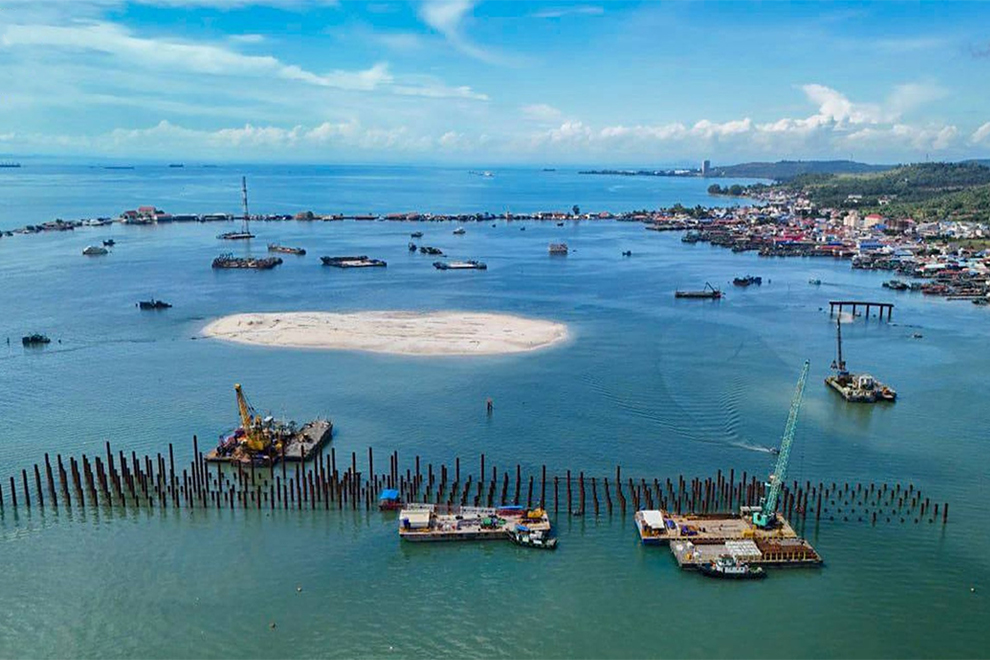 Work is underway to expand the capacity of Sihanoukville Autonomous Port (PAS), Cambodia’s largest seaport. PAS
-Opinion-
New rails, ports and power links are multiplying across ASEAN. The real test is simpler: fix the paperwork, keep the money clean and make systems talk across borders.
Southeast Asia’s map is filling with hard infrastructure. Inland markets are being stitched to deep-water ports, cross-border highways are smoother, and energy links are creeping across borders.
On paper, this looks like a breakout moment for the ASEAN economies that sit astride some of the world’s busiest sea lanes. But roads, tracks and pipes don’t create value by themselves. Rules do.
When borders are unpredictable, documents stay on paper, contracts stay opaque and even shiny new assets fail to deliver. From the Mekong to the Malacca Strait, the pattern is constant: trucks and trains don’t fear distance; they fear delay. The fastest unlock isn’t another ribbon-cutting — it’s making crossings predictable.
Here’s the punchline: three levers — paperwork, transparency, interoperability — turn corridors into reliability, and reliability is what shippers actually buy. Get those right and ASEAN gains throughput and bargaining power; get them wrong and the region adds concrete but stays exposed.
Fix the border first
Give traders the ability to submit cargo data before arrival, and reuse that same data across every agency that needs it. Make inspections risk-based so officers focus on higher-risk shipments and let the rest flow. Publish simple service targets at key gates — the median time a container spends at the border, and the 75th-percentile time that logistics managers really price into contracts. Where these basics exist, both time and — crucially — time variability fall. Reliability is the product.
This isn’t a tech moonshot. It’s software and coordination: customs that “talks” to health, agriculture and port authorities; pre-arrival processing that actually clears cargo; and a corridor unit with the authority to fix frictions that fall between ministries. If systems can’t share the same shipment data, you’ve built a toll road to a traffic jam.
Crisp proof points already exist. Preferential certificates of origin can move electronically through the ASEAN Single Window, letting importers auto-validate origin and release cargo faster. Under the ASEAN Customs Transit System, a sealed truck can cross multiple borders on a single electronic declaration and a single guarantee — no re-clearing at each stop. These are simple rule changes that multiply the value of every kilometre of road.
Finance that frees, not binds
Who pays — and on what terms — matters as much as where a road goes. Heavy reliance on a single lender and closed-door deals raises the risk of one-sided dependence. The fix isn’t glamorous, but it works: open tenders; published contract terms and debt timelines; and blended finance that mixes bilateral funds with multilateral banks and political-risk insurance.
Transparency widens the pool of bidders and cuts capital costs. It also gives governments the confidence to cancel or redesign weak projects before they become costly mistakes.
Apply the same discipline to energy integration. Grid interconnectors and gas links can balance demand across borders and keep factories humming, but only if the rules are bankable: enforceable transit guarantees, clear metering and settlement, credible buyers and a realistic plan for sharing risk when politics, weather or fuel markets turn.
Without those basics, projects get stuck in the loop of announcements and extensions. Stage big builds against verified milestones, diversify financing so no single player holds the keys, and use escrow to keep cash flows predictable.
A live example shows the direction: cross-border power trade pilots in mainland Southeast Asia have proven the concept of wheeling electricity across more than one jurisdiction. The technology isn’t the hurdle; transparent rules are.
Standards are power
As new corridors meet old systems, quiet frictions multiply: competing tech stacks, overlapping security spheres and compliance checks in distant markets. The practical response isn’t grandstanding; it’s interoperability.
Customs platforms should speak your neighbours’ data standards; port and rail software should match across borders; documentation should be clean enough to pass audits in more than one jurisdiction. Choose the technical language once and require every partner to plug into it — sovereignty through standards.
Getting the standards right also blunts external pressure. When procedures are shared and data flows cleanly, the same kilometre of rail or pipe delivers more growth — and less leverage to outside actors. In a more multipolar moment, that’s how ASEAN converts options into bargaining power.
The politics inside the border matter too. Corridors concentrate gains along the line and can leave other places feeling bypassed. That invites backlash. Pair each border hub with local wins: small-firm logistics programs near crossings, skills training in border towns and ring-fenced funds to maintain feeder roads. If voters and small businesses see a benefit, the coalition for connectivity holds when construction dust settles.
This is a rare moment. Supply chains are re-routing; multiple outside players want in; and the region’s consumer market is still growing. That pluralism is leverage only if governments set the operating rules at home. Get the border playbook right, keep the money clean and insist on interoperable standards, and Southeast Asia can bank the benefits of overlapping initiatives while avoiding new strings. Ignore the basics, and the map fills with lines that move fewer goods, at higher cost, with greater vulnerability to pressure.
Steel and concrete will keep grabbing headlines. The quiet levers — customs code, clean contracts and simple dashboards — will decide who actually wins.
Kashif Hasan Khan is head of the Department of Economics at Paragon International University in Phnom Penh. The views and opinions expressed are his own.
-The Phnom Penh Post-