Ceasefire hinges on mutual respect and trust, UN warns
 Ceasefire hinges on mutual respect and trust, UN warns
Synopsis: United Nations human rights chief urges Cambodia and Thailand to honour their agreement to suspend hostilities and rebuild trust amid an exchange of accusations and Thailand’s detention of Cambodian soldiers.
Amid a ceasefire between Cambodia and Thailand, the United Nations human rights chief has called on the two countries to show respect to each other and commit to the confidence-building process to ensure lasting peace.
To achieve this, however, could prove challenging as the two nations continue to lob accusations at each other.
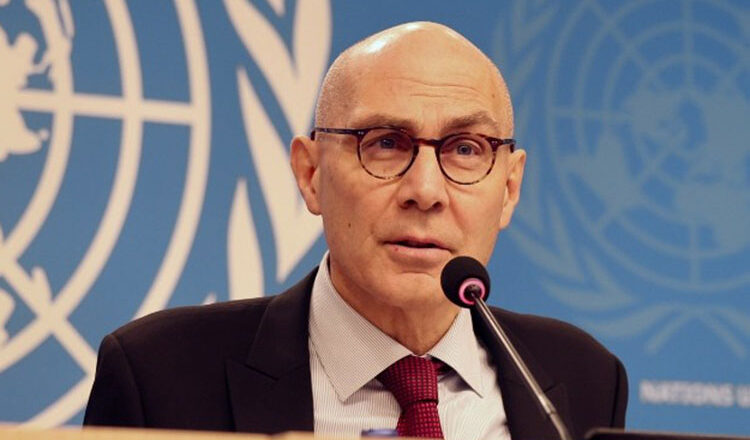
UN High Commissioner for Human Rights Volker Türk on Wednesday called on Thailand and Cambodia to protect civilians from further harm by fully respecting and implementing the ceasefire agreed on Monday, stressing the need to take quick measures to rebuild confidence and peace.
“Particularly at this time of increasing conflicts and crises around the world, I wholeheartedly welcome the ceasefire agreed between Thailand and Cambodia, with the important involvement of Malaysia as ASEAN chair,” Türk said.
“This crucial agreement must be fully respected, in good faith, by both sides, as diplomatic efforts continue, in a bid to resolve the root causes of the conflict.”
The High Commissioner added that it was important that both sides continue efforts to restore security at the border and ensure that victims of violence and displacement receive redress in line with international human rights and humanitarian laws and standards.
More than 180,000 people are reported to have been displaced on the Thai side of the border, while 168,946 were reported displaced in Cambodia.
“In a tense situation of this kind, it is important that both Thai and Cambodian authorities take steps to rebuild confidence, to counter harmful and inciteful rhetoric, and to tackle misinformation in accordance with international human rights law,” Türk said.
“It is the responsibility of both governments to ensure the safety and protection of each other’s nationals on their territory.”
While the ceasefire agreement, signed by Cambodian and Thai leaders in a high-level meeting in Malaysia on July 28 after five days of deadly clashes, has been upheld in principle, diplomatic differences have prevented the two nations from starting the trust-building process.
Thailand has accused Cambodia of violating the ceasefire without backing the claims with evidence.
In addition, Thai soldiers illegally detained 20 Cambodian soldiers on Wednesday – one of whom escaped while two others are feared dead – a day after the ceasefire went into effect. The Cambodian soldiers were reportedly captured during an appointment between the two armies for a post-ceasefire handshake in the disputed Choam Te battlefield zone.
According to the Cambodian military, when its soldiers approached to exchange greetings with their Thai counterparts in the spirit of the ceasefire, Thai forces suddenly turned their weapons on them and arrested them without provocation.
Thailand’s Foreign Affairs Ministry spokesman Nikorndej Balankura, however, claimed that the Cambodian soldiers were encroaching on Thai territory.
“This prompted Thai forces to exercise their inherent right to self-defence and to protect Thailand’s territorial integrity,” he said. “The Cambodian soldiers involved were taken into custody. A number of them were wounded and subsequently surrendered to the Thai side,” said Nikorndej, who is Director General of Thailand’s Department of Information.
This incident, as clarified in the official press statement by the Royal Thai Army, serves as further evidence of ongoing violations of the ceasefire terms by the Cambodian side – violations that Thailand has repeatedly urged Cambodia to cease, he added.
Meanwhile, Cambodia continues to deny what it calls the “false allegation” of the other side.
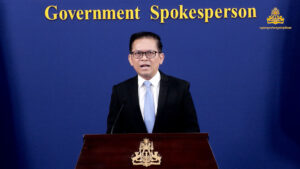
“The Ministry of Foreign Affairs and International Cooperation categorically rejects once again Thailand’s false allegation of ceasefire violation made in a statement issued by the Ministry of Foreign Affairs of Thailand on 30 July 2025,” the ministry’s spokesman Chum Sounry said yesterday in a press conference.
“Cambodia also stresses the importance of restoring and sustaining peace for the benefit of both countries and the region.”
Sounry added that Cambodia is dedicated to a peaceful resolution through the application of international law and mutual respect for sovereignty and territorial integrity.
Asian Vision Institute President Chheng Kimlong said the trust-building process between Cambodia and Thailand could only be accomplished “step by step” and after Thailand commits to respect international laws and sort out its internal political chaos.
“It is not easy for Thailand to violate the ceasefire agreement because it is not just a bilateral agreement between Cambodia and Thailand but an agreement that was observed by Malaysia, the current rotating chair of ASEAN, as well as the US and China, both of which are permanent members of the United Nations Security Council,” he said.
“Thailand also needs to respect the previous treaty, including the Franco-Siamese 1907 Treaty and MOU 2000, in order for Cambodia to trust it again. The Thai government also needs to solve the political problem inside the country to ensure that there is no longer a power struggle between the government and the military.”
Melina Antoniadis, a lawyer specialising in public international law, told Khmer Times that while the ceasefire between Cambodia and Thailand is a welcome development, the underlying issues will remain unresolved and the risk of future conflicts persist unless the border dispute is decided once and for all by the International Court of Justice (ICJ).
“Cambodia has faced similar border disputes with Thailand in the past and has consistently sought peaceful and lawful means to resolve them by submitting cases to the ICJ, consistent with international law,” she said.
In 1962, Cambodia brought the dispute with Thailand over the Temple of Preah Vihear before the ICJ, which ruled in Cambodia’s favour, affirming the temple is located in Cambodian territory.
“Following renewed clashes with Thailand in 2008, Cambodia requested an interpretation of the 1962 judgment, and in 2013 the ICJ reaffirmed Cambodia’s sovereignty over the temple, ordering Thailand to withdraw all personnel stationed on the promontory,” Antoniadis noted.
“In light of the recent conflict, which, as we have seen, has caused damage to parts of the Preah Vihear Temple, it is imperative that Thailand cooperate with Cambodia in jointly submitting this dispute to the ICJ in order to prevent further border clashes and the devastating consequences they bring to our people.”
Khmer Times