A Meeting of Three Global Heavyweights: Xi Jinping, Trump, and Putin — Are the Great Powers Preparing to Divide the World Again?
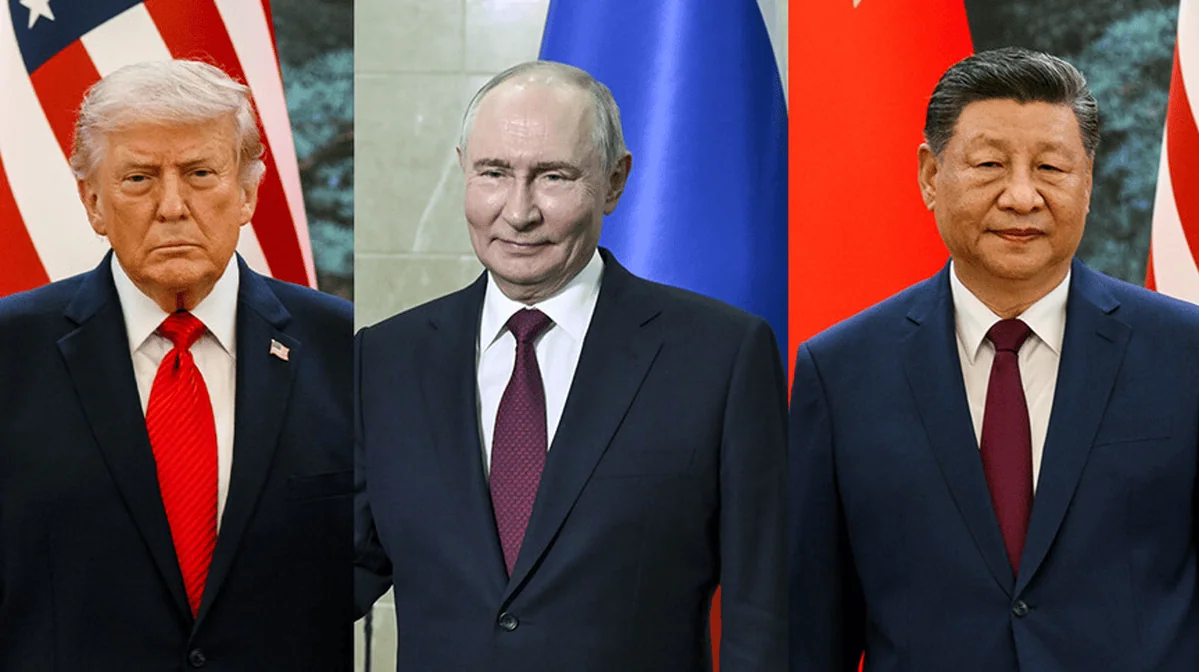 US President Donald Trump, Russian President Vladimir Putin and Chinese President Xi Jinping, who are reportedly scheduled to meet in Shenzhen, China, on November 19. Supplied
As the Second World War was drawing to a close, three great-power leaders — US President Franklin D. Roosevelt, British Prime Minister Winston Churchill and Soviet leader Joseph Stalin — met at Yalta in February 1945 to discuss the future of Europe and the establishment of a postwar world order.
More than 80 years later, history appears to be presenting a somewhat similar picture. This time, the three leaders are US President Donald Trump, Russian President Vladimir Putin and Chinese President Xi Jinping, who are reportedly scheduled to meet in Shenzhen, China, on November 19, to discuss issues concerning international security and stability.
What makes this prospective meeting particularly interesting is that the negotiating table once again brings together three major powers, but the composition has changed. Britain, once one of the world’s largest colonial powers in the twentieth century, no longer occupies a seat at this particular trilateral table. Instead, China has emerged as a new major player. Indeed, China, which once suffered foreign invasion and interference, has become an economic, military and technological power capable of engaging directly with the US and Russia in the twenty-first century.
This transformation appears to reflect a broader shift in the global centre of power. Europe, which once dominated international politics, is no longer the sole centre of geopolitical influence. Instead, the international system is evolving toward a structure in which Asia plays an increasingly significant role.
Nevertheless, the central issue is not simply who sits around the negotiating table. The more important question we should be asking is: Are these leaders negotiating to end existing conflicts, or are they seeking a new formula for dividing spheres of influence and determining the fate of other countries?
Amid the geopolitical tensions of early winter 2026, this article examines five key dimensions of this question.
1. Yalta 1945: When the Great Powers Shaped Postwar Europe
The Yalta Conference, held from February 4 to 11, 1945, became one of the most significant events in the history of international relations. At that time, Nazi Germany was approaching military defeat, and the Allied powers had begun discussing the administration of postwar Germany, the future of Poland and the establishment of the UN.
Although the Yalta Conference was not an agreement to divide the entire world, the decisions reached and the military balance of power at the time contributed significantly to the foundations of the postwar division of influence in Europe.
Following the Second World War, Eastern Europe increasingly came under Soviet influence, while Western Europe developed closer political and security ties with the US. Germany was divided into four occupation zones, which eventually gave rise to two separate states in 1949: the Federal Republic of Germany (West Germany) and the German Democratic Republic (East Germany).
In other words, the Second World War did not merely bring an old international order to an end. It also opened the way for a new order in which military power and spheres of influence became central foundations of international politics for decades.
2. Shenzhen 2026: From Territorial Division to the Division of Influence?
If the Yalta Conference of 1945 represented discussions about the organisation of the world after the Second World War, the proposed Shenzhen meeting of 2026 may be viewed as a test of the great powers’ ability to manage conflicts that remain unresolved.
The US has significant interests in nuclear arms control, strategic competition with China and the stability of the international economic system. Russia, meanwhile, is likely to seek assurances that its security interests and demands concerning Ukraine will be taken into consideration. China, for its part, may wish to demonstrate its role as a major power capable of influencing the direction of global politics while avoiding direct involvement in conflicts that do not serve its strategic interests.
Against this backdrop, the traditional formula of territorial division may not necessarily be repeated in its original form. Instead, contemporary great powers may seek understandings through the recognition of security interests, the establishment of strategic red lines, the reduction of direct confrontation and negotiations concerning regions they consider strategically important.
Such arrangements could represent a new form of dividing spheres of influence without necessarily drawing new borders on the existing world map.
However, negotiations of this nature would also face substantial obstacles. Ukraine, the member states of the EU and other countries cannot simply be disregarded without significant political and international legal consequences.
3. Could One Ukraine Become Three Ukraines?
European history demonstrates that major wars can lead to territorial changes and the emergence of new states.
Following the First World War, the Austro-Hungarian Empire collapsed, and its former territories became parts of several states, including Austria, Hungary, Czechoslovakia and others.
Similarly, the Socialist Federal Republic of Yugoslavia gradually disintegrated during the 1990s and 2000s, eventually giving rise to six independent states from its former constituent republics. Meanwhile, Kosovo’s statehood and international recognition remain contested.
These historical examples demonstrate that political borders are not necessarily permanent. Nevertheless, territorial changes do not mean that every war inevitably produces new states.
In the case of Ukraine, three possible scenarios deserve consideration.
Scenario One: Ukraine Remains a Single Internationally Recognised State
Ukraine could maintain its status as one internationally recognised sovereign state, even if control over certain territories remains disputed.
Under this scenario, Ukraine’s internationally recognised borders would remain legally intact, although the government in Kyiv might not exercise effective control over all territories within those borders.
Scenario Two: A De Facto Division of Territorial Control
Ukraine could face a prolonged division of effective territorial control between areas administered by the government in Kyiv and areas controlled by Russia, without the formal recognition of new independent states.
Such a situation would create a distinction between internationally recognised sovereignty and actual territorial control.
Scenario Three: The Emergence of Three Separate Administrative or Security Zones
Under conditions of major political and military change, Ukraine could theoretically be reorganised into three distinct zones: Territories administered by Kyiv, territories controlled by Russia, and a third area operating under a special security or administrative arrangement.
However, this third scenario remains highly speculative. There is currently insufficient evidence to conclude that Ukraine will eventually become three separate countries.
We should therefore avoid drawing premature conclusions and instead allow time to observe further developments.
4. The Middle East: Will Borders Change, or Will the Balance of Power Shift?
The Middle East is another region that could be affected by either strategic accommodation or intensified competition among the three major powers.
Indeed, the region holds enormous geopolitical importance because of its energy resources, the Strait of Hormuz, the Bab el-Mandeb Strait and major international trade routes.
At the same time, conflicts involving Iran, Israel and Palestine, together with broader security challenges across the region, have made the Middle East a focal point of competing great-power interests.
If the US, Russia and China manage to reach an understanding on Middle Eastern security, the outcome could involve a redefinition of their respective roles in regional security and conflict management rather than the formal partition of existing states.
Conversely, if strategic competition intensifies, the region could continue to experience proxy conflicts, arms races and confrontations along critical energy transportation routes.
Therefore, the central question is not merely which countries might be divided. Rather, we should ask: Which power will gain greater influence over security, energy resources and political decision-making in the Middle East?
5. Is an Old Formula Returning in a New Form?
From the perspective of power politics, competition among great powers is not a new phenomenon. What changes over time are the methods, instruments and circumstances through which such competition unfolds.
In 1945, military strength and territorial control played central roles in shaping the postwar international order.
By contrast, in 2026, power is no longer defined solely by armies and territorial possessions. It also encompasses technological capabilities, international trade, energy resources, financial influence and the ability to control global supply chains.
Consequently, if a “New Yalta” were to emerge, it might not involve drawing black lines across maps to divide territories, as in earlier periods of history. Instead, it could take the form of negotiations to define spheres of influence and establish mutual understandings concerning the strategic interests of major powers.
Yet we should remember that today’s international system is considerably more complex than that of 1945.
Actors such as the EU, India, Japan, ASEAN and other regional powers possess their own diplomatic capabilities and strategic choices. Smaller states also have legal, diplomatic and economic instruments through which they can defend their national interests.
This means that any attempt to reorganise global spheres of influence would face a far more complicated political environment than the one confronting the great powers at the end of the Second World War.
In conclusion, the five dimensions examined above suggest that, from Yalta in 1945 to Shenzhen in 2026, the world has undergone profound transformations. Nevertheless, competition for power and the pursuit of strategic interests remain central forces shaping international politics.
In this context, the anticipated meeting between Xi Jinping, Donald Trump and Vladimir Putin cannot yet be interpreted as an agreement to divide the world anew.
However, it is an important development that deserves close attention. Will these three great powers use diplomacy to promote peace while respecting the sovereignty of individual states? Or will they seek a new formula for defining their respective spheres of influence based on the prevailing balance of power?
Will Shenzhen 2026 mark the beginning of a new era of peace, or the first step toward a reorganisation of great-power spheres of influence in the twenty-first century?
The answer is not yet clear.
What can be said, however, is that history may not repeat itself exactly, but the competition for power and the pursuit of strategic interests have never disappeared from the stage of world politics.
Dr. Khek Vireak is director of the Asia Research Center, Royal Academy of Cambodia. The views and opinions expressed are his own.
-Phnom Penh Post-