Editorial 79 – Seagrass Meadows Beneath the Surface
 Editorial 79 – Seagrass Meadows Beneath the Surface
Opening Thought
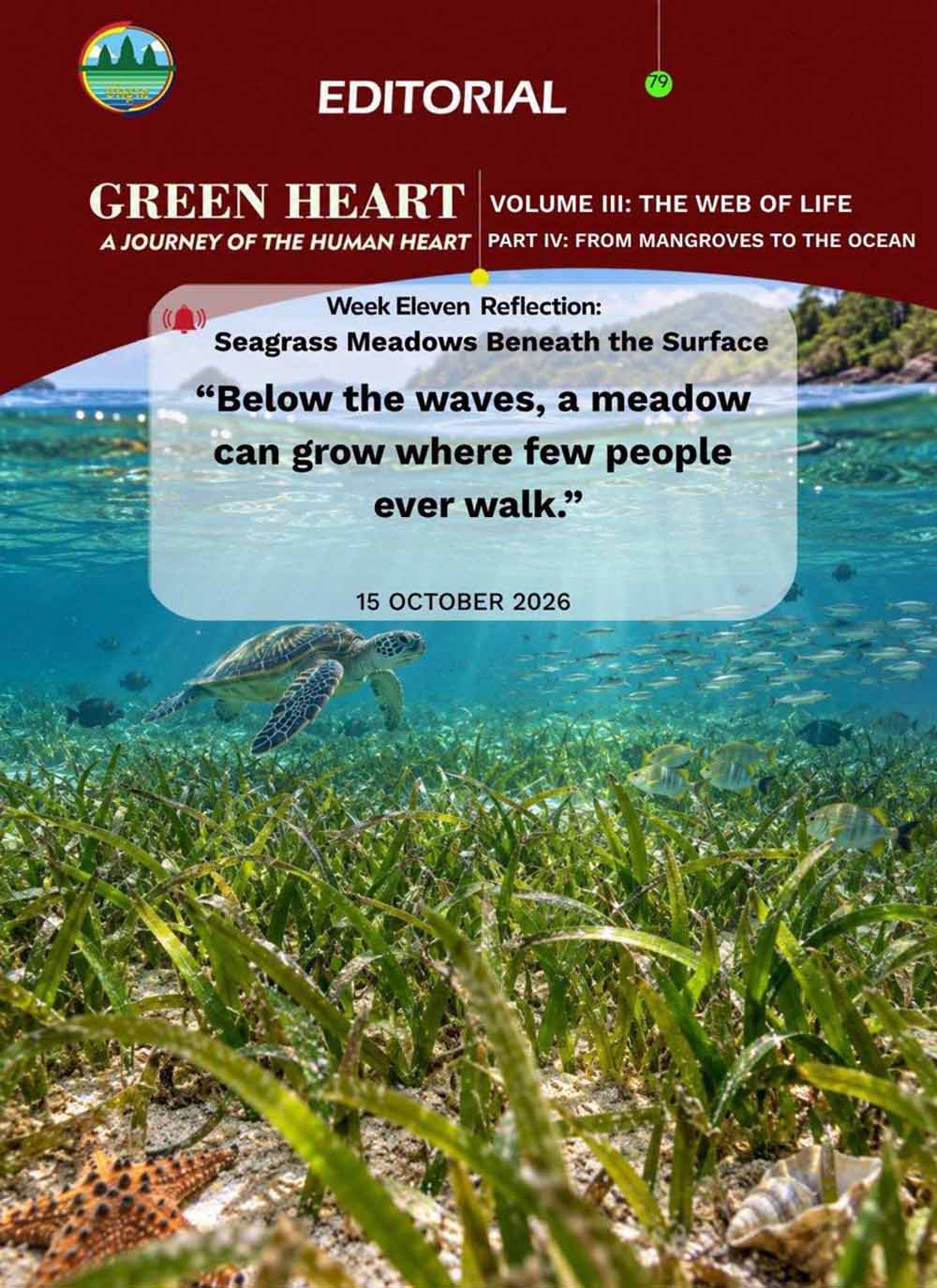
“Below the waves, a meadow can grow where few people ever walk.”
Editorial
Seagrasses are flowering plants adapted to life in salty coastal water. Unlike seaweeds, they have roots, stems, leaves, flowers, and seeds. They form underwater meadows in shallow areas where enough light reaches the bottom.
Seagrass roots and rhizomes anchor plants in sediment. The meadows slow water, trap particles, and provide habitat for fish, invertebrates, turtles, dugongs, and other species, depending on the region.
Young fish may shelter among the blades, making some meadows important nursery grounds. Leaves support grazing and detritus-based food webs. Seagrass habitats may connect mangroves and coral reefs through animal movement and material flows.
Seagrass captures carbon through photosynthesis, and some carbon becomes stored in sediments. Protecting these “blue carbon” ecosystems can support climate mitigation, though storage varies and must be measured carefully.
Seagrass needs light. Sediment, algal growth stimulated by excess nutrients, dredging, and polluted runoff can reduce water clarity. Anchors, boat propellers, destructive fishing gear, and coastal construction may damage plants and sediments.
Because the meadow lies underwater, decline can remain unnoticed. A coastline may look unchanged while a major habitat disappears beneath the surface. Mapping and long-term monitoring make the invisible visible.
Restoration is possible in some places, but difficult. Transplanted shoots or seeds need suitable light, water quality, depth, sediment, and protection. Removing the cause of decline is often the first step.
People who fish, navigate, dive, or live near the coast can contribute observations. Their local knowledge may reveal where meadows once grew, which species use them, and how conditions have changed.
The seagrass meadow teaches that forests and grasslands are not only terrestrial. Plants have entered the sea and built communities beneath the waves.
We protect what we can see, but a green heart learns to imagine below the surface. The hidden meadow is still part of our shared home, quietly sheltering life and holding the seabed together.
Maps, underwater cameras, fisher observations, and water-quality measurements help make hidden change visible. When communities can see where seagrass survives and why, navigation, fishing, restoration, and coastal development can be planned with greater care.
Public stories can help as well. A meadow given a local name and connected to familiar fish or turtles becomes easier to remember. Knowledge gives the hidden habitat a place in community imagination.
What enters shared memory is more likely to enter shared decisions and care.
The hidden meadow then gains visible guardians.
Buddhist Reflection
Right view includes what lies beyond immediate sight. Invisible value remains value. Humility asks us to protect hidden systems before loss makes their importance obvious.
Today’s Reflection
Why can seagrass decline without people on shore noticing immediately?
Today’s Action
Compare seagrass, seaweed, and land grass. List one similarity and two biological differences.
Today’s Pledge
Today I will remember the hidden meadows and protect the clear water they need.