The Thailand-Cambodia Border Conflict: Fact vs. Fiction at the UN
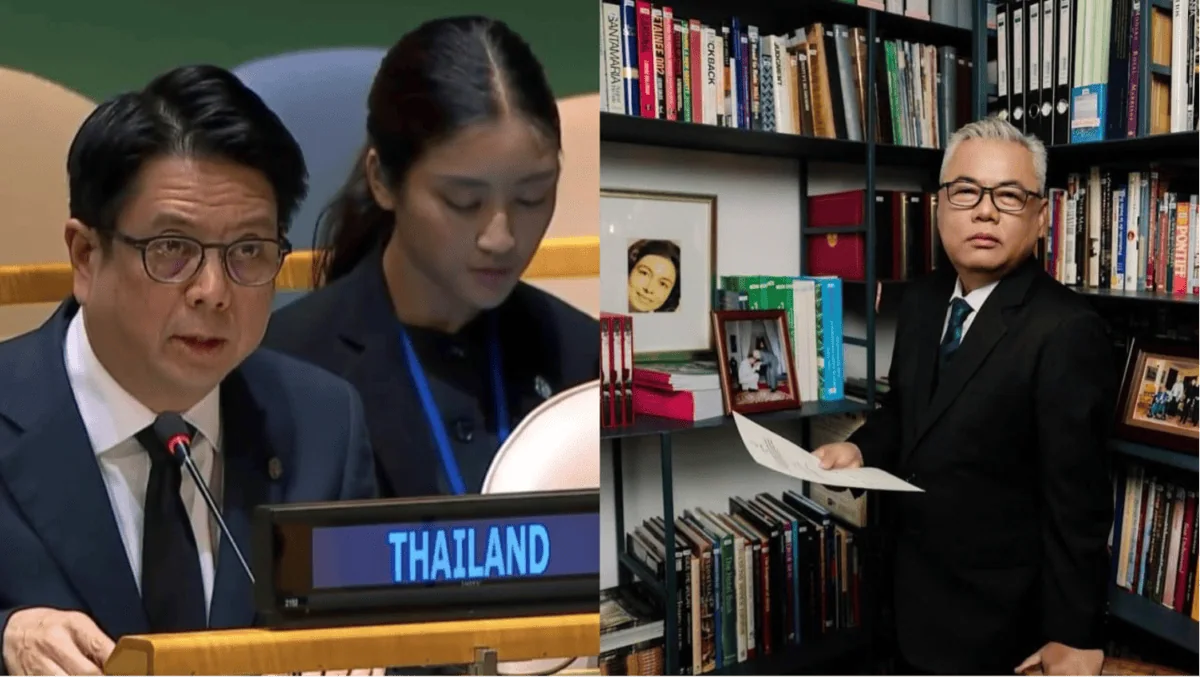 Cherdchai Chaivaivid (left), Thai ambassador to the UN in New York, Youk Chhang, DC-Cam director. Supplied
#Opinion
It is mystifying how comfortable the Thai government appears when presenting wildly false and misleading information about its border conflict with Cambodia in the public forum of the UN General Assembly.
Fortunately, the international community need only refer to the facts on the ground and the historical record to come to a reasonable conclusion on what is required to peacefully resolve the border conflict between Thailand and Cambodia.
There are kernels of truth to what Thailand presented to the General Assembly and one can begin with these. First, there is no question that Thai politicians were upset with Cambodia’s release of a recording of a private conversation between Thai and Cambodia leaders. Second, several Thai soldiers were reportedly injured by unexploded ordnance along the border, and third, there’s no doubt that hundreds of thousands of Thai and Cambodian civilians have and are being harmed by this tragic conflict.
Unfortunately, the extent of truthful information provided by the Thai government stops there, and none of these facts remotely justify the Thai government’s military actions against Cambodia. A lack of facts, however, was not enough to impede the Thai government from creating imagined circumstances and a false narrative to paint Thailand as an innocent victim at the hands of a “provocative” Cambodian government and people.
The Thai government claims, without any clear evidence, that the unexploded ordnance that was the source of injuries to its soldiers were actually mines surreptitiously planted by Cambodians on Thai soil. It conveniently fails to acknowledge that these areas were heavily mined and laden with unexploded ordnance from decades of war. Further, it describes how the Thai military were not the first aggressors in the conflict and the Cambodian civilians who were displaced were actually occupying Thai land since the 1980s in defiance of Thai protests.
All of these imagined ideas depend upon an international community that is removed from the facts on the ground and willing to accept Thailand’s claims purely based upon a presumption that Thailand has no motives to mislead, distort or lie. Again, Thailand struggles with the historical record of its actions along the border with Cambodia.
Time and again, Thailand has sought to seize and control vast portions of Cambodia’s territory. In the 19th century, Thailand occupied large swaths of Cambodian territory until the French and Cambodian governments pushed them out. When World War II began, again, Thailand seized these territories until they were pushed out by the Americans.
Finally, throughout the past several decades, Thailand conducted sporadic military actions to harass or intimidate Cambodia in its control over its territory along the border. In addition, when faced with international court rulings on discreet areas of the border, i.e., the Preah Vihear temple, Thailand also chose to ignore international law.
Thailand’s recent attempt to seize these areas under the false narrative that these areas were always part of Thailand is not a new claim; nor is its creation of false narratives a novel strategy.
Thailand’s representations to the UN General Assembly were a recycling of old ideas for a long-held desire of control over Cambodian territory. We can only hope that the international community recalls the long history here and recognises the recent developments as a repeat of the past.
Youk Chhang is director of the Documentation Center of Cambodia (DC-Cam). The views and opinions expressed are his own.
-Phnom Penh Post-