Online scams must not be used to mask Cambodia’s sovereignty issues, says Information Minister
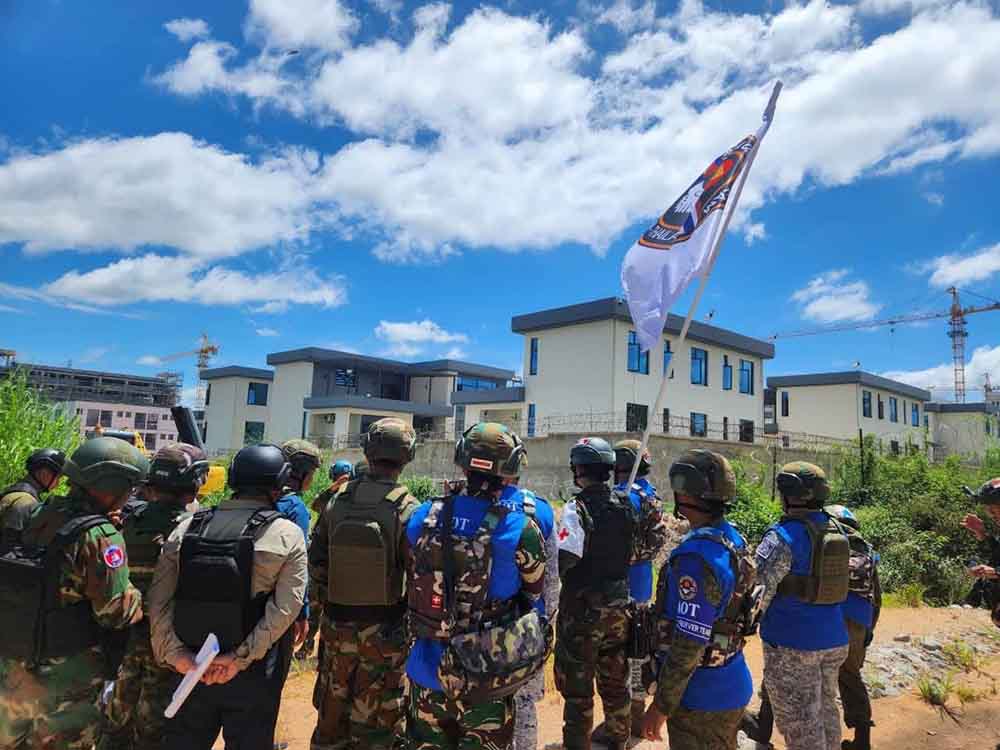 ក្រុមអ្នកអង្កេតការណ៍អាស៊ាន (AOT) ឈរមើលទិដ្ឋភាពអគារខ្មែរដែលត្រូវយោធាថៃព័ទ្ធបន្លាលួសយកនៅតំបន់អូរស្មាច់។ រូបថត សហការី
Minister of Information Neth Pheaktra has called on Thailand to address fundamental questions over territorial sovereignty before discussing “fact-checking” activities related to online scam operations in border areas.
In a message posted on his Facebook page on Monday, he said that before journalists and other stakeholders examine buildings, documents, computers or other materials allegedly linked to online scams, they should first determine whose territory those locations are situated in and when and how Thai forces came to control them.
His remarks came as Thailand planned to take members of the ASEAN Observer Team as well as Thai and international journalists to border areas, including the O’Smach–Choam checkpoint area, today, under the stated purpose of allowing them to observe the situation directly and independently verify the facts.
Pheaktra stressed that professional fact-checking should examine not only what is presented at a particular site, but also its geographical location, coordinates, maps, treaties, border documents, the situation before the fighting and the legal basis for the presence of foreign forces there.

Regarding O’Smach, he said Cambodia has repeatedly maintained that the locations currently controlled by Thai forces are situated in Cambodian territory and has formally protested the entry of Thai forces and the bringing of foreign military attachés, officials and journalists into the areas without Cambodian authorisation.
He emphasised that military presence, the raising of a national flag or effective control by force cannot by themselves establish sovereignty or replace maps, treaties, border documents and other legal foundations defining state territory.
Pheaktra also made clear that Cambodia does not protect online scam operations and remains firmly opposed to such crimes, which should be addressed through law enforcement, police cooperation, intelligence sharing, mutual legal assistance, arrests, extraditions and other established international mechanisms.
However, he stressed that combatting online scams and resolving issues of state sovereignty are separate matters.
“The suspicion of criminal activity in one state’s territory does not give the forces of another state the right to enter, occupy or exercise authority over that territory unilaterally,” he said.
He further questioned whether online scams were being used retrospectively to justify the presence and control of Thai forces in areas that Cambodia says were taken through military action.
He said credible fact-checking should examine the chronology of events rather than focus solely on materials presented during a visit organised by one side.
Pheaktra recalled that on February 2, Cambodia strongly protested Thailand’s bringing of foreign military attachés and law-enforcement officials to two hotels in O’Smach. According to Cambodia’s Ministry of Foreign Affairs, the locations are about 397 metres from the O’Smach International Checkpoint and adjacent to Border Marker 5, and were taken under Thai military control during the fighting in December last year.
Cambodia subsequently protested the placement of containers blocking roads, road construction, the installation of barbed wire, earthworks and other infrastructure in the O’Smach area, as well as the raising of the Thai flag and the bringing of Thai and foreign journalists to the area without Cambodian permission.
He also cited a June 30 statement by the Ministry of Information, which said that bringing foreign journalists into O’Smach by the Thai side could not confer authority or sovereignty over the area.
Pheaktra concluded that journalists should verify not only what they see inside a building, but also where they are standing, who brought them there and what legal basis exists for the presence of the party controlling the location.
He stressed that bringing journalists to a location cannot create sovereignty, control by force cannot redraw an international border, and online scams must not be used as a post-event justification for the illegal occupation of its territory by force. AKP