Thai ‘defence’ plan questioned amid ceasefire violations
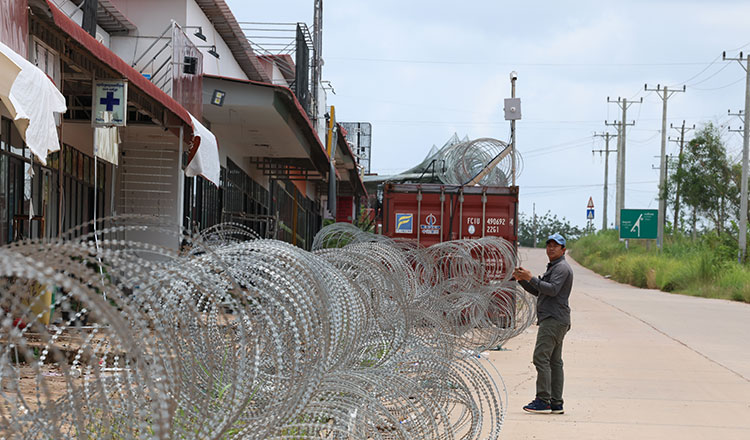 The Thai military illegally blockades Cambodian territory with barbed wire in Pursat province amid a ceasefire. KT/Khem Sovannara
Synopsis: Phnom Penh calls on Thailand to respect the 2025 ceasefire agreement and resolve territorial disputes through international law rather than military force.
Questions are mounting over the purpose of Thailand’s military preparations along the Cambodia–Thailand border, as Cambodian officials continue calling for disputes to be resolved through international law and peaceful mechanisms.
Thailand’s Joint Information Centre (JIC) defended the “Chakrabongse Bhuvanath” plan as a national defence measure, rejecting suggestions that it demonstrated advance preparation for military action against Cambodia.
A Cambodian official said the issue is not whether Thailand has the right to maintain national defence plans, which every state is entitled to do, but what the plan was intended to achieve when translated into operational preparations and military actions.
The official cited remarks attributed to former Second Army Region Commander Boonsin Padklang, who was reported by Thai media as saying that, while serving as commander, he had “constantly thought about how we would take back the territory.”
“This is not an allegation invented by Cambodia. These are remarks attributed to a former Thai military commander and reported by Thai media,” the official said.
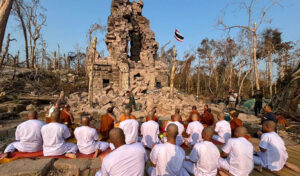
The official added that the remarks raise questions over Thailand’s explanation that the preparations were purely defensive, particularly given the reference to taking territory back. Subsequent developments must also be considered, including Thai forces establishing a military presence and displaying the Thai flag at locations Cambodia maintains are within its sovereign territory.
“A military plan cannot be judged merely by the label attached to it. Its purpose must also be assessed against the objectives expressed before its implementation and the actions that followed,” the official said.
The official stressed that self-defence is intended to repel a threat and does not provide a legal basis for acquiring territory, establishing sovereignty through military presence, or changing an international boundary by force. The planting of a flag, deployment of troops, or construction of military infrastructure cannot create legal title to territory.
“Borders are determined by law, not military force. A flag planted after the use of force cannot redraw a boundary,” the official said.
Meanwhile, government spokesman Pen Bona reiterated Cambodia’s position that the Joint Statement of December 27, 2025, should be considered in its entirety rather than through selected provisions.
Bona said the first six measures of the Joint Statement established commitments to reduce tensions between the two sides. These include an immediate ceasefire covering all types of weapons, attacks against civilians and infrastructure, and military assets.
The agreement also requires both sides to maintain their forces at existing positions and prohibits further troop movements, including patrols into the other side’s positions.
Bona said the Joint Statement does not affect border demarcation or the international boundary between Cambodia and Thailand. The Joint Boundary Commission (JBC) is tasked with continuing surveys and border demarcation under existing agreements, with priority given to affected civilian areas.
The agreement allows civilians in affected border areas to return to their homes and resume normal livelihoods. Both sides are prohibited from increasing forces along the border or taking provocative actions, including military activities entering the other side’s airspace, territorial integrity, or positions. The construction or expansion of military infrastructure beyond existing positions is also prohibited.
Bona said Cambodia’s JBC sent diplomatic notes to Thailand requesting a special JBC meeting and proposing a joint technical team to resume field surveys.
In a Wednesday Facebook post, Information Minister Neth Pheaktra rejected calls for Cambodia to refrain from raising the border dispute at international forums, saying silence would not resolve issues on the ground.
He said Cambodia cannot remain silent while Thai forces allegedly remain on Cambodian territory, disputed structures remain in place, and Cambodian civilians are unable to return to their homes.
“As long as violations of Cambodia’s sovereignty and territorial integrity continue, Cambodia will continue to speak,” he said.
Pheaktra stressed that Cambodia’s position was not intended to confront Thailand, but to protect its national interests and pursue peaceful diplomacy. He said Cambodia has the right to defend its sovereignty, territorial integrity, people, and legal position, while diplomats have a responsibility to present the country’s position to the international community.
He urged Thailand to refrain from unilateral actions that could alter the situation along the border, respect the ceasefire, comply with existing agreements, and use peaceful dispute-settlement mechanisms consistent with international law.
“Cambodia does not claim what belongs to others. But Cambodia cannot accept the use of force or unilateral actions to create new facts on the ground and then be expected to remain silent about them,” he said.
Pheaktra reaffirmed Cambodia’s support for dialogue, bilateral mechanisms and peaceful approaches to resolving disputes. He noted that ASEAN, the Organisation internationale de la Francophonie, and the United Nations provide platforms for countries to raise concerns and pursue diplomatic solutions.
“Diplomacy is the alternative to weapons, and speaking is better than shooting,” he said.
He added that Cambodia will continue presenting its position through bilateral channels and international forums to defend peace based on law and sovereignty.
“Cambodia will be silent when there are no violations left to speak of,” Pheaktra said. “Until then, Cambodia will continue to speak – with facts, with law, and with dignity.”
-Khme Times-