Cambodia rejects Thai PM border claim as lacking legal basis
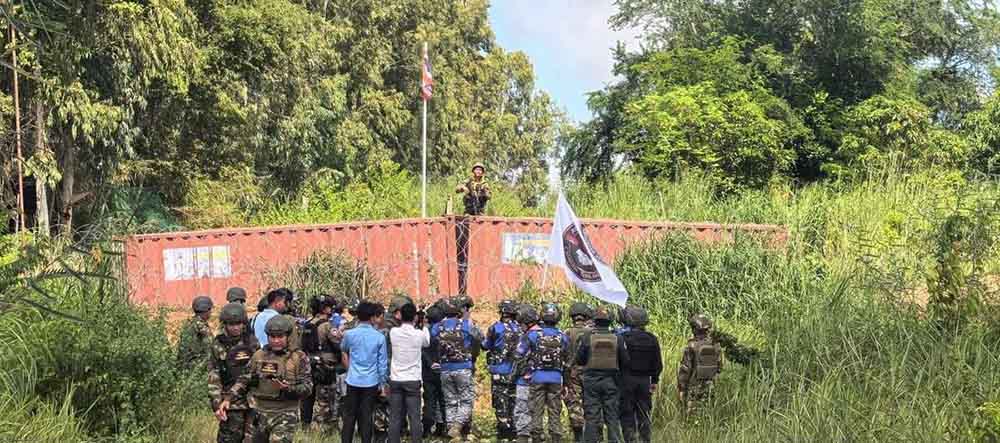 ASEAN observers inspect Thai military deployments, trenches and bunkers in Oddar Meanchey province on Thursday. Ministry of Defence
Synopsis: Phnom Penh dismisses Bangkok’s position over Prime Minister Anutin Charnvirakul’s August 23 visit to the disputed An Seh border area, saying treaties, maps and established boundary mechanisms support Cambodia’s territorial claim.
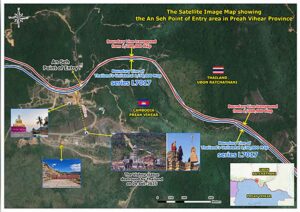
Cambodia has rejected Thailand’s position over Thai Prime Minister Anutin Charnvirakul’s August 23 visit to a disputed border area, saying maps and treaties demonstrate that the location is Cambodian territory while accusing Bangkok of using the issue of online scams to deflect attention from what Phnom Penh describes as military aggression and territorial occupation.
Anutin has maintained that his visit to the Chong An Ma border area, referred to by Cambodia as the An Seh area in Preah Vihear province, fully complied with Thai law and the Cambodia-Thailand 2025 Joint Statement.
He said his inspection of border security and personnel was conducted in accordance with Thai laws.
However, Information Minister Neth Pheaktra said maps, treaties and other internationally recognised boundary documents demonstrate that the location visited by Anutin is Cambodian territory.
In a message posted on his Facebook page, Pheaktra said a photograph of Anutin at the site does not determine territorial sovereignty.
He said Cambodia’s position is based on the 1904 Franco-Siamese Convention, the 1907 Franco-Siamese Treaty, the work of the Franco-Siamese boundary commissions and maps produced during the boundary delimitation process.
“The location where Mr Anutin stood must therefore be assessed by reference to maps and boundary documents, not by flags or military presence,” Pheaktra said.
He said Thailand should provide the legal basis for any claim that the location falls under Thai sovereignty, stressing that unilateral claims or physical presence cannot establish legal sovereignty.
Tensions rose after Cambodia formally protested Anutin’s August 23 visit, describing it as an unauthorised visit to Cambodian sovereign territory. The Cambodian government said the An Seh area had been illegally occupied by Thai armed forces since 2025 and that the visit would not legitimise any claim to the territory.
Cambodia cited the 1:200,000-scale maps produced during the historical delimitation of the boundary between Indochina and Siam and the Joint Statement of the third special meeting of the General Border Committee on December 27, 2025, as part of the legal and diplomatic framework underpinning its position.
Pheaktra said Cambodia’s objection concerns an unauthorised entry into Cambodian territory and called for the disagreement to be addressed through existing bilateral mechanisms, particularly the Joint Boundary Commission (JBC), rather than military deployment or unilateral actions.
Cambodia and Thailand have established mechanisms for surveying and demarcating their land boundary, including the 2000 Memorandum of Understanding on the Survey and Demarcation of the Land Boundary and the JBC.
Pheaktra said Cambodia has proposed JBC meetings at least nine times in accordance with the Joint Statement issued on December 27, 2025, but claimed that Thailand has continued to delay the meetings.
Separately, Pheaktra accused Thailand of using the issue of online scams to divert attention from armed aggression and illegal occupation of its territory.
He rejected a statement by the Joint Information Centre on the Thailand-Cambodia situation that Bangkok had not used online scams as a pretext for military operations or territorial occupation.
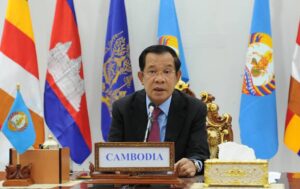
Pheaktra cited remarks by Senate President Hun Sen on Thursday, in which he accused Thailand of using online scams as a pretext for aggression and occupation of parts of Cambodian territory.
The minister referred to Thai military attacks on civilian compounds in O’Smach and Choam in Oddar Meanchey province and Thmar Da in Pursat province.
He highlighted concerns raised by Prime Minister Hun Manet over the continued presence of troops, barbed wire, containers, trenches and other infrastructure, which Cambodia says have created new conditions on the ground before the border is demarcated.
Pheaktra said Cambodia recognises online scams as a serious transnational crime and has taken strong action against such networks. He said more than 700 scam-related locations had been cleared, with authorities continuing investigations, arrests, asset freezes, extraditions, victim rescues and international cooperation.
However, he argued that combating online crime cannot provide a legal basis for one state to cross an international border, use military force or establish territorial control in another country.
“Online scams cannot provide a legal basis for one state to cross an international border, use military force or establish territorial control over another state,” he said.
Pheaktra rejected attempts to portray Cambodia as solely responsible for the region’s online scam and human-trafficking problems, citing United Nations and United Nations Office on Drugs and Crime materials describing the crimes as transnational issues affecting several countries across Southeast Asia.
He said that Cambodia’s position is not aimed at protecting scam operations but at protecting its sovereignty and territorial integrity.
At a press conference on Friday, the National Assembly’s Commission on Foreign Affairs, International Cooperation and Information Chairman Suos Yara said Cambodia’s next task was to protect its international reputation and counter allegations made against the country.
Yara said Cambodia has taken concrete action against online scams, stressing that claims linking Cambodia to scam activities should not be used as a pretext for aggression.
-Khmer Times-