
Cambodia-Japan Cooperation is a Partnership for Peace, Prosperity, and Regional Safety
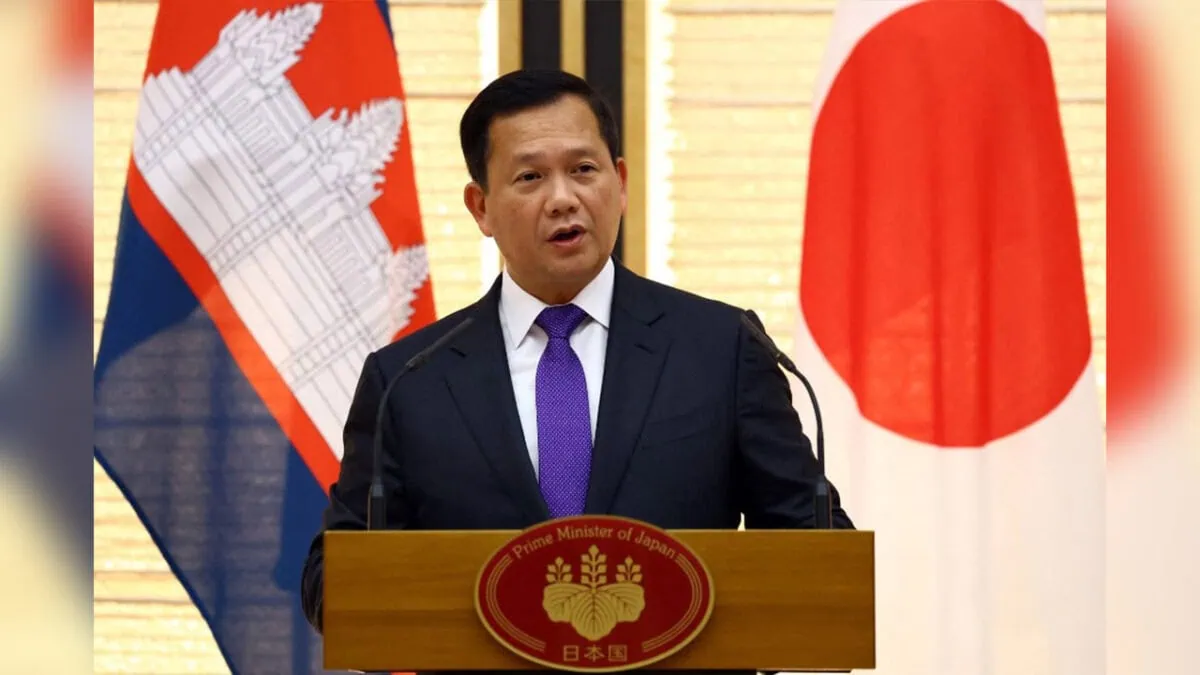 Cambodian Prime Minister Hun Manet speaks during a joint news conference with former Japanese Prime Minister Shigeru Ishiba, in May 2025. ISSEI KATO
#Opinion
In an era of shifting geopolitical currents across the Indo-Pacific, the enduring partnership between Cambodia and Japan stands as a quiet yet powerful testament to what constructive diplomacy can achieve. Rooted in mutual respect, shared values of peace and a genuine desire for sustainable development, Cambodia-Japan relations offer a model of cooperation that prioritises stability over rivalry and progress over confrontation.
Japanese support for Cambodia — in humanitarian assistance, economic development and carefully calibrated defence capacity-building — exists solely to strengthen Cambodia’s internal resilience and contribute to a safer, more prosperous region. This is not about power projection; it is about partnership for peace.
Japan has long been one of Cambodia’s most consistent and trusted development partners. From the post-conflict reconstruction era to the present day, Tokyo’s assistance has focused on tangible improvements in the daily lives of Cambodian people.
Japanese Official Development Assistance has helped build critical infrastructure — roads, bridges, schools, hospitals and water systems — that forms the backbone of national development. Technical cooperation has transferred expertise in agriculture, public administration, education and healthcare.
These efforts are not abstract; they translate into better livelihoods, improved human capital and a stronger foundation for Cambodia to stand on its own feet as a developing nation. Japan’s approach has always emphasised ownership by the Cambodian side, capacity building, and long-term sustainability rather than dependency.
The goal has remained clear: to help Cambodia become a more developed, self-reliant and stable country that can contribute positively to ASEAN and the broader region.
In the realm of defence and security cooperation, the same principle of peaceful intent guides the relationship. Japan’s engagement with Cambodia’s defence sector is modest, transparent and strictly limited to supporting internal security, disaster response and professional capacity building.
It includes training, equipment for non-combat purposes such as disaster relief and maritime safety, and exchanges that promote international norms of military professionalism and civilian oversight. There is no ambition for power projection or entanglement in regional rivalries.
Japan’s postwar identity as a peace-loving nation underpins every aspect of this cooperation. For Cambodia, these ties help strengthen the ability of its armed forces to protect sovereignty, respond to natural disasters that frequently affect the region and maintain internal order — functions essential for any nation seeking stability and development. Far from militarising the relationship, such cooperation reinforces the shared commitment that security tools exist to safeguard peace, not to threaten it.
This partnership delivers benefits well beyond bilateral borders. A stable, developing Cambodia contributes to the overall resilience of ASEAN. A Cambodia that can manage its internal affairs effectively, respond to humanitarian challenges and participate constructively in regional forums helps reduce sources of tension and uncertainty in Southeast Asia.
Japan’s consistent support for ASEAN centrality, the rules-based international order and peaceful dispute resolution aligns perfectly with Cambodia’s own interest in a predictable and secure regional environment. In this sense, Cambodia-Japan cooperation is not merely bilateral goodwill; it is an investment in regional safety and prosperity that serves the wider Indo-Pacific community.
For this positive trajectory to continue and deepen, Cambodia has an important responsibility to strengthen the foundations of good governance. Sustainable development and lasting peace require institutions that are transparent, accountable and free from systemic corruption.
Corruption erodes public trust, discourages quality foreign investment, distorts resource allocation and ultimately undermines the very development gains that partners such as Japan help to create. Cambodia’s leadership has repeatedly affirmed its commitment to reform.
Accelerating concrete measures — strengthening anti-corruption institutions, ensuring transparent public procurement, protecting independent oversight and fostering a culture of integrity in both public and private sectors — would send a powerful signal.
It would demonstrate that Cambodia is determined to maximise the impact of international support and to create an environment where Japanese businesses, investors and development partners can engage with confidence. A cleaner system is not a concession to external pressure; it is an investment in Cambodia’s own future strength and dignity.
People-to-people ties form another vital pillar of the relationship, and tourism offers one of the most direct and mutually beneficial avenues for growth. Japanese visitors bring not only economic value but also cultural exchange, mutual understanding and soft connections that reinforce long-term friendship. To unlock the full potential of this exchange, Cambodia would benefit greatly from introducing visa-free entry for Japanese tourists.
Such a measure would remove an unnecessary barrier, encourage more Japanese travellers to explore Cambodia’s rich heritage — from the temples of Angkor to its vibrant cities and natural landscapes — and signal openness and warmth toward a key partner. Japan has long welcomed Cambodian visitors and students; reciprocal facilitation of travel would strengthen the human foundation of the relationship and generate tangible economic returns for Cambodian communities working in hospitality, crafts and services.
Looking ahead, the Cambodia-Japan partnership has every reason to grow deeper and more dynamic. Japan’s experience as a peaceful economic powerhouse, its technological strengths and its commitment to quality infrastructure and human resource development complement Cambodia’s aspirations for inclusive growth and regional integration. Continued cooperation in areas such as digital transformation, green energy, education and disaster resilience can help Cambodia navigate the challenges of the 21st century while remaining true to the principles of peace and self-determination.
In conclusion, Japanese support for Cambodia in humanitarian, developmental and defence-related fields is, and should remain, firmly oriented toward peace and the internal advancement of the Cambodian nation.
It is a partnership that strengthens Cambodia so that it can stand taller, contribute more effectively to regional stability and offer its people a better future. By redoubling efforts against corruption and by extending visa-free access to Japanese tourists, Cambodia can further enhance the mutual benefits of this relationship and demonstrate its seriousness as a reliable partner.
In a region that needs more bridges and fewer walls, the Cambodia-Japan friendship offers a hopeful example: cooperation grounded in respect, focused on development and dedicated to the enduring goal of peace and safety for all.
Dr. Seun Sam is a policy analyst with the Royal Academy of Cambodia. The views and opinions expressed are his own.
-Phnom Penh Post-