Pheaktra: Thai troops, razor wire cannot turn occupation into sovereignty
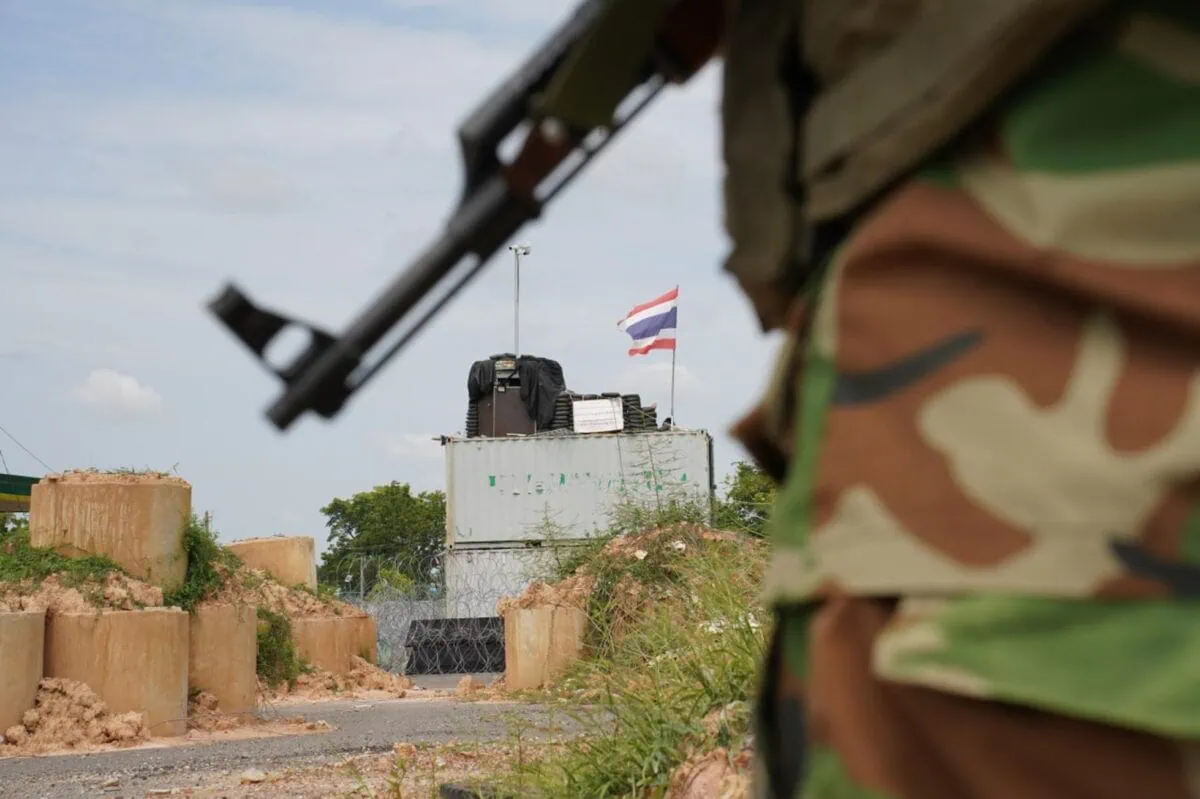 A Cambodian soldier observes a Thai military position in Banteay Meanchey province’s Boeung Trakoun area. Hong Raksmey
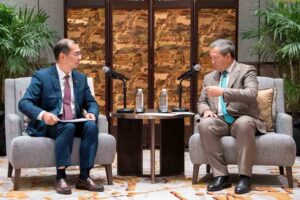
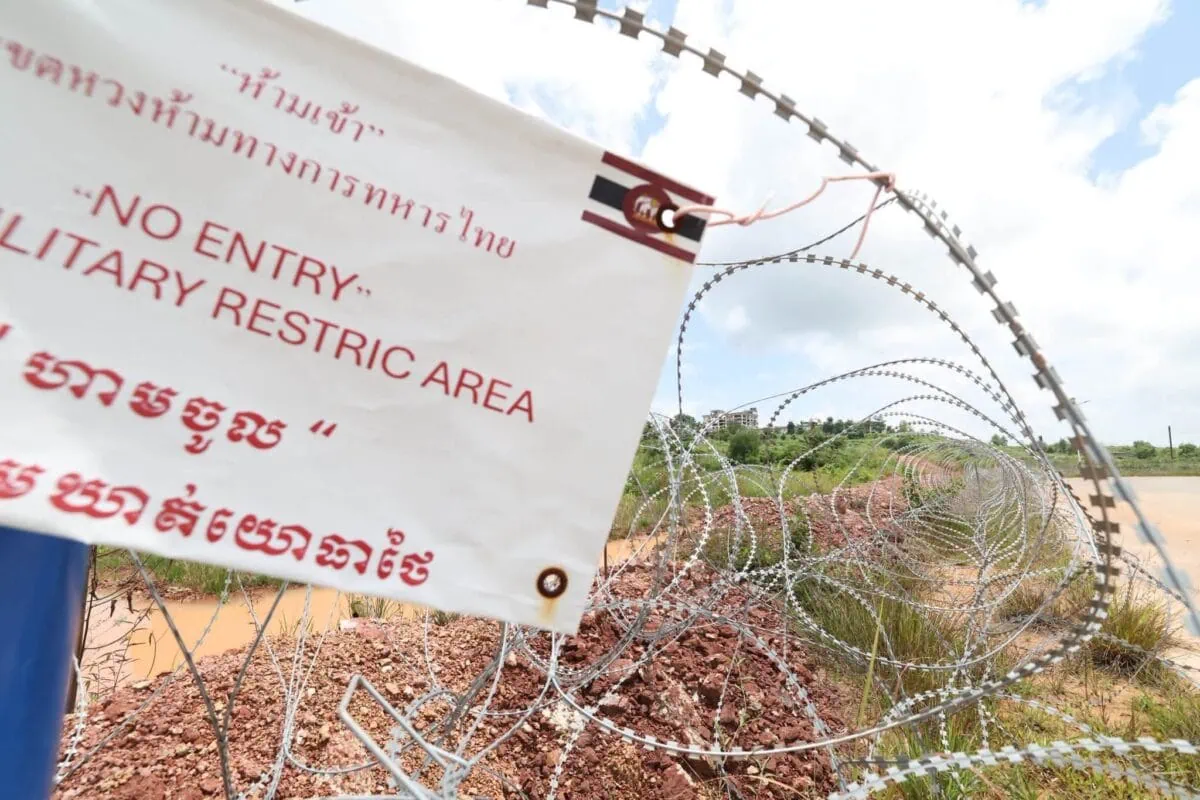
Minister of Information Neth Pheaktra has warned that Thailand cannot turn military control of Cambodian territory into lawful sovereignty by deploying troops, installing razor wire and shipping containers or building infrastructure, arguing that international borders must be determined by law rather than “facts on the ground” created through force.
In a lengthy statement, Pheaktra drew a distinction between effective control of territory and lawful sovereignty.
He noted that while armed forces may enter an area, install razor wire and shipping containers, dig trenches, construct roads or prevent residents from returning to their land and homes, but none of these actions can convert military control into legal title.
“The use of force may change who physically occupies the ground, but it cannot change who holds lawful title to that ground,” he said.
Pheaktra said that if evidence establishes that Thai forces are positioned inside Cambodian territory, their control of those locations through military force cannot create sovereign rights for Thailand.
Cambodia has previously protested against Thai troops installing razor wire and shipping container barricades in several areas, including Chouk Chey and Prey Chan villages in Banteay Meanchey province, while Cambodian officials have repeatedly demanded that displaced civilians be allowed to return safely to their homes.
Thailand has rejected Cambodian accusations that it is occupying Cambodian territory and has maintained that its forces are operating within Thai territory or areas where the boundary remains disputed.
Pheaktra stated that any disagreement over the precise location of the international boundary must be resolved through treaties, maps, boundary documents, mutually agreed bilateral mechanisms or other peaceful dispute-settlement procedures, rather than unilateral military action.
“Barbed wire is not a boundary line. Containers are not boundary pillars. Trenches are not treaties. And the presence of troops is not territorial title,” he said.
‘Facts on the ground’ cannot determine borders
Pheaktra warned particularly against attempts to create faits accomplis – facts on the ground established unilaterally and subsequently presented as the basis for political or territorial claims.
He said a state could not use military force to enter an area, prevent local residents from accessing their property, install barriers and military positions, and then cite the situation it created as evidence of sovereignty.
“The danger of the use of force in territorial disputes is the attempt to create faits accomplis, preserve them over time, and subsequently use them as political or legal arguments,” he added.
The minister invoked one of the fundamental rules of the post-Second World War international order – the prohibition on acquiring territory through force.
Article 2(4) of the UN Charter requires member states to refrain from the threat or use of force against the territorial integrity or political independence of another state.
The principle was elaborated in the UN General Assembly’s 1970 Declaration on Principles of International Law concerning Friendly Relations and Co-operation among States, Resolution 2625, which states that territorial acquisition resulting from the threat or use of force cannot be recognised as legal.
Pheaktra said the distinction was crucial because military control demonstrates only who exercises physical control at a particular moment, rather than determining which country possesses lawful sovereign title.
“An army may establish control by force, but it cannot manufacture territorial title,” he said.
Cambodia has repeatedly brought the same principle into its diplomatic arguments over the border dispute.
During a UN Security Council open debate in July, Cambodia’s permanent representative to the UN, Chhea Keo, stressed Phnom Penh’s commitment to peaceful dispute settlement and international law, arguing that international borders cannot be changed through force or the unilateral creation of new realities on the ground.
Pheaktra insisted that disagreements over the Cambodia-Thailand border should instead be addressed through the legal instruments and mechanisms available to the two countries.
“The solution cannot be to use force to create faits accomplis on the ground and then invoke the situation created by that force as a basis for claiming legal rights,” he said.
Preah Vihear precedent
Pheaktra also invoked the long-running Preah Vihear case as a legal lesson demonstrating that the physical presence of troops does not override sovereignty established under international law.
On June 15, 1962, the International Court of Justice (ICJ) ruled that the Temple of Preah Vihear was situated in territory under Cambodian sovereignty.
The Court consequently ruled that Thailand was obliged to withdraw any military or police forces, guards or other personnel stationed at the temple or in its vicinity on Cambodian territory.
The dispute returned to the ICJ decades later when Cambodia requested an interpretation of the 1962 judgment amid disagreement over the territorial extent of the ruling.
In November 2013, the Court unanimously concluded that its 1962 judgment had determined that Cambodia held sovereignty over the whole territory of the Preah Vihear promontory, within the limits identified by the Court, and that Thailand was consequently obliged to withdraw relevant personnel from that territory.
The ICJ also noted that Thailand accepted a general and continuing legal obligation to respect the integrity of Cambodian territory in any territory found by the Court to be under Cambodian sovereignty.
However, the Preah Vihear judgments did not settle the entirety of the Cambodia-Thailand boundary. The 2013 Court specifically noted limits to the territorial scope of the original dispute and did not determine sovereignty over areas beyond the Preah Vihear promontory, including Phnom Trap.
Pheaktra acknowledged this distinction, saying the relevance of the rulings was the broader lesson that physical military presence cannot supersede sovereignty established through law.
“The central question is therefore not: ‘Who is physically present there?’ The proper question is: ‘Who has lawful title to the territory?’” he said.
He repeated that territorial claims must instead be supported by relevant treaties, maps, boundary records and other legal evidence.
“If those questions are answered only by pointing to the presence of troops, then what is being demonstrated is not legal title. It is merely power,” he added.
“Guns are not an answer to the question of sovereignty.”
Border communities remain central to dispute
Pheaktra’s argument holds particular significance for Cambodian communities that remain unable to return to some border locations following the fighting.
Cambodia has accused Thailand of using barriers and military positions to prevent residents from returning to their homes, including in Chouk Chey and Prey Chan, while Thai authorities have disputed Cambodian descriptions of the territorial status of some locations.
He said the passage of time also could not automatically transform a situation created through force into lawful territorial title. Pheaktra note that this approach would undermine peaceful border settlement by creating an incentive for states to establish physical control first and negotiate later.
Thailand has consistently maintained that border disagreements should be addressed through existing bilateral mechanisms and has rejected Cambodian allegations that Thai troops have illegally occupied Cambodian territory.
Both countries have long used bilateral mechanisms, including the Joint Boundary Commission (JBC), to address land-boundary issues.
Pheaktra said the dispute should therefore not become a contest over which side can deploy more soldiers, extend barriers farther or establish new physical conditions more quickly.
“History may record where an army once stood. But law determines which state holds sovereignty over that territory,” he said.
For Cambodia, he argued, the issue goes beyond the immediate territorial dispute and concerns the wider international principle that borders cannot lawfully be altered through armed force.
“Barbed wire may obstruct people, but it cannot obstruct the law. Containers may block a road, but they cannot create a border. Armed forces may unlawfully occupy a location by force, but they cannot create lawful sovereignty,” he said.
“Borders are determined by law, not by guns; sovereignty derives from lawful rights, not from faits accomplis created by force; and aggression cannot become territorial title.”
-Phnom Penh Post-
- A Cambodian soldier observes a Thai military position in Banteay Meanchey province’s Boeung Trakoun area. Hong Raksmey
- A Thai razor wire barricade on what Phnom Penh insists is sovereign Cambodian territory. Supplied