When Fences Try to Rewrite a Border
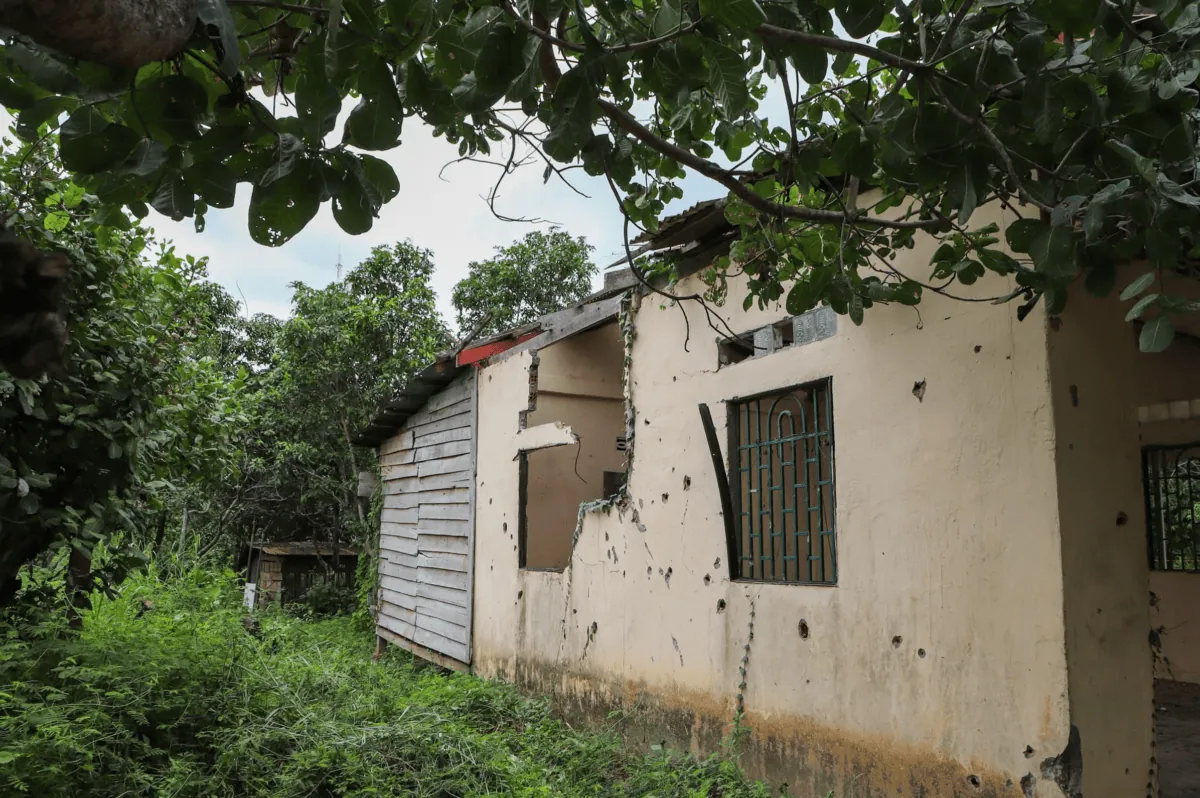 Th Techo Morakoth Health Centre in Preah Vihear province suffered severe damaged and was forced to close during last year’s fighting. The AOT visited the site on August 11. Defence ministry
The force altering the landscape today is not organic. It is barbed wire. It is concrete posts, barricades, forward military positions, and walls erected on ground that Cambodia recognises as its own.
This reality is written clearly in the systematic actions taken by Thai forces along the border — encroaching upon sovereign Cambodian territory, carving out unauthorised military zones and deliberately maintaining the displacement of Cambodian communities. Despite bilateral peace declarations and formal agreements committing both parties to respect and enforce all clauses of de-escalation, Thai authorities continue to violate these terms.
Homes remain guarded by foreign bayonets, agricultural lands are locked behind barricades, and Cambodian citizens are systematically denied their fundamental right to return to their ancestral properties, even when diplomatic frameworks explicitly demand it.
This pattern of aggression represents a direct and egregious assault on the legal bedrock of bilateral stability. Under established peace declarations and boundary protocols — anchored in the 2000 Memorandum of Understanding (MOU 2000) and the Joint Boundary Commission (JBC) — both nations are legally bound to preserve the status quo, refrain from unilateral structural changes and resolve demarcation jointly.
Yet, Bangkok has systematically subverted these core mandates. Too often, manufactured border crises serve as a convenient smokescreen for domestic political survival within Thailand’s volatile political theatre — where hardline factions weaponise nationalism, push to unilaterally discard binding treaties like the MOU 2000 and pander to domestic populism at the expense of regional peace.
Even as these political manoeuvres play out in domestic legislative halls, Thai authorities on the ground deploy heavy machinery to construct unauthorised infrastructure, reinforce fortified positions and attempt to dissolve the legal rules they pledged to uphold, treating solemn treaties as disposable rhetoric while manufacturing irreversible realities on the ground.
The human cost of these violations has drawn profound international concern, prompting direct scrutiny from the UN. Following on-the-ground assessments, the UN Special Rapporteur on the situation of human rights in Cambodia explicitly called upon authorities to respect international law and address the plight of thousands of displaced civilians still locked out of their hometowns under foreign military control.
Emphasising that human rights apply universally regardless of nationality or conflicting territorial claims, international observers have underscored that blockades and ongoing displacement violate core bilateral ceasefire agreements — demanding that Bangkok match its stated commitments to international law with concrete action on the ground.
Beyond physical barricades and unauthorised walls, the legacy of conflict casts a long, lethal shadow over the soil. Generations of Cambodians living along these contested zones continue to face the daily peril of unexploded ordnance, cluster munitions and deadly remnants of war left embedded in their fields and community spaces.
As the Cambodian Mine Action Centre (CMAC) has repeatedly underscored, these hidden hazards are a persistent barrier to normal life and rural development. Yet, as CMAC authorities have firmly pledged, Cambodia remains resolutely committed to clearing every square metre of its national territory — ensuring that the land is safely reclaimed and that the safety of its citizens takes absolute precedence over ongoing provocations.
Time and again, Cambodia has risen to counter these violations through rigorous diplomatic channels, lodging formal protests with international bodies and issuing strong diplomatic notes against persistent encroachments. From the unyielding appeals against unauthorised bunker construction and infrastructure intrusion at vital border checkpoints to the documented cries of displaced communities locked out of their homes, Cambodia has maintained an unwavering record of peaceful, legal opposition.
Yet, these formal protests — anchored in international law and bilateral de-escalation frameworks — continue to be met with unilateral actions designed to create irreversible facts on the ground.
This is the most dangerous illusion of our time: the belief that borders are altered only by ink and parchment in diplomatic chambers. Sometimes, the attempt to rewrite a boundary is made on the ground — one planted post, one strand of razor wire and one platoon stationed at a time in direct defiance of signed treaties and official diplomatic protests.
When walls are built, roads sealed, citizens locked out of their homes in breach of peace accords, and armed forces dug into contested terrain day after day, something far more consequential than a simple land grab is underway. It is the deliberate manufacture of a “fait accompli” — the creation of “new facts on the ground” engineered in the cold hope that endurance will one day be codified as law.
Yet territory is not a blank sheet of paper where raw power can draw new lines at will.
The Fallacy of the Strongest Gun
International stability has long rested on a foundational premise: sovereignty is not a prize awarded to the army with the heaviest guns, nor does legal title crystallise simply because one force manages to entrench itself on a piece of high ground for a few months longer than its rival.
Power can certainly erect a fence. Power can plant a boundary marker. Power can pour concrete and mount guard towers. But power cannot generate legitimacy.
If physical occupation alone were sufficient to confer sovereignty, every frontier on the globe would be in a state of permanent volatility — subject to violent renegotiation the moment a stronger neighbour decides to march across a line and flout its own treaty obligations.
Cambodia does not require war to prove it is Cambodia. What Cambodia demands is the rule of law — the ironclad principle that sovereign territory cannot be unilaterally mutated by coercion, and that peace agreements and treaties like the MOU 2000 cannot be brushed aside through domestic political manoeuvring.
Histories can be conveniently edited by politicians. Maps can be reinterpreted to suit national narratives. But the earth itself remembers. It remembers the families who tilled the soil, the homes abandoned in haste, the paths choked off by barricades and the silent iron posts driven into the ground by foreign hands in violation of formal commitments.
A Response Rooted in Law, Not Rancour
In the face of such provocations, the appropriate response cannot be anchored in populist animosity toward the Thai people. National dignity is not measured by the volume of shared grievances, but by the steadiness of our resolve.
Our defence must be built on three unshakeable pillars:
- The supremacy of international law, which rejects territorial acquisition by force and demands strict adherence to signed bilateral agreements, such as the MOU 2000, rather than selective domestic revocations.
- The rigor of historical evidence, which anchors our claims in verified jurisprudence rather than emotional rhetoric.
- The strategic patience of a state, which understands precisely what it is protecting and refuses to be baited into reckless escalation.
Generations pass, and physical structures eventually weather away. Today, a fence may stand. A post may stand. A wall may stand. But no artificial barrier can ever outlast history. No fence can ever stand taller than sovereign right. And no amount of unilateral muscle can write the future of Cambodia in place of the Cambodian people.
At the heart of this national trial lies an unbreakable bond of trust between the Cambodian people and their government — a partnership forged through shared historical memory and a collective resolve to protect our motherland.
Across the country, public sentiment burns with intense passion, with citizens voicing an understandable and fierce desire to see the state exhaust every avenue of global accountability, from formal petitions at the International Court of Justice (ICJ) to accountability mechanisms like the International Criminal Court (ICC).
At the same time, national maturity requires a shared understanding of the rigorous legal thresholds governing international tribunals: international courts demand exhaustive evidentiary chains, specific jurisdictional triggers and procedural exhaustion before they can intervene.
The Royal Government has meticulously laid the groundwork through precise diplomatic protests, documentation of violations, and adherence to international jurisprudence—balancing public urgency with calculated legal precision to ensure that when Cambodia takes a case to the world stage, our legal foundation is impregnable.
Ultimately, the test facing the region today transcends concrete and barbed wire; it is a test of whether international law and bilateral good faith still govern Southeast Asian diplomacy, or whether the law of the jungle will be permitted to redraw the map. Cambodia chooses the path of law, justice and unyielding endurance. In that choice lies not only the defence of our sovereign borders, but the preservation of a stable, rules-based regional order upon which the future of every neighbouring nation depends.
From the remnants of past disputes, Cambodia will continue to rise — not to strip away what belongs to others, but to resolutely preserve what is rightfully its own.
Borders may be tested. But Cambodia’s sovereignty is not a negotiable commodity to be rewritten simply because someone arrived early with a shovel, a post, a gun and a broken promise.
Long Panhavuth is founder and attorney-at-law at Pan & Associates Lawfirm. The views and opinions expressed are his own.
-Phnom Penh Post-
——————–
Photot: Th Techo Morakoth Health Centre in Preah Vihear province suffered severe damaged and was forced to close during last year’s fighting. The AOT visited the site on August 11. Defence ministry