If Thailand Has Nothing to Hide, Why Fear the Truth?
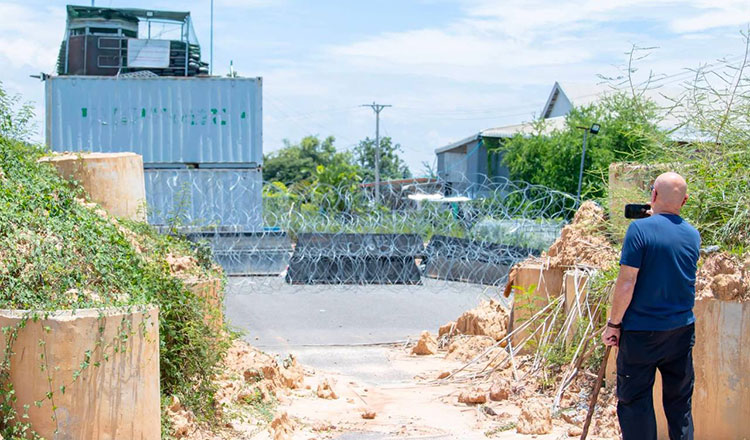 UN special rapporteur Tom Andrews visited displaced border communities and observed Thai military barricades last week. Supplied
#opinion
When a United Nations Special Rapporteur publishes an assessment after an official country visit, governments are free to disagree with the findings. They may present evidence, offer alternative interpretations, or point out factual errors. That is part of constructive engagement with the UN human rights system.
What is more difficult to understand is why a government would seek to discredit the messenger instead of addressing the substance of the message.
That question now confronts Thailand following its response to the end-of-mission statement by UN Special Rapporteur Tom Andrews after his visit to Cambodia. Andrews reported that more than 20,000 Cambodian civilians remain displaced and that many told him they could not return because their homes are located in territory currently occupied by Thai military forces. He reminded both countries that international law recognizes the right of civilians displaced by armed conflict to return to their homes and urged Cambodia and Thailand to work together to facilitate that return.
Thailand’s Ministry of Foreign Affairs swiftly rejected these findings, insisting that Thailand neither initiated the conflict nor occupies Cambodian territory. It also questioned the Rapporteur’s assessment and argued that UN special procedures should rely on “credible and verifiable sources” while considering all perspectives.
That response raises a fundamental question. “If Thailand has not illegally invaded Cambodia, and if it is not illegally occupying Cambodian territory, why is it so concerned about an independent UN expert reporting what he directly observed and what displaced civilians told him?”
The UN Special Rapporteur is not an advocate for Cambodia. He is an independent mandate holder appointed by the UN Human Rights Council. His role is to gather information from governments, civil society, affected communities, humanitarian organizations, and other stakeholders before presenting an independent assessment. Governments may disagree with his conclusions, but the credibility of the UN system depends on responding with evidence—not attempts to undermine the independence of the mandate itself.
If Thailand believes the Rapporteur is wrong, the appropriate response is simple. Open the disputed areas to independent international observation. Allow UN agencies, humanitarian organizations, diplomats, and international media unrestricted access.
Permit impartial verification of who controls the territory, why thousands of Cambodian civilians remain unable to return home, and whether military occupation exists. Transparency is the strongest answer to criticism. Defensive attacks on independent observers are not. This is especially important because the issue is not merely a diplomatic disagreement. It is fundamentally about civilians.
Families remain displaced. Homes have reportedly been destroyed or remain inaccessible. Communities continue to bear the consequences of armed conflict long after the guns have fallen silent. These humanitarian realities deserve careful attention regardless of political narratives. Reuters and the Associated Press similarly reported the Rapporteur’s statement that more than 20,000 Cambodians remain displaced and that many cannot return because their villages are in territory under Thai military control—an allegation Thailand continues to deny.
International law is equally clear on one point: civilians displaced by armed conflict have the right to return voluntarily, safely, and with dignity. Whether that right can be exercised depends not on political statements but on conditions on the ground. If Thailand maintains that no illegal occupation exists, independent verification should strengthen-not weaken—its position.
History offers an important lesson. Governments confident in their legal and factual position generally welcome impartial scrutiny because it validates their claims.
Governments that fear scrutiny risk creating the opposite impression—that there may be facts they would rather the international community not examine too closely.
This is not about choosing between Cambodia’s narrative and Thailand’s narrative. It is about allowing objective facts to speak for themselves. If Thailand believes the truth supports its position, then it should have nothing to fear from independent reporting, credible international observation, or UN scrutiny.
After all, truth does not require protection from investigation. It is falsehood that does.
Roth Santepheap is a geopolitical analyst based in Phnom Penh. The views expressed are his own.
-Khmer Times-