Beyond friend or foe: Navigating the murky waters of modern statecraft
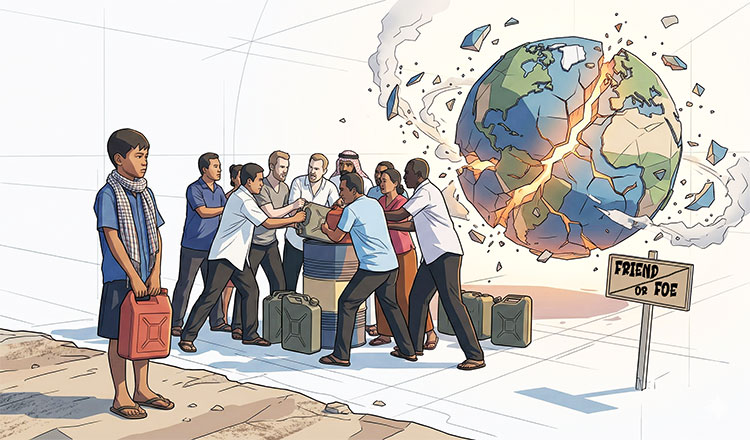 In a world where the old rules of diplomacy are fading, states can no longer adjudge the actions of others simply on the basis of ‘friendship’. Khmer Times
#editorial
In the simplistic lens of traditional diplomacy, international relations are often reduced to a binary “friend or foe” dynamic. However, a closer look at the shifting geopolitical tides in Southeast Asia and beyond suggests that the rules-based multilateral order is rapidly being replaced by a more chilling “might is right” reality. In this era of global security and economic uncertainty, survival dictates that small states move beyond sentimental labels and act with extreme caution.
Recent headlines have painted a picture of a Cambodia increasingly adrift. A Reuters report on Cambodia seeking fuel from Singapore and Malaysia, following supply restrictions from Vietnam and China, was quickly interpreted by some as a sign of isolation or a fracturing of the “ironclad” friendship with Beijing. Similarly, the Thai King’s sudden visit to Laos—described with the warm sentiment of “coming home”—was read by observers as a move to bypass or isolate Cambodia.
From a Cambodian perspective, these optics are sensitive. Given a history of invasion and ongoing occupation by Thailand, such regional manoeuvring can easily be spun as a precursor to renewed aggression. Some even view the Thai-Lao rapprochement as a balancing act to ensure Laos’ silence in the event of a future Thai-Cambodian conflict. From the Cambodian perspective, the phrase “coming home” carries a dual meaning: while it may simply reflect warm Lao hospitality, it also carries a more ominous undertone suggesting that by claiming Laos as “home,” Thailand may eventually intend to claim or even invade the territory.
However, to view these shifts purely through the lens of personal “friendships” is to miss the broader point: everybody is desperate.
While Vietnam has restricted certain energy exports to Cambodia, this should not be viewed as a calculated act of hostility, but rather a desperate survival tactic. Vietnam is currently grappling with a severe energy security crisis driven by its heavy reliance on traditional power sources and volatile global markets.
As of 2024–2025, Vietnam’s power grid remains overwhelmingly dependent on fossil fuels, which account for approximately 55% of its total electricity generation.
Vietnam’s current oil reserves are significantly below international safety standards (which typically recommend a 90-day supply). National inventory levels currently hover at just 1.7 million cubic metres, which is roughly enough to sustain the country for only 10 to 15 days of domestic consumption. In response to this thin margin, the government recently mobilised an emergency four million barrels of oil from international partners just to ensure short-term stability.
To keep its industrial engine running and stabilise domestic prices amidst Middle East tensions, the Vietnamese government issued Decree 72/2026/ND-CP in March. This emergency measure slashed import taxes on petrol, diesel, and jet fuel from previous rates (up to 10%) down to 0% through April.
This data highlights a nation operating on the edge. For Vietnam, “curbing external exports” to neighbours like Cambodia is a natural, if difficult, consequence of trying to prevent a total domestic blackout and sustain its own industrial activities.
To prevent such economic desperation and geopolitical rivalry from spiralling into open conflict, regional rivals are building sophisticated “firewalls.” The China-Vietnam relationship serves as a prime example: despite their maritime friction, the two nations launched a historic “3+3” Strategic Dialogue in March, bringing together Foreign Affairs, Defence, and Public Security Ministers to ensure that territorial disputes do not trigger a “World War 3” scenario in the South China Sea.
Even the United States demonstrates this pragmatism. In the first two weeks of the conflict between the Iran and the US and Israel, Trump initially downplayed the global impact of the Hormuz Strait’s closure. His rhetoric focused on the US being “energy independent” and suggested that the blockade served to “choke” the Chinese economy, which relies on the waterway for nearly 40% of its maritime crude.
Later, on March 14, Trump posted on Truth Social that, the “Countries of the World that receive Oil through the Hormuz Strait must take care of that passage.” He explicitly invited China (along with France, Japan, and others) to send warships to help police the strait. And two days later, on March 16, in an interview with the Financial Times, he further softened the “adversary” lens, arguing that an open Hormuz Strait is a shared benefit for both the US and China.
Like the desperation of other countries mentioned above, while Cambodia is navigating these pressures, it is far from a state of panic. The country boasts a strong foundation for resilience: more than 60% of its energy is renewable and clean, and its food security remains robust. While food export production capacity might take a hit due to certain reliance on fuel, domestic consumption is secure. The recent oil “hoarding” scares that made the situation look dire have largely relaxed following strict government monitoring of stocks.
To conclude that Cambodia is being isolated by its neighbours or that its “ironclad” friend is a premature judgment in an extremely murky political climate. Today, every nation is thinking deeply and carefully about its own survival and security.
Here the lessons drawn by China are really important and strikingly relevant for all nations. Following the US and Israeli strikes on Iran in early 2026, the Chinese military—via its propaganda platform “China Military Voice”—published a list of five key lessons derived from the conflict.
1- The deadliest threat: The enemy within – Highlighting the danger of internal instability or “hidden intentions” that can undermine national security.
2- The costliest miscalculation: Blind faith in peace – A warning that a country must never grow complacent or assume peace is guaranteed, as “careless peace” can be fatal.
3- The Coldest Reality: The logic of superior firepower – A recognition that in modern statecraft, military and technological superiority (specifically “superior weapons”) often dictates the outcome of international disputes.
4- The cruellest paradox: The illusion of victory – Suggesting that perceived military triumphs may be deceptive and do not necessarily lead to long-term stability or resolution.
5- The ultimate reliance: Self-reliance – The absolute necessity for a state to depend on its own resources and capabilities rather than external alliances or international rules.
In a world where the old rules are fading, states can no longer judge their actions—or the actions of others—simply on the basis of “friendship”. It is not about who your friends are; it is about who can help you survive the next sunset.
-Khmer Times-