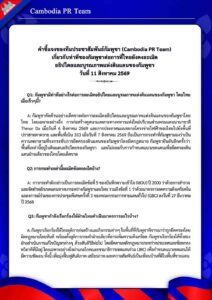
Regarding the Advancement of the Joint Boundary Commission (JBC) Process for the Resumption of Cambodia–Thailand Border Demarcation July 30, 2026
 Regarding the Advancement of the Joint Boundary Commission (JBC) Process for the Resumption of Cambodia–Thailand Border Demarcation July 30, 2026
Cambodia PR Team Responses
Regarding the Advancement of the Joint Boundary Commission (JBC) Process for the Resumption of Cambodia–Thailand Border Demarcation
July 30, 2026
Q1: What efforts has Cambodia made to advance the resumption of JBC work?
A: Cambodia has continuously promoted the use of the JBC mechanism in a peaceful manner and in accordance with existing agreements. Since the entry into force of the second ceasefire on December 27, 2025, the Cambodian side has submitted nine proposals to the Thai side to convene a special JBC meeting and to deploy Joint Survey Teams (JSTs) to carry out work on the ground. At the same time, Cambodia has also continued to inform and present its position to the ASEAN Observer Team to ensure that the border resolution process remains transparent and based on mechanisms mutually agreed upon by both parties.
Q2: What are the main obstacles preventing the resumption of joint border survey and demarcation work?
A: Joint border survey and demarcation work has been disrupted following the armed clashes and the illegal occupation of certain areas along the border by the Thai side, which have prevented the Joint Survey Teams from carrying out work on the ground. In particular, work in the areas of Chouk Chey and Prey Chan villages, and the border segment between Boundary Pillars No. 52 and 59 has been suspended. Therefore, Cambodia has proposed the resumption of JBC meetings and the deployment of JSTs to allow technical work to proceed.
Q3: Why does Cambodia consider the resumption of JBC work a priority?
A: Cambodia regards JBC work as the primary and priority means of resolving border issues because it is a technical mechanism for peaceful resolution, avoiding the use of military force. The resumption of survey and demarcation on the ground will help establish clarity on the border line and create conditions for confidence-building and long-term stability, as both parties act in accordance with established international law. In particular, it also provides the basis for ensuring that affected civilians can return to their homes safely, without obstruction, and with dignity.