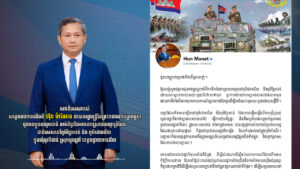
Regarding the Claims of the Thai-Cambodian Joint Information Center (JIC) July 22, 2026
Cambodia PR Team Responses
Regarding the Claims of the Thai-Cambodian Joint Information Center (JIC)
July 22, 2026
Q1: Is Thailand’s claim that it has not occupied Cambodian territory true?
A: According to Cambodia’s position, this claim does not correspond to the facts that have occurred. Cambodia has lodged successive official protests against the continued presence of Thai forces in areas that Cambodia considers to be within its sovereignty, as well as against all acts of aggression. These actions cannot be regarded as maintaining the status quo; rather, they constitute an alteration of the actual situation. Cambodia has consistently demanded that Thailand cease such actions and return to respecting agreements and international law.
Q2: Is Thailand’s claim that it respects the Joint Statement true?
A: Respect for the Joint Statement cannot be measured merely by verbal declarations of position, but must be demonstrated through the implementation of commitments agreed upon by both parties. In this regard, Cambodia considers that if Thailand truly adhered to the Joint Statement, it should continue the work of the Joint Boundary Commission (JBC) in good faith, as agreed under the 2000 MOU and reaffirmed in the Joint Statement.
Q3: How do Thailand’s actual actions in the past reflect its commitment to reducing tensions?
A: Thailand’s actual actions in the past have not contributed to reducing tensions as committed to in the Joint Statement. Cambodia has lodged successive protests against the continued illegal occupation of areas within Cambodian territory, the installation of barbed wire, the construction of roads, water embankments and other infrastructure, as well as the installation of shipping containers, the establishment of military positions, the destruction of the staircase leading to Khnar Temple and the organization of tourism activities, including opening the site for visits and selling tickets at Ta Krabey Temple. These actions constitute an alteration of the actual situation and are inconsistent with the objectives of confidence-building and de-escalation agreed upon by both parties.