Editorial : Living with Nature: The Greatest Education for Our Children
JULY 17, 2026
Education is often measured by the knowledge students gain, the examinations they pass, and the careers they pursue. These are important achievements. But there is another kind of education—one that shapes not only the mind, but also the heart and the character.
It is the education of learning to live with nature.
For thousands of years, humanity did not live apart from nature. We lived with it. We woke with the sunrise, planted with the seasons, depended on rivers for life, and found peace beneath the shade of trees. Nature was not our backdrop; it was our home, our teacher, and our partner.
Today, however, many children are growing up surrounded by concrete instead of forests, screens instead of streams, and artificial light instead of the stars. They know how to navigate the digital world, yet many have never planted a tree, watched a butterfly emerge, or listened to the quiet wisdom of a forest.
This distance from nature is more than a change in lifestyle. It is a loss of perspective.
Nature teaches lessons that no classroom can fully replicate.
A river teaches perseverance. It never stops flowing, finding a way around every obstacle.
A tree teaches patience. It grows quietly, year after year, never rushing, yet becoming strong enough to shelter generations.
A forest teaches cooperation. Countless plants, animals, insects, and microorganisms thrive together in balance, reminding us that life flourishes through harmony rather than competition alone.
The changing seasons teach resilience. After every dry season comes the rain. After every fallen leaf comes new growth. Nature reminds us that every challenge carries the promise of renewal.
When students spend time in nature, they begin to understand these lessons—not through memorization, but through experience.
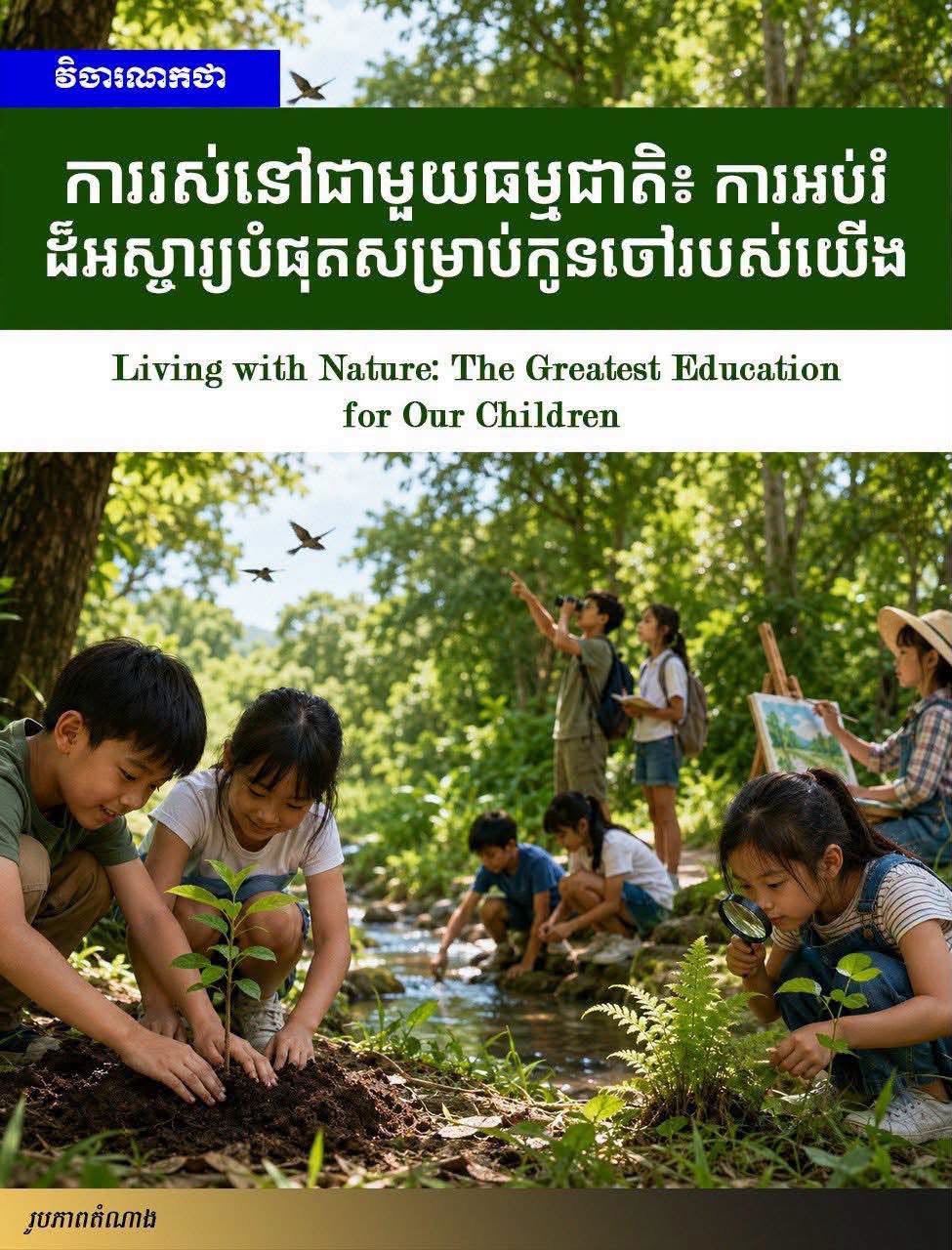
Living with nature also nurtures gratitude. A child who plants a tree appreciates the value of clean air. A child who cares for a garden understands the importance of water. A child who watches birds build their nests learns that every living creature has a place and a purpose.
These experiences shape responsible citizens.
Environmental protection is not merely about enforcing laws or adopting new technologies. It begins with a way of life. People protect what they understand, and they understand what they experience. When students learn to live with nature, caring for the environment becomes a natural habit rather than an obligation.
Schools therefore have a unique opportunity to bring learning beyond the classroom. School gardens, tree planting, nature walks, outdoor science lessons, wildlife observation, and community conservation projects allow education to become a living experience. Every lesson beneath the open sky becomes a lesson remembered for life.
Families also have a vital role. Parents can encourage children to spend time outdoors, plant trees together, care for flowers, grow vegetables, visit national parks, or simply enjoy the beauty of a sunrise. These simple moments create lasting memories and deepen a child’s respect for the natural world.
Living with nature also benefits students themselves. Time spent in green spaces improves physical health, reduces stress, strengthens concentration, encourages creativity, and promotes emotional well-being. Nature restores not only the environment—it restores the human spirit.
As the world confronts climate change, biodiversity loss, pollution, and rising temperatures, our greatest investment is not only in cleaner technologies or stronger policies. It is in raising a generation that instinctively understands its place within nature.
Our children should never see themselves as masters of the Earth. They should see themselves as its caretakers.
The Earth is not an inheritance from our ancestors alone. It is a trust that we hold for our children and grandchildren. Every river we keep clean, every forest we protect, every tree we plant, and every species we preserve is a promise to the future.
Let us therefore teach our students not only to study nature, but to live with it.
Let every school become a place where learning extends into gardens, forests, rivers, and parks.
Let every family make time to reconnect with the natural world.
Let every community create spaces where children can experience the beauty and wonder of life around them.
For when children learn to live with nature, they also learn to live with humility, responsibility, compassion, and hope.
In the end, the measure of education is not only the knowledge we pass from one generation to the next.
It is the wisdom we leave in their hearts.
And among the greatest forms of wisdom is this simple truth:
Humanity thrives when it lives in harmony with nature.
#Environment, #Nature, #Earth, #Eco, #GoGreen, #Sustainability, #ClimateChange, #ClimateAction, #GlobalWarming, #EnvironmentalAwareness