Struggles Persist on the Borders: Insights from Anlong Veng
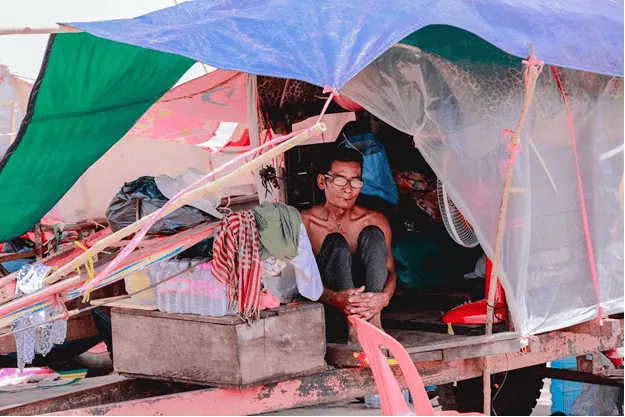 A displaced man at a makeshift camp in Anglong Veng district, Oddar Meanchey province. Supplied See less
Camo pants and Cambodian flags race by on motorcycles to the Choam-Sangam border post. Seven months after last year’s December 7 to 27 border skirmishes, life has yet to return to normal for the Cambodian borderland populations. Approximately 29,000 residents still have not returned from refugee camps. They remain housed in “waiting villages” built by the Cambodian government, while thousands more suffer from the economic consequences of the Cambodia-Thailand border conflict.
During the December fighting, several residents described hearing gunfire, artillery and explosions from Anlong Veng town and nearby villages in Oddar Meanchey province. Those who were lucky enough to have connections fled to Siem Reap to stay with family or friends, while others stayed to take care of their land and livestock, or maintain their businesses.
Before the conflict, Anlong Veng was a transit hub, offering tourists from Thailand a variety of restaurants, places to sleep and a few popular tourist sites. Tourists and transportation networks stimulated the economy enough for the town to maintain steady growth, alongside its agricultural industries. Most other border towns in the province lacked tourist flows, leaving them reliant on agricultural production as the primary economic activity.
Many residents are newcomers, having moved here for better economic opportunities. Microloans and larger bank loans allowed innovative residents to create and expand new businesses, including restaurants, farms and tourist accommodation. Three compounding factors pose significant limitations to rural hubs’ economic expansion.
Firstly, the lack of tourism has severely damaged the prospective economic growth. Guest houses do not receive a steady flow of visitors and other industry services have slowed. Restaurants and vendors receive fewer customers and struggle to make ends meet.
Secondly, the closure of the Choam-Sa’Ngam border post did more than just block the flow of Thai tourists; it also prevents Cambodians from accessing Thai markets and buying cheap goods and produce. Now, vendors must rely on other sources of goods, often costing more than Thai options.
The US-Iran war added the final dimension to cost analysis and logistics management for transportation industries and business owners. Although an indirect conflict, it threatens to raise oil prices in both Thailand and Cambodia, creating increasingly expensive costs for daily transportation and energy usage.
The border conflict’s resolution is distant. Communications have slowed because Thailand has refused to engage in bilateral negotiations with Cambodia, after the latter invoked compulsory conciliation under the UN Convention on the Law of the Sea (UNCLOS).
In line with the precedent of the Australia-Timor Leste compulsory conciliation invocation resolved in 2018, Cambodia must prepare for a long conciliation process.
Cambodia has shown its resilience on the international stage, but it must help its vulnerable communities at home. From basic food costs to supporting local businesses, the government needs to issue economic incentives to keep these hubs not only afloat but stimulate them.
Cambodia must prepare contingencies for future economic downturns, border skirmishes and environmental challenges before they occur. Other provinces have seen increased government spending, meaning interest in supporting national development projects is active. Implementing the same level of investment in border regions through development projects and economic aid will create stability and limit vulnerability to future waves of conflict.
In addition to state resources, Cambodia has received large sums of international aid from the US, China, the EU and UNICEF, which have been used for humanitarian assistance for displaced communities.
However, international aid only amounts to precarious survival, not economic revival. Job security is threatened by displacement and warrants government assistance, which can come in the forms of direct cash aid, job creation in government-sanctioned projects and tax breaks and loan forgiveness for small-business owners in affected provinces.
Securing the borders militarily has signalled national unity and strength but a disconnect is found with Phnom Penh when citizens struggle to pay the bills and provide for their family.
These economic and security hardships in Anlong Veng are seen elsewhere, perhaps even more intensely at the centres of the border conflict in Banteay Meanchey and Preah Vihear provinces.
Phnom Penh must establish resilient economic policies that support borderland hubs, like Anlong Veng district town, against the compounding effects of global disputes – beyond basic humanitarian aid programs and militarisation – that allow communities to grow, even in the face of destabilising threats.
Calin Hurley is completing a research internship with the Anlong Veng Peace Center, while pursuing a bachelor’s degree in international affairs at George Washington University. The views and opinions expressed are his own.