Constructive ties require concrete actions
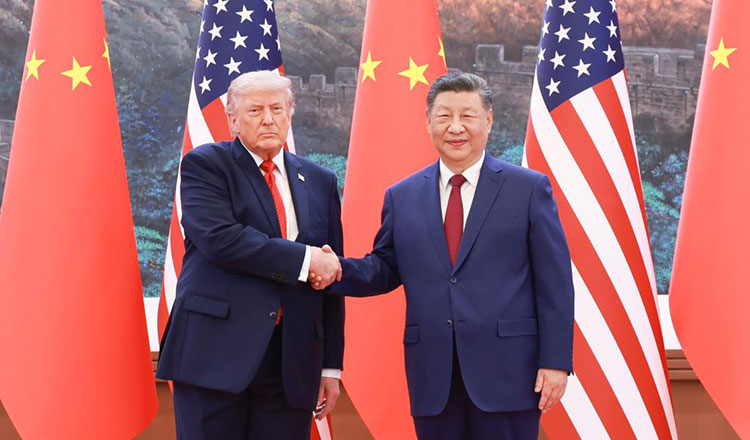 Photo:- Chinese President Xi Jinping holds talks with US President Donald Trump, who is on a state visit to China, at the Great Hall of the People in Beijing on May 14. Xinhua
#opinion
The head-of-state diplomacy between China and the United States during President Donald Trump’s visit to China in May has produced a series of common understandings, including a new vision for building a constructive bilateral relationship of strategic stability. This vision provided guidance and set the direction for the development of China-US ties over the next three years and beyond.
The “constructive strategic stability” refers to a positive stability with cooperation as the mainstay, a sound stability with moderate competition, a constant stability with manageable differences and an enduring stability with promises of peace.
Yet some recent US actions have not aligned with the outcomes of Trump’s visit. Early last month, the Pentagon added multiple Chinese companies to a list of entities it baselessly claims have aided the Chinese military. Meanwhile, US Secretary of State Marco Rubio told a Senate panel that a $14 billion arms sale to Taiwan remains under review, adding that Washington’s policy towards the island remains unchanged.
Building a constructive bilateral relationship of strategic stability is not just a slogan; it requires action, as Foreign Minister Wang Yi said in a telephone conversation with Rubio on July 7.
Wang called for both sides to move in the same direction and make consistent efforts to remove disruptions, overcome obstacles and stay firmly on the right course to translate the important consensus reached by the two heads of state into policies and practical measures.
To this end, he said both sides should expand the list of cooperation and create more positive agendas, while at the same time narrowing the list of problems and managing various risks and hidden dangers. The most prominent of these is the Taiwan question. Wang explicitly urged the US side to handle Taiwan-related issues with extra prudence, saying “a slight move on the Taiwan question could affect the whole situation”.
This is because the Taiwan question is at the very centre of China’s core interests. The US must be aware of this, honour its commitments and make the right choices. It should abide by the one-China principle and the three Sino-US joint communiques, while reining in various confrontational moves that seek to leverage the Taiwan question to pressure Beijing.
Both sides agreed the phone conversation was positive and constructive, and agreed to jointly implement the important consensus reached by the two heads of state and to maintain flexible communication.
If the US genuinely wishes to build a constructive relationship with China, it needs to match its words with deeds. Discussing cooperation while simultaneously engaging in confrontation or constantly testing the limits on issues involving China’s core interests will lead bilateral ties nowhere.
It is good to hear that following recent economic and trade consultations, the two sides have set guiding targets for expanding two-way agricultural trade and agreed in principle to include relevant agricultural products in arrangements under a reciprocal tariff-reduction framework. As a spokesperson for the Chinese Ministry of Commerce said yesterday, China is ready to work with the US to create favourable conditions for two-way agricultural trade.
To turn the vision of a constructive relationship of strategic stability into reality, the two sides should remain committed to coordination and cooperation. They need to always uphold the spirit of equality, respect, and mutual benefit, ensuring that institutional communication channels are leveraged in a timely manner to prevent unexpected incidents from negatively affecting bilateral relations.
-Khmer Times-