Resurrecting the jungle law: Thailand’s toxic mix of strategic paranoia and opportunistic irredentism
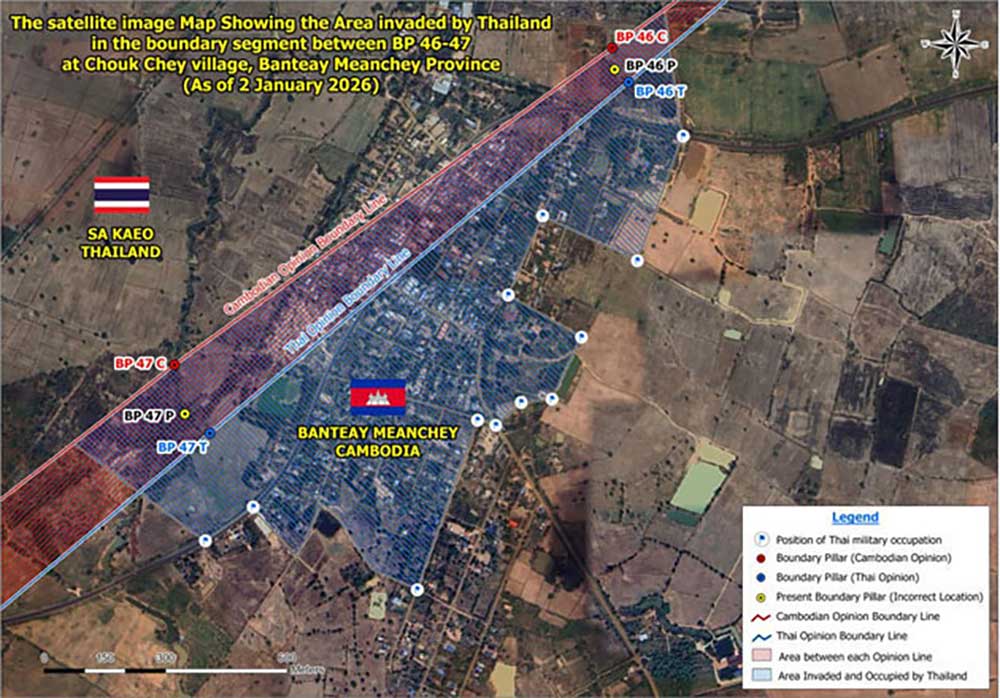 - Cambodia re-proposes to Thailand that a meeting be convened on border demarcation. Supplied
#editorial
Statesmen do not resort to severing ties with neighbouring countries easily. In the theatre of regional politics, a familiar pattern usually emerges during electoral periods: political factions stoke border tensions just to win an election, only to quietly normalise relations later. Yet, the Thai administration has shown absolutely no effort to normalise relations in the aftermath of its political transition, choosing instead to sustain an atmosphere of hostility. When the standard electoral playbook is abandoned so completely, we are forced to look at the second major pattern of international friction: the perception of an existential threat.
The central riddle of this crisis lies in the sheer, staggering asymmetry of the conflict and Bangkok’s reckless disregard for the global legal order. No official explanation from Thailand could ever convince a rational observer that Cambodia was genuinely invading its territory or posing an existential threat to its survival. No conventional logic can justify Thailand’s actions as an act of legitimate self-defence under Article 51 of the UN Charter.
The scope of Thai military aggression has completely shattered any legal framework of proportionality and necessity. The deployment of advanced F-16 and JAS 39 Gripen fighter jets to execute deep-strike missions, the dropping of massive, one-tonne MK84 bombs on Cambodian soil, and the heavy utilisation of military drones for cross-border attacks and surveillance have converted a localised frontier dispute into a brutal campaign of aerial devastation. Most damningly, the indiscriminate bombardment extending up to 80 kilometres deep into Cambodian territory represents a severe, unprovoked violation of Cambodia’s sovereignty and territorial integrity.
Beyond this overwhelming kinetic violence, Thailand has actively engaged in a calculated campaign to rewrite geography by force. By moving troops to illegally occupy undisputed Cambodian land, Bangkok is attempting to create a military fait accompli on the ground. To justify this lawless expansion, the Thai administration has weaponised a unilateral, self-drawn map that completely lacks international legal standing and blatantly contradicts long-established historical treaties.
This behaviour represents a flagrant breach of the foundational tenets of modern international law. By carrying out unauthorised border incursions, conducting illegal land surveys and forcibly installing arbitrary boundary markers – even directly violating binding bilateral frameworks like the 2000 Memorandum of Understanding – Thailand has discarded the very rules of statecraft. No matter how skilful or talented Thai diplomats are, they simply cannot explain these actions to the international public without a betrayal of their own conscience and logic. Their international law experts cannot argue Bangkok’s case without actively unlearning the long-accumulated knowledge, treaties and customs of global jurisprudence.
After all, given the immense human and capital resources at Thailand’s disposal, it makes no sense to simply conclude that the Thai administration is acting out of pure, reckless impulse to crush a smaller neighbour under the banner of self-defence. It defies logic that Thailand, as a proud founding member of ASEAN, would so carelessly trample upon the principles of international law, dialogue and diplomacy that it has championed for decades – especially given its own historical role in assisting Cambodia to find domestic peace in the past.
Historical patterns suggest this behaviour is rarely spontaneous; rather, it hints at a deeper, darker calculus. Is it because Thailand fears a profound existential crisis, having been alerted that a new wave of superpower geopolitical rivalry is returning to haunt the Mekong region once again, much like the devastating proxy dynamics of the past Vietnam War?
Or is it because Thailand is acting on pure, cynical opportunism while global superpowers are preoccupied with restructuring and negotiating a new global balance of power? Is Bangkok weaponising this manufactured crisis as a golden opportunity to reclaim what its ultra-nationalists have long bemoaned as “lost territories” surrendered during the French Protectorate era?
To correct the historical record, the territories covered under the colonial agreements were never originally Thai lands illegally occupied by France; they were ancient Khmer heartlands that Siam had systematically clipped away in the decades leading up to King Ang Duong’s coronation in 1848.
During Ang Duong’s reign, Siam directly administered the provinces of Battambang (including parts of modern Banteay Meanchey and Pailin) and Siem Reap, which had been formally annexed in 1794. Siam also fully annexed or stripped Cambodian authority over the northern and border domains of Melou Prei, Thala Borivat, Sisophon, and historically Khmer-majority lands like Surin, Sisaket, and Buriram during the wars of the 1830s and 1840s.
The nature of Ang Duong’s grief over these lands was profound. Knowing Cambodia lacked the military power to win them back, he spent his final years desperately attempting to bypass Siam by writing secret letters to France.
Forty-seven years after Ang Duong’s death, the French protectorate finally forced Siam to retrocede these stolen provinces. Under the Franco-Siamese Convention of February 13, 1904, France compelled Siam to return northern and coastal frontier zones, successfully securing Melou Prei, the maritime province of Koh Kong, and vital sections of Stung Treng. Building on those legal foundations, the landmark Franco-Siamese Treaty of March 23, 1907 forced Siam to officially retrocede Cambodia, permanently reuniting Battambang, Sisophon, and the cultural crown jewel of Siem Reap (Angkor) with the Khmer nation.
However, during World War II, when France fell to Nazi Germany, Thailand actively exploited that global vulnerability to violently undo the justice of both the 1904 and 1907 settlements. Under the ultra-nationalist regime of Field Marshal Plaek Phibunsongkhram, Bangkok cultivated a calculated alignment with Imperial Japan, using Axis leverage to ignite the Franco-Thai War (1940–1941).
Following intense air and ground offensives into Cambodia, Thailand utilised Japanese coercion to force the weakened French administration into submission. This collusion was formalised through the Tokyo Armistice on January 31, 1941, and executed via the Japanese-imposed Treaty of Tokyo on May 9, 1941. Under these dictates, Thailand illegally re-annexed Battambang, Siem Reap and Stung Treng. This expansionism culminated on December 21, 1941, when Thailand signed a formal Mutual Offensive-Defensive Alliance Pact with Imperial Japan, fully embedding itself within the Axis war machine.
In 1944, the Committee on Postwar Programs (PWC) within the United States Department of State, whose job was to look ahead and formulate long-range US foreign policy and territorial strategies for when the war ended, stated that “since the transfer to Thailand… of the Indochinese territories was made after Japan had started on its course of aggression and France had capitulated to Germany, they [such transfers of territory] cannot be regarded as valid acts.”
On October 19, 1944, the American Embassy in London was instructed to inform the British Secretary of State for Foreign Affairs that: “We do not recognise the lawfulness of such acquisitions [areas obtained by Thailand from Indochina, Malaya and Burma] and agree that such territories must in fact be restored to Indochina, Malaya and Burma from whom they were taken.”
Though forced to fully return these lands under the 1946 Franco-Thai Settlement Treaty as a mandatory prerequisite for joining the United Nations, the dangerous irredentist appetite behind it clearly lingers in the conservative Thai psyche.
Ultimately, the true inner rationale driving Bangkok’s elite remains hidden behind closed doors. We may never know for certain whether they are acting out of a paranoid fear of a shifting Mekong geopolitical landscape, or if they are simply driven by an unyielding desire to rewrite old territorial grievances. However, the exact motivation matters less than the objective reality of their actions on the ground. Whichever rationale turns out to be true, Thailand’s current posture is connectionally linked to its darker past – undeniably opportunistic, deeply imperialistic, blatantly irredentist, and entirely illegal under international law.
These actions signal a dark development for Southeast Asia, warning that regional security is under serious threat and that the law of the jungle is threatening to reign over the region once again.
Crucially, Thailand is not merely a passive observer of this drift towards chaos; it is actively leading the trend of regional lawlessness. By opting for an opportunistic land grab during a chaotic global rebalancing of power, Bangkok has completely abdicated its historical role as a champion of diplomacy and multilateralism – a legacy it built as a founding member of ASEAN.
Instead of mobilising forces to resist this geopolitical breakdown, Thailand is setting a dangerous precedent by demonstrating that raw ambition and might-makes-right politics can supersede established treaties. In prioritising short-term territorial gains, Bangkok has abandoned its responsibility as a protector of regional peace and a primary architect of Southeast Asian unity. By pioneering this shift away from international law, Thailand has left its neighbours to navigate a volatile, fragmented future born entirely of raw power and fear.
-Khmer Times-