Preparing the landscape for Cambodia’s semiconductor sector
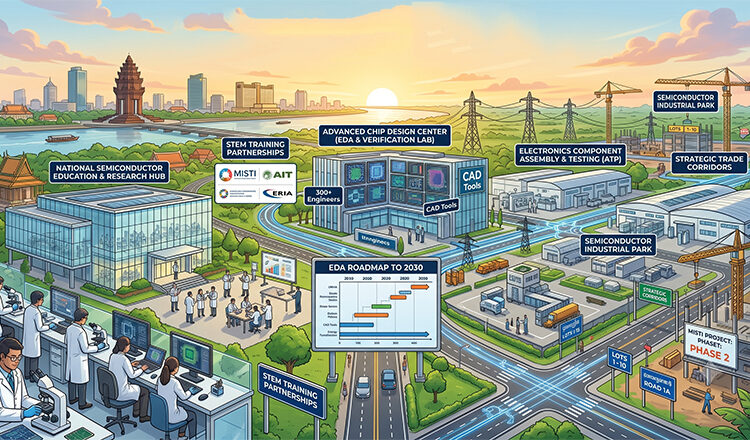 Semiconductor companies will not risk investing billions in a country unless they are confident political tensions or trade wars will not suddenly shut down their production lines or block their markets. Khmer Times
Cambodia does not have a policy for semiconductors. This article is to share the perspectives from a foundational study that the General Secretariat of the Committee for Economic and Financial Policy conducted and published in September 2024.
Entitled the “Study on the Identification of Strategic Industries and their Promotion through Special Economic Zones,” the research identified semiconductors as one of the future strategic industries. The paper is available only in Khmer.
Consultations were conducted in January and February 2024 with industry players in Vietnam and Thailand regarding the preparatory landscape for the sector.
In Thailand, the Working Group met with the Federation of Thai Industries and the Thailand Printed Circuit Association.
Thailand is a major electronics hub. Between 2021 and 2023, the country brought in a massive 132.1 billion baht ($3.7 billion) in printed circuit board (PCB) investments from tech companies from China – including Hong Kong and Taiwan – Japan and Germany. Because of this big footprint, Thailand handles 5% of the entire global market for PCBs, exporting up to $1.6 billion a year, a figure projected to surge up to 15% (roughly $8 billion) per year in the near future.
But when the team asked the big question: “Is Thailand ready for a semiconductor industry?” – the answer was not an immediate yes or no.
In general, it is understood that the PCB industry is one of the first step towards building up a semiconductor ecosystem. Despite sitting on a multi-billion-dollar PCB industry, Thai industrial players were still not immediately-enthusiastic for this high-tech industry because this industry is no longer just a regular business; it is highly strategic and politically sensitive.
Semiconductors have become matters of national security. Giant semiconductor companies will not risk investing billions in advanced factories unless they have absolute confidence that global political tensions or trade wars won’t suddenly shut down their production lines or block their markets.
Thailand’s lesson is clear: building the early-stage ecosystem is only half the battle; navigating global politics is the other.
Now let’s look at the case of Vietnam.
Being one of the three national high-tech parks, Saigon Hi-Tech Park (SHTP) is state-run, and established by the Vietnamese government. Because it is a national priority project, the state grants the highest level of tax and land lease incentives to qualifying domestic and international enterprises operating in it.
SHTP’s early strategy (2002–2020) focused heavily on luring global tech leaders to anchor the park’s credibility. SHTP attracted over $12.1 billion in total investment across 161 projects, with foreign direct investment (FDI) making up the lion’s share at $10.1 billion. This was achieved through a multi-pronged approach:
1. Targeting top-tier global leaders
SHTP courted and secured more than 10 global high-tech anchors, including Intel (assembly and testing), Samsung, Nidec, Jabil, Microchip, and Sanofi. Microelectronics. Semiconductors make up the single largest sector in the park at 41% of total investments.
2. Maximising tax and land incentives
Vietnam leveraged the maximum fiscal incentives allowed under its laws to outcompete regional rivals.
- Corporate income tax (CIT) exemptions: A preferential CIT rate of 10% for 30 years for large projects (over $250 million disbursed within three years). SHTP offered a “0% CIT” rate for the first four years of profit, followed by a heavily reduced 5% rate for the next nine years.
- Import/export and tariff holidays: 0% VAT and full import tax exemptions on goods to create fixed assets or used directly for scientific research.
- Land rental exemptions: Drastic reductions or full exemptions on land lease fees based on state decrees.
3. Institutional agility and ‘One-Stop-Shop’ services
Providing incentives is merely the first step; delivering and implementing them is the critical second step. To minimise bureaucratic friction for foreign executives, SHTP established an on-site, unified management process. This “one-stop-shop” directly issues investment certificates, construction permits, and foreign work permits, while providing electronic customs clearance, instant tax filing, and on-site banking services.
4. The drastic diplomatic push
The Vietnamese government was aggressive in its pursuit of global tech champions. Senior leaders went as far as travelling directly to Silicon Valley, waiting outside executive offices for hours to secure pitches with high-tech executives.
Despite successfully positioning SHTP as a global manufacturing hub, decades of relying purely on an FDI-driven model brought a harsh realisation: technological transfer is not free, and it does not happen automatically. Multinational corporations kept proprietary technologies closely guarded, leaving Vietnam with lower-value, labour-intensive segments of the value chain (such as basic assembly and testing).
Consequently, from 2020 onwards, SHTP entered its “Innovation Era,” shifting away from passive reliance on foreign entities towards nurturing domestic technology.
The core strategies driving this modern Vietnamese pivot include:
1. Heavy state-funded R&D and professional units
Instead of waiting for foreign companies to share knowledge, the Vietnamese government began utilising its national budget to fund internal R&D through specialised, state-run facilities in SHTP:
- SHTP Labs (est 2004): Operates five focal labs mastering highly strategic sectors: semiconductor, nanotechnology, precision mechanics and Automation, biotechnology, and ICT.
- SHTP Incubation Centre (est 2006): Dynamically supports local tech entrepreneurs and commercialises homegrown high-tech products to enhance national tech capacities.
- SHTP Training Centre (est 2005): Focuses on upskilling locals, specifically to design and engineer systems, moving workers out of low-wage assembly roles.
2. The ‘Triple Helix’ model
Vietnam’s modern strategy centres on maximising the synergy between three core pillars, with SHTP acting as the strategic link.
- The government: Provides national funding, R&D funding and supportive policies.
- Educational tnstitutions: SHTP sits just 2km away from the Vietnam National University Campus, creating a direct pipeline for high-quality intellectual capital and joint research.
- Private enterprises: Connecting local startups and domestic firms directly with the market to build a homegrown high-tech supply network.
By shifting the policy focus from absolute FDI reliance to state-backed R&D, Vietnam aims to transition SHTP from a domestic manufacturing park into an internationally standardised innovation district by 2045 – one that creates, owns, and exports its own global brand of Vietnamese high technology.
What do these lessons mean for Cambodia?
There should be three simple lessons for Cambodia’s preparedness for semiconductor industry.
First, we must maintain maximum flexibility in providing incentives. Navigating high-tech, politically sensitive industries is challenging, yet the Cambodian government is capable of moving rapidly and being highly adaptive. When we engage a serious investor intent on developing strategic industries here, we can provide tailored incentives and support that extend beyond standard investment laws to ensure success. Line ministries need to effectively implement a one-stop window mechanism, providing maximum facilitation to investors without friction to ensure that the incentives they are entitled to are actually delivered.
Second, we should carefully think about our dual paths forward. We are not going to try to build high-end semiconductor fabrication plants on day one. It depends entirely on which part of the value chain we want to target. Following Thailand’s early steps, Cambodia can focus on the mid-stream and downstream segments – like PCBs, assembly, and testing. That is how we build a real ecosystem step-by-step. In the meantime, Cambodia should consider supporting R&D with the national budget – not to invent new technologies, which is unrealistic for developing countries, but to promote applied technologies suited to the local context so that local universities and enterprises can meaningfully join the value chain once foreign high-tech companies start operations in Cambodia. This way, Cambodia would not become too expectant of technology transfers from FDI.
Third, we should be confident about our people. Sceptics often think that Cambodia lacks tech talents or that Cambodia does not have skilled labour, etc. But time and again, Cambodian workers have proved to be remarkably agile and fast at catching up. Look at precision companies like Minebea and Denso operating in our country. When they started the factories, they did not expect Cambodian workers to be able to do the job but when opportunities were given, Cambodian proved that they are not less capable than their foreign peers. Our youth have the drive and the brainpower; we simply need to build the launchpad and provide them with the right opportunities.
Sim Vireak is Undersecretary of State, Ministry of Economy and Finance. The article is adapted from his presentation at the workshop on “Advancing Cambodia’s Semiconductor Ecosystem” co-organised by Trade Policy Advisory Board and Economic Research Institute for ASEAN and East Asia.
-Khmer Times-