Beyond raids: Cambodia’s crackdown on scam compounds
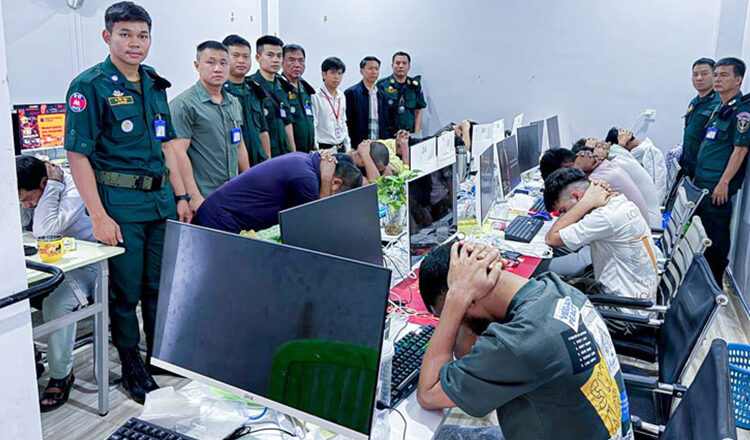 File photo of scam raid in Sihanoukville that resulted in 29 arrests. Police
#opinion
Cambodia’s crackdown on cyber-scam compounds is real. Obviously, it is not a show.
Police raids have become more frequent. Operations once hidden behind hotel facades and casino developments are being exposed far beyond Sihanoukville. Arrests once considered politically inconvenient are now making headlines.
Victims are increasingly being identified, screened, and repatriated. Senior officials have faced investigation. Ministries are coordinating more closely.
That deserves recognition. Fight corruption is key in the war against online scams. Zero tolerance for those involved in such crimes is required.
Notably, scam compounds are not isolated criminal anomalies. They are sophisticated economic systems. They flourish where governance gaps become business opportunities and law enforcement loopholes allow criminal syndicates to penetrate and operate.
The compounds themselves are merely storefronts. The real architecture lies elsewhere — in recruitment pipelines, encrypted messaging platforms, payment networks, corrupt patronage systems, and a global digital economy still poorly equipped to police itself.
Raids can disrupt operations. They do not, by themselves, dismantle incentives.
That is the first hard truth Cambodia’s international partners must understand: arrest statistics are lagging indicators, not evidence of lasting success.
Often, by the time police breach a compound, syndicates have already adapted. Recruitment ads migrate to new Telegram channels. Fraud scripts are copied to fresh servers. Financial flows move through different wallets and intermediaries. One building closes; another opens across a border town or special economic zone.
The operational advantage of these networks is not infrastructure. It is mobility.
Which is why a strategy centred only on “more raids, faster raids” risks creating the illusion of momentum while leaving the underlying machinery intact.
The second truth is more uncomfortable: victim protection is not secondary humanitarian work. It is the foundation of effective enforcement.
Many people found inside these compounds are trafficking victims themselves — lured through fraudulent job offers, trapped by debt bondage, stripped of passports, beaten when quotas are missed. Treating them primarily as criminals poisons investigations from the outset. Witnesses disappear. Testimony collapses. Syndicates recruit replacements faster than prosecutions can proceed.
Cambodia’s gradual shift towards victim screening, shelter coordination, and repatriation is therefore more important than many outside observers appreciate. It reflects a recognition — still incomplete, but meaningful — that coercion sits at the centre of this economy.
That shift now requires sustained investment: trauma-informed care, interpreters, legal aid, employment pathways, and credible witness protection. International partners eager for stronger prosecutions should understand a simple reality: stable witnesses produce stronger cases. Fear produces silence.
The third truth is one diplomats often prefer to discuss in a whisper.
Corruption is not adjacent to this system. It is embedded within it.
Transnational criminal networks do not choose jurisdictions randomly. They gravitate towards environments where opacity is purchasable and oversight negotiable. If beneficial ownership remains hidden, if local officials can be bribed to ignore labour violations, or if special economic zones operate beyond meaningful scrutiny, organised crime will continue to pool there with remarkable efficiency.
This is why technical assistance narrowly focused on tactical enforcement so often disappoints. Training police while ignoring integrity systems is like repairing a roof while leaving the foundation cracked.
And yet Cambodia has done some things right — more than many critics acknowledge.
Inter-ministerial coordination has improved. Authorities have tightened controls on suspicious employment contracts, SIM-card registration and digital payment channels. Even limited transparency after raids creates accountability pressure that did not exist before.
These are not cosmetic changes. They are pressure points the syndicates genuinely dislike.
International support should build there.
That means helping Cambodia strengthen financial-intelligence capacities capable of tracing cross-border laundering networks. It means faster cooperation on extradition and asset freezes. It means lawful-access mechanisms that allow investigators to obtain platform data before evidence disappears into encrypted systems and offshore jurisdictions.
You do not dismantle a transnational criminal economy with local tools alone.
But foreign partners should also resist the temptation to securitise everything. There is a danger in turning anti-scam operations into broad campaigns against migrants, debtors, or informal workers — the very populations trafficking syndicates target most aggressively. Push them further underground and criminal networks gain leverage, not less.
Nor should governments outsource responsibility to technology platforms. Social media companies can remove fraudulent accounts more aggressively, and they should. But moderation systems are not substitutes for functioning legal cooperation. Criminal accountability still depends on institutions.
Ultimately, Cambodia’s crackdown presents a rare opportunity: a moment when the interests of multiple actors briefly align. Cambodia wants international credibility, safer cities, and sustainable investment. Regional partners want stability. Victims want dignity and a path home.
The question is whether that alignment can survive beyond the news cycle.
I still think about the rescued worker who described the silence inside those compounds. What finally broke it, he told me, was not simply the arrival of police. It was the moment someone believed him long enough to document what had happened and act on it.
That distinction matters.
Raids make headlines. But the slower work — tracing money, protecting witnesses, exposing corruption, rebuilding lives — is what determines whether the next compound opens at all.
Real progress is not measured by how loudly authorities announce arrests.
It is measured by how quiet the system becomes when there is nothing left to hide.
The writer is a concerned citizen based in Phnom Penh.
-Khmer Times-